On the western edge of Tucson, where the city gives way to the rugged slopes of the Tucson Mountains, the Arizona-Sonora Desert Museum offers an unusual answer to a familiar question: How do you help people understand a place?
You could put its history behind glass. You could label its plants in a garden. You could show its animals in a zoo. Or you could bring those pieces together and let visitors move through a version of the landscape itself.
That is the idea behind the Arizona-Sonora Desert Museum. Founded in 1952, the institution combines a zoo, botanical garden, natural-history museum, and art gallery across a broad desert property. Its paths lead through rocky hillsides, cactus gardens, shaded habitats, and animal exhibits designed to show how life fits together in the Sonoran Desert.
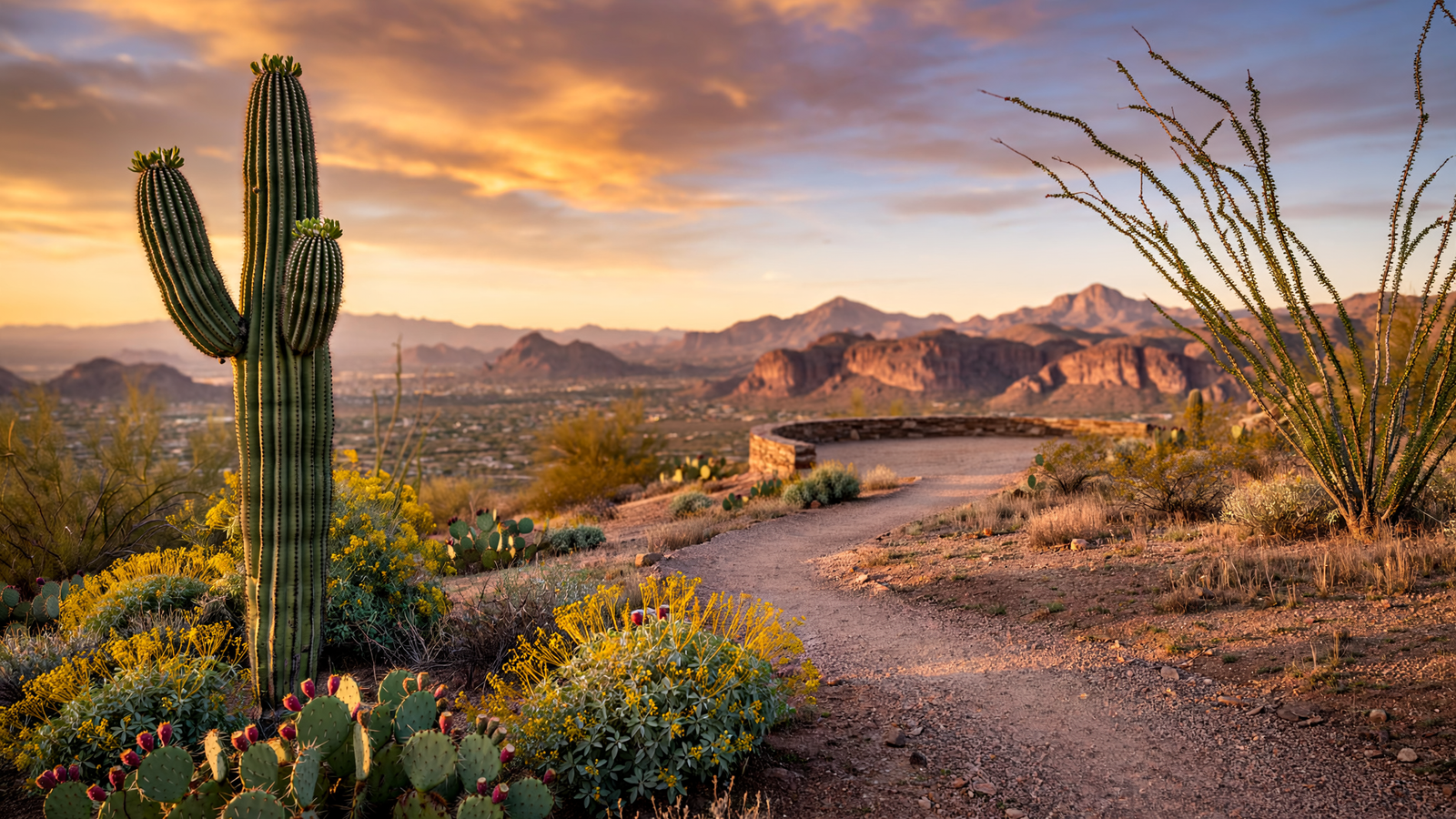
The result is less like walking through a conventional museum and more like spending time inside a three-dimensional field guide. A visitor may begin with a landscape of saguaros, pass a mountain-lion habitat, pause beside a hummingbird garden, and then encounter an exhibit explaining the geology or ecology of the region. The desert is not merely the subject. It is the setting, the collection, and the lesson.
A museum without many walls
The Arizona-Sonora Desert Museum is often described as a living museum because so much of its work happens outdoors. Its campus covers about 98 acres, with roughly two miles of walking paths connecting its different areas. The institution says its collections include hundreds of animal species and more than a thousand kinds of plants native to the region and other parts of the Sonoran Desert.
That scale changes the pace of a visit. Instead of moving from room to room, visitors move from habitat to habitat. The trail may narrow between prickly pear and agave, open onto a view of the mountains, or turn into a shaded space where desert wildlife can be observed at close range. The experience asks people to notice temperature, texture, distance, and sound—qualities that are difficult to communicate on a gallery label alone.
The museum’s design also reflects the character of the Sonoran Desert. This is not an empty landscape, and the institution does not present it that way. The region supports a remarkable variety of life because seasonal rain, varied elevations, rocky terrain, and plant adaptations create many different ecological niches.
Visitors can see some of those relationships in the plant collections. Cacti and succulents are the most immediately recognizable representatives of the desert, but the landscape also includes trees, shrubs, grasses, wildflowers, and plants associated with washes and higher mountain habitats. Together, they show that “desert” is not a single environment. It is a mosaic of places, each with its own conditions and inhabitants.
The Sonoran Desert as a living system
The museum sits in one of the world’s most biologically diverse deserts. The Sonoran Desert stretches across southern Arizona and northwestern Mexico, and it receives enough seasonal moisture to support a richer plant community than many people expect from a desert region.
The saguaro is the landscape’s most famous symbol, but the saguaro does not stand alone. Birds nest in its arms and cavities. Insects pollinate its flowers. Mammals eat its fruit. The plant’s presence is part of a much larger network of relationships, and the museum’s exhibits help make those connections visible.
That approach is especially useful for people who may know the desert mainly through photographs. A photograph can show a saguaro’s shape, but it cannot fully convey how many other species depend on desert plants, how quickly the landscape changes after rain, or how much life can be hidden in shade, soil, and stone.
Animal habitats at the museum include representatives of the Southwest’s larger and smaller wildlife. Mountain lions, black bears, Mexican gray wolves, javelinas, coyotes, reptiles, amphibians, birds, and pollinators all help tell different parts of the regional story. Some animals are difficult to see in the wild, while others are familiar neighbors whose behavior becomes easier to understand when viewed at close range.
The institution’s role is not simply to display animals. Its conservation and education programs place them within broader questions about habitat, human development, water, fire, and the future of wildlife in a changing region. A habitat exhibit can therefore do more than create a memorable encounter. It can give visitors a framework for understanding why wild spaces matter beyond the boundaries of a park or preserve.
A place built for attention
One of the museum’s quiet achievements is the way it encourages visitors to slow down. Desert scenery can seem visually simple from a distance: tan rock, blue sky, green cactus. Along the trails, however, the details keep multiplying.
A small bird moves through a shrub. A lizard disappears beneath a rock. A flowering plant draws insects that may be easy to miss unless someone has stopped to look. A wash cuts through the terrain, offering a clue about how water moves across the land during storms. The longer a visitor remains in one place, the less empty the desert appears.
This kind of attention is central to good place-based education. Instead of treating the landscape as a backdrop, the museum makes it the main character. The paths provide enough structure for a first-time visitor, but they also leave room for observation and discovery.
For families, that can make the museum an introduction to natural history. For longtime residents, it can be a way to revisit a familiar environment with new questions. For visitors from outside Arizona, it offers context for landscapes that might otherwise be reduced to a scenic drive or a collection of postcard images.
More than a visitor attraction
The museum’s public face is its campus, but its work extends beyond the trails. Its programs include education, research, animal care, horticulture, conservation, and efforts to connect people with the natural world of the Sonoran Desert.
That combination reflects a broader change in how natural-history institutions understand their responsibilities. A museum is not only a place that preserves knowledge from the past. It can also help communities interpret current environmental changes and make informed decisions about the places where they live.
In the Southwest, those questions are immediate. How should communities live with wildlife? What happens when development fragments habitat? Which plants can survive prolonged heat and drought? How does fire affect different desert and mountain environments? What can people do to protect pollinators, water, and native species?
No single attraction can answer all of those questions, but a place like the Arizona-Sonora Desert Museum can make them tangible. It gives visitors an opportunity to see adaptations, dependencies, and vulnerabilities rather than encountering them only as abstract terms.
A Tucson landmark with a wider horizon
The museum’s location is part of its identity. It is close enough to Tucson to be accessible as a day trip, yet far enough from the city center to feel surrounded by the terrain it interprets. The Tucson Mountains form a dramatic backdrop, and the surrounding Sonoran Desert reinforces the sense that the institution belongs to this particular place.
That local connection matters. The museum does not present a generic “desert” assembled from isolated objects. It focuses on the living region outside its gates, while also acknowledging that the Sonoran Desert crosses an international border and contains many distinct communities and habitats.
Its setting also makes the visit change with the season. Desert plants respond to rainfall. Temperatures alter animal behavior. Spring blooms, summer storms, autumn light, and winter weather each give the trails a different character. There is no single version of the museum, because there is no single version of the desert.
For a place often imagined as harsh or barren, that may be the most important lesson. The Sonoran Desert is not defined by what it lacks. It is defined by the ways life has learned to use limited water, intense sunlight, rocky ground, and changing seasons.
The Arizona-Sonora Desert Museum makes those adaptations visible. It turns a walk into an encounter with ecology, a garden into a lesson in survival, and a collection of animals into a portrait of a larger home. In doing so, it gives Tucson something more lasting than another attraction: a place where the region can explain itself.