Engine coolant helps regulate your car’s temperature. If its level is low, the engine may overheat, so it’s useful to know how to check the reservoir. This guide covers a basic check and a small top-up—not diagnosing a leak or repairing the cooling system.
Check your owner’s manual first: it identifies the coolant your car requires and shows where to find the reservoir. If you can’t identify the correct coolant or the right container, don’t guess.
Before you begin
- Wait until the engine is completely cool. Hot coolant and pressurized vapor can cause serious burns.
- Park on level ground, switch off the engine and set the parking brake.
- Have the owner’s manual, a clean rag and the vehicle-approved coolant ready.
Steps
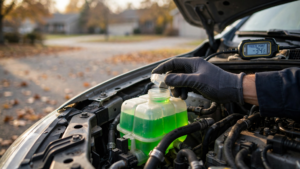
- Find the coolant reservoir. Use the manual to locate it under the hood. Many reservoirs are translucent and have “MIN” and “MAX” or “LOW” and “FULL” marks. Don’t mistake it for the windshield-washer-fluid container.
- Check the level without opening the system. With the engine cool, look at the side of the reservoir and compare the level with its marks. If it sits between the minimum and maximum marks, a top-up is generally unnecessary.
- Confirm the required coolant. Check the manual or the coolant specification printed on the reservoir cap or nearby label. Coolant color alone does not reliably identify its type. Don’t mix products unless the vehicle maker specifically allows it.
- Open only the reservoir cap, if needed. If the level is below the minimum mark, and the engine is completely cool, slowly remove the reservoir cap. Do not remove a radiator cap; if your car has a different or sealed setup, follow the manual or ask a qualified technician.
- Add coolant gradually. Pour the specified coolant into the reservoir until the level reaches the cold-fill mark or sits between MIN and MAX. Do not fill above MAX. If the instructions call for concentrate to be diluted, follow the product and vehicle directions rather than estimating.
- Secure the cap and clean up. Tighten the cap as directed and wipe away any spills. Keep coolant away from children and pets; it can be poisonous if swallowed.
- Recheck later when the engine is cool. Note whether the level stays in range. If it drops again, don’t keep topping it up as a substitute for finding the cause.
Things to know
Never open a hot cooling system, even if the car has stopped running. If the engine is overheating, you see a leak, or the coolant repeatedly falls below the minimum mark, stop and arrange professional help rather than continuing to drive and risk engine damage. Don’t pour leftover coolant down a drain or onto the ground. Check local household hazardous-waste guidance for disposal options.
A quick check is straightforward when the engine is cool and you follow the vehicle’s instructions. Use the correct coolant, stay within the reservoir’s marks and get recurring low levels checked.