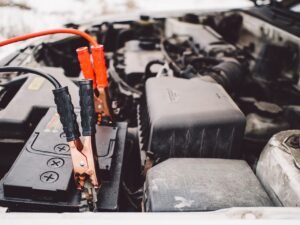
This guide walks you through simple, safe tasks you can do at home to keep a conventional 12‑volt car battery healthy: a visual inspection, a basic multimeter check (resting and charging voltages), cleaning corroded terminals, and quick tests to tell when the battery or charging system needs professional testing. These steps help prevent being stranded and extend battery life.
What you will need
- Safety glasses and nitrile or rubber gloves
- Digital multimeter (DC voltage) or an approved battery tester
- Wrench or socket set sized for your battery terminal nuts
- Battery terminal brush or a small wire brush and an old toothbrush
- Baking soda and water (1 tablespoon baking soda in 1 cup water) and a spray bottle or small container
- Clean rags and a small brush to remove loose debris
- Dielectric grease or petroleum jelly (to protect terminals after cleaning)
- Optional: battery maintainer/charger if battery needs topping up
Quick safety reminders
- Work in a well‑ventilated area and never lean over the battery—batteries can give off hydrogen gas that can ignite. ([tdi.texas.gov](https://www.tdi.texas.gov/pubs/videoresource/fsvehiclebat.pdf?utm_source=openai))
- Do not smoke or create sparks near the battery. Remove metal jewelry that could touch both terminals. ([tdi.texas.gov](https://www.tdi.texas.gov/pubs/videoresource/fsvehiclebat.pdf?utm_source=openai))
- If the case is cracked, leaking, swollen, or frozen, do not try to charge or jump it—replace it. ([autoclubsouth.aaa.com](https://autoclubsouth.aaa.com/automotive/auto_maintenance_text.aspx?section=Batteries&utm_source=openai))
Steps: Inspect, test, clean and protect
- Park, turn everything off and let the car sit. Open the hood and make sure the ignition is off, keys out, and any accessories are off. Let the battery sit at least a few minutes if the car was recently running so the surface charge settles.
- Do a visual check. Look for cracks, bulges, leaking fluid, heavy corrosion (white/blue powder) around terminals, or loose hold‑down straps. If you see damage or fluid leakage, stop and have the battery replaced. ([exchange.aaa.com](https://exchange.aaa.com/wp-content/uploads/2012/09/AAA-Car-Care-Battery.pdf?utm_source=openai))
- Measure resting voltage with a multimeter. Set the meter to DC volts (20 V range). Touch the red probe to the positive terminal and the black probe to the negative. A fully charged 12‑volt lead‑acid battery reads about 12.6 V at rest; readings near 12.4 V are partially charged and below about 12.0 V need charging. A resting voltage alone does not tell the whole story, but it’s a useful first check. ([static.nhtsa.gov](https://static.nhtsa.gov/odi/tsbs/2016/MC-10119457-9999.pdf?utm_source=openai))
- Check charging voltage (alternator check). Start the engine and measure voltage again at the battery terminals. A properly working charging system will usually show roughly 13.5–14.8 V while the engine runs; if the voltage is substantially lower or higher, the alternator/regulator or wiring may need service. ([westerbeke.com](https://www.westerbeke.com/operator%27s%20manual/56315%207.6-5.7%20egtd%20operators%20manual%20rev%200.pdf?utm_source=openai))
- If the resting voltage is low, try charging or using a maintainer per the charger’s instructions. After a full charge, test again. If the battery won’t take or hold a charge, it likely needs replacement or a professional load test. Consumer testing and shop load tests measure whether the battery can hold up under starter load. ([consumerreports.org](https://www.consumerreports.org/cro/car-batteries/buying-guide.htm?utm_source=openai))
- Clean corroded terminals (only if battery is intact). Put on eye protection and gloves. First disconnect the negative (black) cable, then the positive (red) cable—always remove negative first to reduce the chance of a short. Make a paste of baking soda and water and apply it to corroded areas to neutralize acid, then scrub with the terminal brush. Rinse carefully with a little water and dry thoroughly. Reattach the positive cable first, then the negative, and tighten snugly (not so tight you strip threads). Apply a thin coat of dielectric grease or petroleum jelly to slow future corrosion. ([exchange.aaa.com](https://exchange.aaa.com/wp-content/uploads/2012/09/AAA-Car-Care-Battery.pdf?utm_source=openai))
- Perform a simple cranking check (if comfortable). With the multimeter connected, have a helper attempt to start the car while you watch the meter. If voltage drops below about 9.5–9.6 V while cranking at roughly 70°F (21°C), the battery will usually fail a load test and likely should be replaced; large voltage drops can also point to bad cable/ground connections or a failing starter. If you aren’t comfortable doing this, skip to step 8 and get a professional test. ([manuallib.com](https://www.manuallib.com/download/2023-10-18/Yuasa%2012V%2C%201%20AMP%20Automatic%20Battery%20Charger%20%26%20Maintainer%E7%94%A8%E6%88%B7%E6%89%8B%E5%86%8C.pdf?utm_source=openai))
- When in doubt, get a professional battery and charging system test. Many auto parts stores and repair shops will test batteries and charging systems for free and can perform a load or conductance test that gives a reliable pass/fail result. If your battery is more than about three years old or shows marginal readings, schedule a shop test. ([cluballiance.aaa.com](https://cluballiance.aaa.com/the-extra-mile/advice/car/make-battery-last?utm_source=openai))
Tips & things to know
- Battery life: typical car batteries last about 3–5 years; extremes of heat and cold shorten life. If your battery is older than three years, have it tested at least once a year. ([cluballiance.aaa.com](https://cluballiance.aaa.com/the-extra-mile/advice/car/make-battery-last?utm_source=openai))
- Surface charge: if you test immediately after running the engine, the voltage can be higher—always measure resting (after the car sits) for state‑of‑charge checks. ([garagedex.com](https://garagedex.com/guides/how-to-test-a-car-battery-with-a-multimeter/?utm_source=openai))
- Jump starting: follow correct cable order, clamp placement, and safety steps (attach the final negative clamp to an unpainted ground on the dead car, not the dead battery). If you’re unsure or traffic conditions make it unsafe, call roadside assistance. ([aaa.com](https://www.aaa.com/autorepair/articles/finding-an-auto-repair-shop-you-ca%E2%80%A6/how-to-jump-a-battery-and-get-yourself-back-on-the-road?utm_source=openai))
- Don’t try to charge or jump a frozen or visibly damaged battery—replace it. ([autoclubsouth.aaa.com](https://autoclubsouth.aaa.com/automotive/auto_maintenance_text.aspx?section=Batteries&utm_source=openai))
When to replace the battery
Replace the battery if it: repeatedly fails to hold a full charge; shows internal damage or leaks; has a cranking voltage drop below about 9.5–9.6 V under load; or is more than 3–5 years old and testing marginal. Many stores will sell and install the correct battery size and recycle your old one. ([manuallib.com](https://www.manuallib.com/download/2023-10-18/Yuasa%2012V%2C%201%20AMP%20Automatic%20Battery%20Charger%20%26%20Maintainer%E7%94%A8%E6%88%B7%E6%89%8B%E5%86%8C.pdf?utm_source=openai))
With a few simple checks a couple of times a year—especially before winter and after hot summer months—you can avoid most unexpected no‑starts and get more dependable life from your battery.
Encouragement: These checks are quick once you’ve done them once. If anything looks or reads wrong, a short visit to an auto parts shop for a professional test will save time and hassle later.