In 1325, a young man from Tangier set out for Mecca on a pilgrimage. The journey was meant to fulfill a religious duty. It became something far larger: a lifetime of travel across much of the known Islamic world, followed by a book that gave later readers a traveler’s view of the 14th century.
The traveler was Ibn Battuta. His account, known as the Rihla, is not simply a route plotted on a map. It is a record of movement through cities, courts, religious communities and unfamiliar customs. Its lasting appeal lies in that combination: the scale of the journey and the close attention paid to the people met along the way.
A pilgrimage that kept expanding
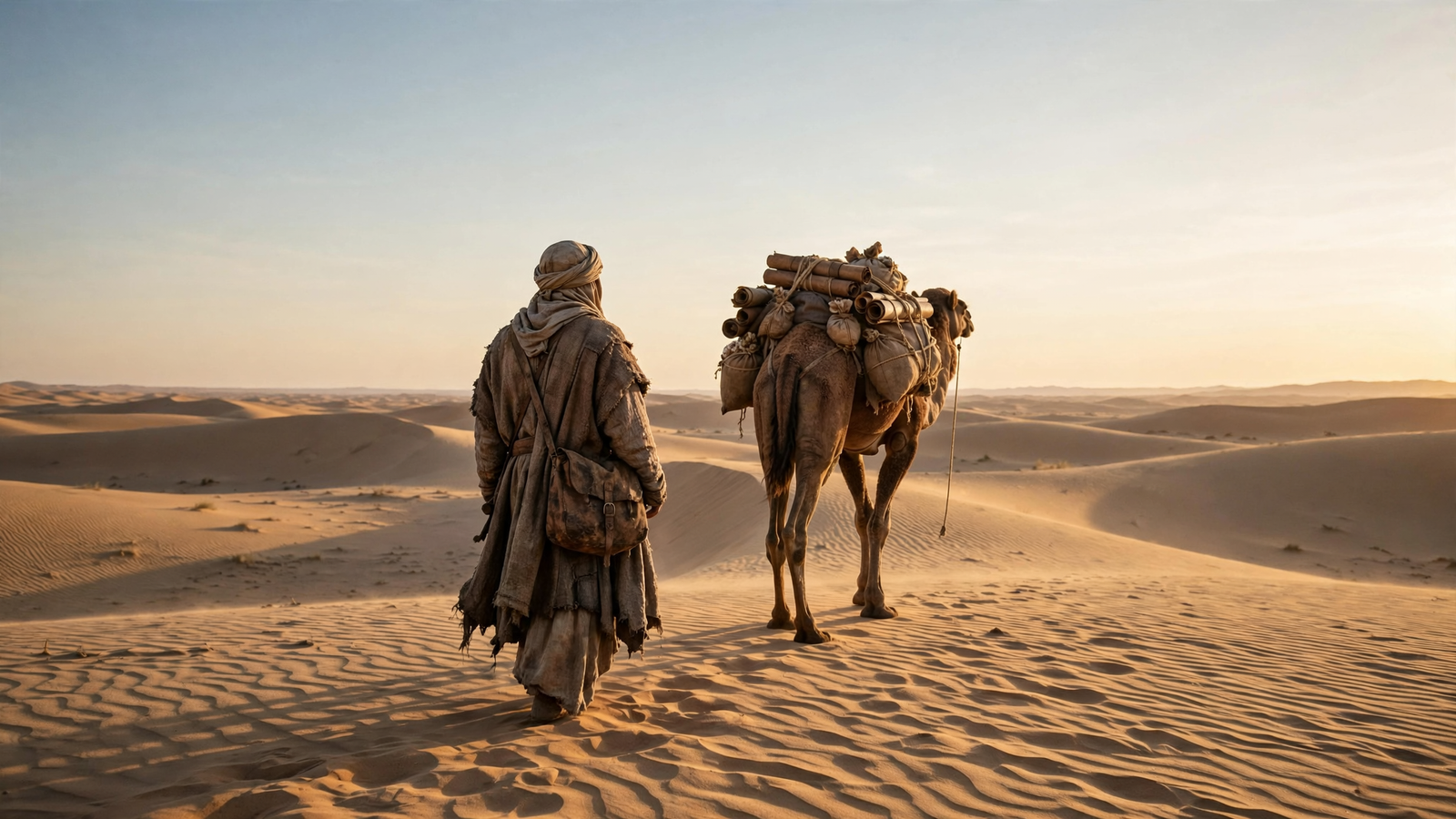
Ibn Battuta was born in Tangier, in present-day Morocco, in 1304. He was about 21 when he left home for the Hajj, the pilgrimage to Mecca. In an age before railways, air travel or modern passports, even reaching the holy city meant joining routes shaped by geography, trade and the security of the road.
After arriving in Mecca, he did not simply turn around. His travels continued through parts of the Middle East and East Africa, and later carried him through Central Asia and the Indian subcontinent. He spent years in India, where he served at the Delhi court, and traveled onward toward Southeast Asia and China. He also made journeys in Iberia and across parts of West Africa.
Modern summaries often describe the full itinerary as roughly 75,000 miles. That figure conveys the extraordinary reach of his travels, but it should not be mistaken for a modern GPS track: the distances are estimates reconstructed from a narrative, and the account was put into written form after many of the journeys had taken place.
Travel becomes a book
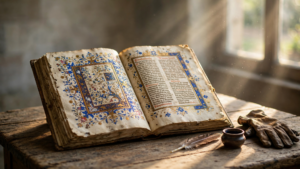
The Rihla was not a notebook published exactly as Ibn Battuta wrote it on the road. After returning to Morocco, he was asked by the Marinid sultan Abu Inan to recount his travels. The account was written down by the scholar Ibn Juzayy, with whom Ibn Battuta worked in Fez in the 1350s.
That process matters. The book brings together recollection, oral storytelling and the conventions of travel literature. Its full Arabic title is commonly rendered as A Gift to Those Who Contemplate the Wonders of Cities and the Marvels of Travelling. The title signals an ambition beyond listing destinations: to make distant places memorable to readers who might never see them.
The narrative offers snapshots of the institutions and social worlds Ibn Battuta encountered. He describes religious learning, rulers and courts, hospitality, pilgrimage, trade and local practices. The details vary from place to place, and the book’s interest is not that it reads like a neutral survey. It is one traveler’s account, shaped by his concerns and the circumstances of his time.
A connected world, seen from the road
One reason the Rihla remains important is the scale of the connections it reveals. Ibn Battuta moved through networks in which pilgrims, scholars, merchants and officials traveled between cities far apart. Shared religious traditions and scholarly institutions could give a traveler points of recognition, while local customs and political arrangements made each stop distinct.
His account also complicates the idea that medieval travel meant staying close to home. Long-distance journeys were possible, though never effortless or guaranteed. They depended on routes, patrons, guides, transport and the ability to find support along the way. Ibn Battuta’s experiences show how a traveler could sometimes move between distant centers by drawing on those relationships and institutions.
At the same time, readers should approach the book as a historical source with care. It was composed after the journeys, not as a day-by-day field log. Some passages have prompted debate among scholars about how particular experiences were reported or whether every described place was personally visited. That does not make the work unimportant. It makes the distinction between a travel narrative and a modern verified itinerary worth keeping in view.
Why the journey still travels
Travel books often promise access to somewhere else. Ibn Battuta’s account does that across a striking range of landscapes, but it also preserves the traveler’s own shifting position: a pilgrim, a guest, a judge and an observer dependent on the people who helped him move onward. The result is not a single panoramic view of the medieval world. It is a series of encounters gathered across a very long road.
Centuries later, the Rihla still invites readers to imagine travel as more than distance covered. A journey changes as it meets new languages, customs and centers of power; memory then changes it again when experience becomes a story. Ibn Battuta’s pilgrimage turned into a book because someone asked him to tell what he had seen. That act of recounting gave his travels a second life—one that lets readers follow, with appropriate historical caution, a remarkable route through the 14th-century world.