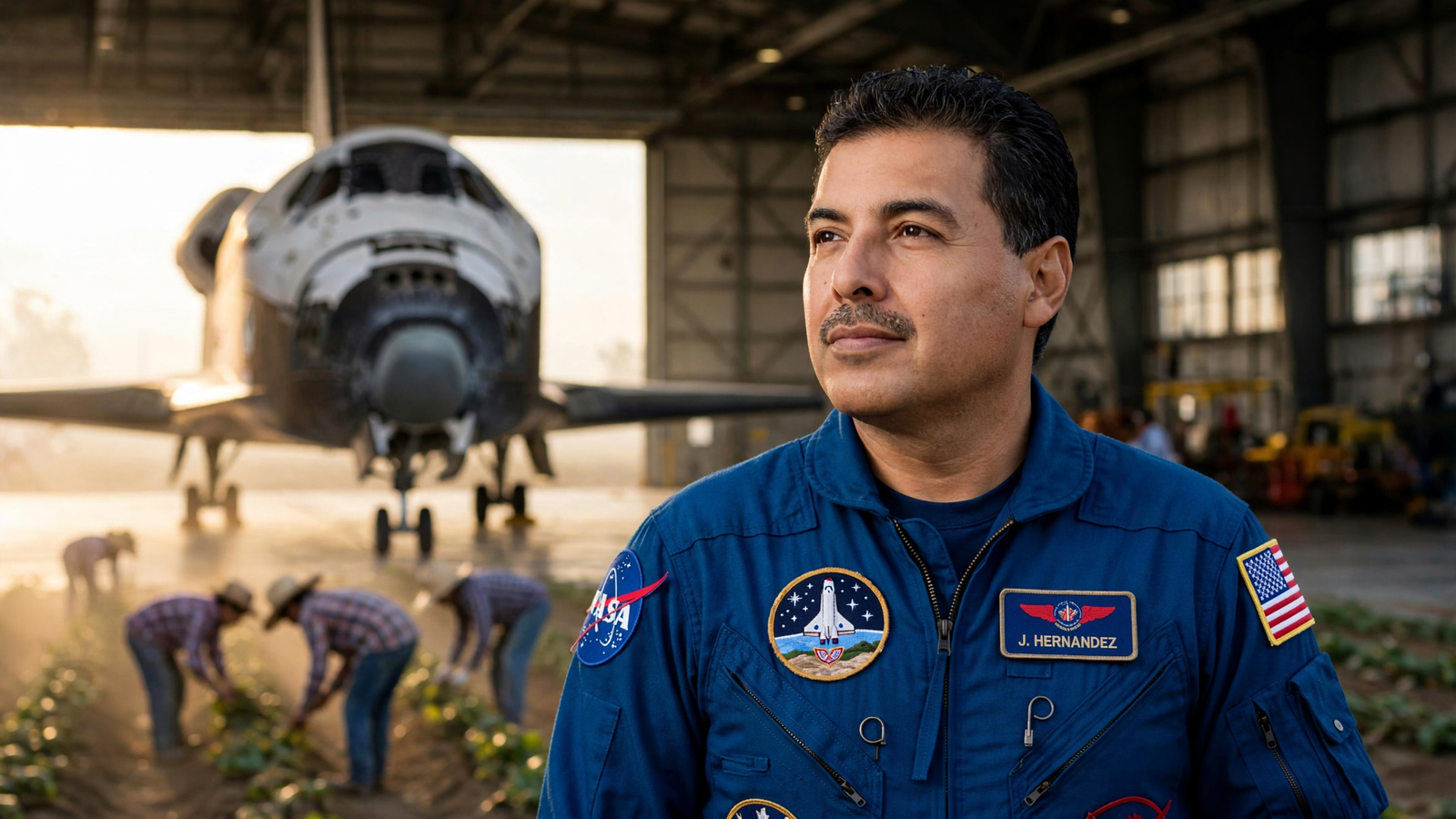
When José Hernández looked up at the night sky as a child, space was not an obvious destination. His family moved with the agricultural seasons, traveling between Mexico and California’s San Joaquin Valley for farm work. The rhythm of their lives was set by harvests, school calendars, and the search for the next job.
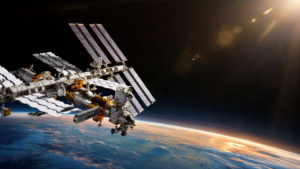
Hernández would eventually travel much farther than the fields his parents worked. In 2009, he flew aboard the Space Shuttle Discovery as a NASA mission specialist, spending nearly two weeks in orbit and helping deliver equipment to the International Space Station.
His journey is often described as a story of persistence—and it is that. But it is also a story about the institutions that made persistence useful: public schools, universities, research laboratories, NASA’s astronaut program, and a family that treated education as a route toward greater choices.
A childhood shaped by movement
Hernández was born in 1962 in French Camp, California, and grew up in a Mexican American farmworker family. His parents worked in agriculture, and the family’s livelihood depended on following seasonal labor. As a boy, Hernández moved between communities in California’s Central Valley and Mexico before eventually settling more permanently in Stockton.
That early experience could have made school feel secondary. Instead, his family developed a practical rule: education came first. Hernández has recalled that his parents eventually decided to stay in one place so their children could have more continuity in school.
The decision did not erase the family’s economic challenges. It did, however, give Hernández a stable platform from which to pursue interests that had begun with science and technology. He became especially interested in space after watching the Apollo missions and learning about astronauts who seemed to come from very different worlds than his own.
The distance between a San Joaquin Valley classroom and a NASA spacecraft was enormous. Hernández crossed it through a series of smaller, achievable steps. For related reading, see The International Space Station: How the World Built a Laboratory Above Earth.
Building a career one qualification at a time
Hernández studied electrical engineering at the University of California, Santa Barbara, graduating in 1984. He later earned a master’s degree in electrical engineering from Stanford University.
His academic training led to a position at Lawrence Livermore National Laboratory, where he worked on technologies connected to medical imaging and other technical systems. One of his projects helped advance methods used in mammography, work that gave him experience with complex instrumentation and applied research.
At Livermore, Hernández was not simply waiting for a chance to become an astronaut. He was building the kind of technical record NASA expected from its applicants. The work demanded precision, teamwork, and the ability to solve problems whose answers were not always obvious—skills that would later matter in spaceflight.
He also developed a broader understanding of what engineering could do. A technical career was not separate from ordinary life. It could affect how doctors detect disease, how machines operate, and how people live with problems that once seemed beyond their control.
The long road to NASA
NASA’s astronaut selection process is highly competitive. Applicants typically bring advanced degrees, professional accomplishments, physical fitness, and experience working under pressure. Even highly qualified candidates may apply repeatedly without being chosen.
Hernández was among those who kept returning to the process. He has said that NASA turned down his applications multiple times before selecting him. The repeated rejections became part of the public story, but they were not the whole explanation for his eventual success.
Each application gave him another chance to assess what he needed to improve. He strengthened his technical experience, developed leadership skills, and continued meeting the demanding qualifications for the astronaut corps. Persistence worked because it was paired with preparation.
NASA selected Hernández as an astronaut candidate in 2004. He joined a class that included pilots, engineers, physicians, and scientists, then began the training required for spaceflight. That preparation covered spacecraft systems, robotics, survival techniques, emergency procedures, physical conditioning, and teamwork.
For Hernández, the training represented a change in scale. The problems he had once approached as an engineer were now connected to a vehicle, a crew, and a mission operating hundreds of miles above Earth. For related reading, see NASA’s Deep-Space Laser Link Is Opening a Faster Way to Talk Across the Solar System.
Discovery’s mission to the International Space Station
Hernández’s spaceflight began on August 28, 2009, when Discovery launched on the STS-128 mission. He served as a mission specialist alongside commander Rick Sturckow, pilot Kevin Ford, and fellow mission specialists.
The shuttle carried supplies and equipment to the International Space Station, including the Leonardo Multi-Purpose Logistics Module. The module functioned as a cargo carrier during the flight and transported materials needed for the station’s continuing work.
During the mission, the crew delivered equipment associated with the station’s environmental systems, research facilities, and living quarters. One important task involved installing a system that would help recycle urine into drinkable water. Such technology may sound less dramatic than a moon landing, but life-support systems are central to making long-duration human spaceflight possible.
Hernández also operated the shuttle’s robotic arm and supported the movement of equipment outside the spacecraft. Robotic operations require careful coordination: the crew must work with limited views, delayed instructions, strict procedures, and hardware that can weigh many thousands of pounds.
Discovery returned to Earth in September after a mission lasting nearly two weeks. Hernández had become one of the relatively small number of people to see Earth from orbit—and one of the few astronauts whose childhood began in the world of migrant farm labor.
A different kind of astronaut story
Spaceflight stories often focus on the spectacular: launch, weightlessness, spacecraft maneuvers, and views of Earth. Hernández’s story adds another dimension. It shows how the space program is connected to ordinary public institutions and to communities that may not see themselves reflected in its most familiar images.
His achievement did not come from a single inspirational moment. It came through a sequence of decisions made over decades: parents choosing educational stability, a student completing engineering degrees, a researcher developing specialized skills, and an applicant continuing to improve after rejection. For related reading, see Landsat: How a Public View From Space Became an American Record of Earth.
That sequence matters because it makes the achievement more understandable without making it less remarkable. Hernández did not leap directly from a farmworker family to orbit. He moved through schools, laboratories, professional networks, and training programs. Each stage widened the next possibility.
His career also challenged a narrow idea of who belongs in advanced science and space exploration. A child from a family of migrant workers could become an engineer. An engineer could contribute to medical technology. A researcher could become an astronaut. The path was difficult, but it was not closed.
Taking the lesson back to Earth
After leaving NASA, Hernández continued working in engineering and business. He became involved in efforts connected to technology, education, and opportunity, including work intended to encourage young people from underrepresented communities to pursue science, technology, engineering, and mathematics.
His public message has remained grounded in process. Ambition matters, but so do preparation, mentorship, education, and the willingness to revise a plan without abandoning the larger goal.
That may be the most useful part of Hernández’s example. His story is not a promise that determination alone can overcome every barrier. Families need support, schools need resources, and institutions need to recognize talent beyond familiar backgrounds. But his life demonstrates what can happen when aspiration meets sustained effort and a real opportunity to advance.
In photographs from orbit, Earth appears without the boundaries that organize life on the ground. From that height, fields, cities, and oceans form one connected surface. Hernández’s route to space offers a similarly broad view of achievement: a mission can begin in a classroom, in a family decision, or in a child’s question about the sky.
José Hernández reached the International Space Station after traveling a long way from the seasonal fields of California. His flight became more than a personal milestone. It became evidence that the nation’s scientific future can be enlarged when people from overlooked places are given the education, time, and opportunity to prepare for it.
Use: Birthplace and background, engineering education, professional experience, astronaut selection, and career information.
Use: Launch date, mission objectives, crew activities, International Space Station logistics, and mission operations.
Use: Hernández’s work at Lawrence Livermore National Laboratory and the connection between his research career and astronaut selection.