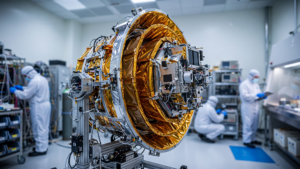
A telescope does not always need to zoom in to make a major discovery. Sometimes the important view is the whole sky: a wide, carefully measured panorama that lets astronomers compare millions of objects at once.
That is the approach behind SPHEREx, a NASA space telescope launched on March 11, 2025. Its name stands for Spectro-Photometer for the History of the Universe, Epoch of Reionization and Ices Explorer. Rather than concentrating on a few targets in exquisite detail, SPHEREx is designed to survey the entire sky in 102 infrared wavelength bands. The resulting map can help researchers ask how galaxies formed, what the early universe was like, and where some of the raw ingredients for planets are stored.
A sky map made of more than pixels
Most people picture a sky survey as a collection of photographs. SPHEREx will make images, but its distinctive feature is the way it measures light. Different wavelengths carry clues about the objects that emitted or absorbed them. A star, galaxy or cloud of dust can leave a recognizable pattern in its light, much as different materials have different signatures.
SPHEREx divides near-infrared light into 102 bands. That does not mean it sees 102 colors in the everyday sense: infrared lies beyond human vision. The bands let scientists compare how bright an object is at different wavelengths and use those measurements to infer properties such as its distance or the substances in a cloud.
The telescope is built for breadth rather than close-up portraits. Its survey is intended to include hundreds of millions of galaxies and more than 100 million stars in the Milky Way. A galaxy in the map will not necessarily appear as a detailed spiral, and a single measurement will not answer every question about it. The strength is consistency: astronomers can study a huge population using the same observing approach.
Looking for a pattern left by the early universe
One of SPHEREx’s goals reaches back to an extraordinarily early chapter of cosmic history. The leading account of the universe includes a brief period of rapid expansion called inflation. Scientists have evidence that supports the broad picture, but they are still working to determine what physical process drove it and how it unfolded.
SPHEREx will not photograph inflation as it happened. Instead, it will measure the positions and distances of many galaxies to build a large-scale, three-dimensional map. Astronomers can then look for statistical patterns in how matter is distributed. Those patterns may help test models of inflation and the universe’s subsequent growth.
This is a different kind of evidence from a dramatic image of a single distant galaxy. A large survey can reveal whether a proposed explanation fits the arrangement of many galaxies, not just one striking object. The result is likely to be a set of constraints and comparisons among theories, rather than a simple yes-or-no verdict.
Tracing how galaxies changed over time
SPHEREx is also intended to study the history of galaxies. Because light takes time to travel, distant galaxies are seen as they were in the past. Measuring their infrared light across many bands helps researchers estimate distances and compare galaxies at different stages of cosmic history.
On their own, wide-area measurements will not replace detailed observations from telescopes such as the James Webb Space Telescope. Instead, surveys and close-up studies can complement each other. A broad map can identify populations and regions worth investigating; a more focused telescope can then examine selected targets in greater detail.
That division of labor matters because the universe is too large for any one observatory to study every object closely. SPHEREx’s value lies partly in providing a consistent overview that researchers can use to place more specialized observations in context.
Frozen molecules in stellar nurseries
The mission also turns its infrared view toward the Milky Way. In cold, dense clouds between stars, molecules can freeze onto the surfaces of tiny dust grains. These icy materials are part of the environment from which stars and planetary systems form.
By measuring light from these regions at different wavelengths, SPHEREx can help researchers map the distribution of ices and investigate molecules that matter to the chemistry of planet-forming environments. The goal is not to announce that life exists elsewhere. Rather, it is to improve our understanding of where certain chemical ingredients occur and how they move through the stages that lead from interstellar clouds to new planetary systems.
That distinction is important. Finding a molecule or an ingredient associated with life does not establish that a world is inhabited. It tells scientists something about the chemistry available in a place, one piece of a much larger question.
Why a survey can be a discovery engine
SPHEREx’s strategy is built around repetition and coverage. The spacecraft is designed to scan the whole sky repeatedly during its two-year primary mission, building a dataset that can be compared across wavelengths and over time. Its observations are intended to support researchers studying topics beyond the mission’s three headline themes, including stars, galaxies and the material between them.
There is a practical trade-off in this design. A survey telescope cannot offer the same fine detail as an observatory that spends long periods on a small patch of sky. But a uniform map can uncover relationships that would be hard to notice in isolated observations. When hundreds of millions of objects are measured in a common framework, scientists can search for patterns, test models and identify unusual targets.
SPHEREx is therefore not simply making a bigger picture of the night sky. It is creating a kind of reference map in which light itself carries extra information. The promise is not one guaranteed headline discovery, but a new resource for asking connected questions about the universe: how its structure grew, how galaxies evolved, and how the chemistry of stars and planets began.