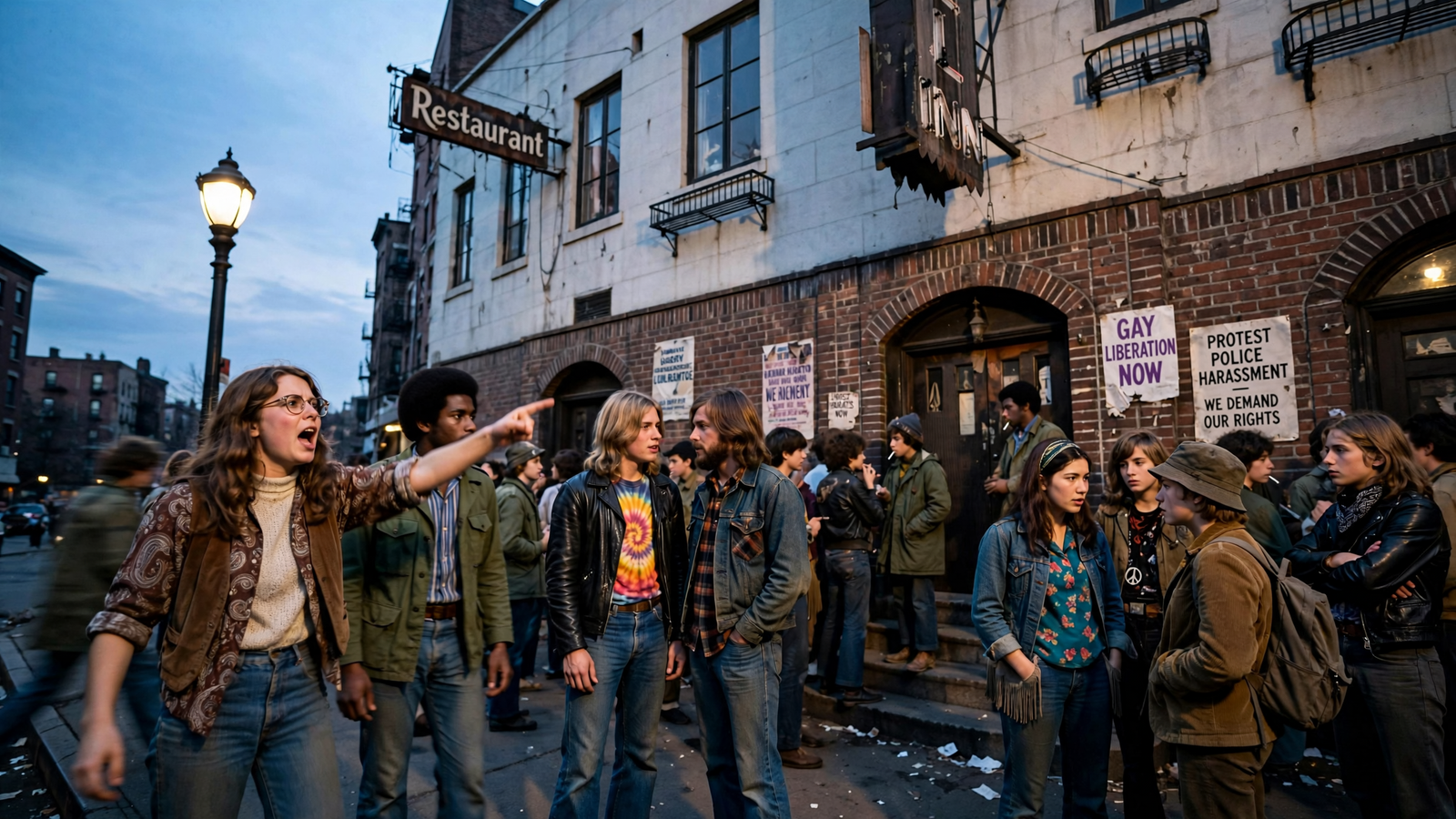
Before dawn on June 28, 1969, police entered the Stonewall Inn, a small bar on Christopher Street in New York City’s Greenwich Village. Raids on gay bars were not unusual. Authorities regularly used liquor laws and other regulations to disrupt places where LGBTQ+ people gathered, and patrons had learned to expect humiliation, arrest, or both.
That night followed a familiar pattern at first. Officers ordered people to line up for identification. Some customers were taken away. Others were allowed to leave. But outside the bar, the crowd did not disperse. As more people gathered on the street, frustration became resistance. The confrontation continued for hours and returned over several nights.
The Stonewall uprising did not begin the fight for LGBTQ+ rights. Activists had been organizing for years, often under intense legal and social pressure. But Stonewall became a powerful turning point: a moment when a routine display of state control met a public refusal to remain quiet.
A raid that reflected an older system
New York’s gay bars operated in a precarious environment. Many were controlled by organized-crime interests because licensed businesses could face penalties for serving openly LGBTQ+ customers. The Stonewall Inn itself was not a polished nightclub. It had limited facilities, relatively high prices, and a reputation as one of the few places where people who were often excluded elsewhere could dance and socialize.
The clientele was diverse, including gay men, lesbians, transgender people, drag performers, and young people who had found few safe public spaces. Some patrons were homeless or estranged from their families. For them, the bar was more than a place to drink. It was one of the few places where they could appear in public without having to conceal every part of their lives.
Police raids were enabled by a broader legal and cultural system. Same-sex relationships were criminalized in many parts of the United States, and homosexuality was classified as a mental disorder by the American Psychiatric Association until 1973. Employment discrimination, housing discrimination, censorship, and public harassment were widespread. Even where a particular act was not illegal, LGBTQ+ people could lose jobs, housing, custody of children, or access to public life.
In that context, a bar raid was not experienced as an isolated inconvenience. It was a reminder that a person’s safety and dignity could be placed in the hands of police, employers, landlords, doctors, and family members.
What happened at Stonewall
Accounts differ on the precise details of the first moments outside the bar, including who made the earliest gesture of defiance. The larger sequence is clearer. After police began processing patrons, a crowd formed on Christopher Street. People jeered, applauded, and resisted the usual process by which those arrested were removed.
The situation escalated. Bottles and other objects were thrown, and the crowd pushed back against officers. Police retreated into the Stonewall Inn and waited for reinforcements. The building was damaged and a fire was started, though officers extinguished it. By the early morning, the crowd had dispersed.
The confrontation did not end there. Protests and clashes returned over the next several nights. Demonstrators criticized police harassment and demanded the right to gather openly. Greenwich Village became a stage for a conflict that had been building for years: whether LGBTQ+ people would continue to be treated as a population to control or begin to claim public space on their own terms.
The uprising involved anger, confusion, humor, fear, and courage. It was not a single, perfectly coordinated event. It was a spontaneous eruption shaped by local conditions and by people who had already spent years developing the language and networks of protest.
Stonewall’s immediate legacy
The most important change came after the street battles. Within weeks, activists formed the Gay Liberation Front in New York. The organization rejected the idea that LGBTQ+ people had to win acceptance by appearing less visible or more conventional. It connected the struggle for sexual freedom with other movements of the era, including opposition to racism, war, and economic inequality.
Other groups followed. The Gay Activists Alliance formed later in 1969 and focused more directly on political organizing and LGBTQ+ rights. Activists published newspapers, organized demonstrations, challenged discriminatory policies, and created community institutions. Stonewall supplied a shared reference point and a story that could travel beyond New York.
One year after the uprising, activists in New York, Los Angeles, and Chicago organized public demonstrations to mark its anniversary. New York’s event, known as the Christopher Street Liberation Day March, is widely recognized as the beginning of the modern Pride tradition. What began as a commemoration became an annual public assertion that LGBTQ+ people belonged in the streets, in politics, and in the national conversation.
The movement’s progress was neither immediate nor uniform. Activists faced police violence, public hostility, internal disagreements, and a backlash that intensified during the 1970s and 1980s. The HIV/AIDS crisis brought immense loss and exposed the failures of government and medical institutions. Many of the people who pushed the movement forward were marginalized within it, including transgender people, people of color, lesbians, bisexual people, poor people, and people without stable housing.
Remembering Stonewall accurately therefore means resisting a simplified version in which one night solved a national problem. The uprising mattered because it helped make a new kind of organizing possible, not because equality arrived afterward.
From a bar on Christopher Street to a national landmark
In the decades after Stonewall, the movement helped produce major legal and cultural changes. LGBTQ+ people won greater protection in some workplaces and communities, same-sex relationships were decriminalized nationwide through a 2003 Supreme Court decision, and marriage equality became national law in 2015. Those developments came through years of litigation, elections, local organizing, journalism, protest, and personal acts of visibility.
The Stonewall site also changed meaning. Once a place known mainly to the people who gathered there, it became a symbol of resistance recognized around the world. In 2016, President Barack Obama designated the Stonewall National Monument, the first U.S. national monument dedicated to the LGBTQ+ rights movement. The monument includes the Stonewall Inn, Christopher Park, and nearby streets and sidewalks associated with the uprising.
That federal designation did not freeze the story in the past. It acknowledged that ordinary places can become part of a nation’s historical record. The sidewalk outside a bar, the corner where a crowd refused to move, and the park where people continued to gather can all carry the memory of political change.
Why the story still matters
Stonewall remains important because it shows how history can turn on the difference between being present and being silent. The people at the Stonewall Inn did not begin the LGBTQ+ movement, and they could not know what their resistance would mean decades later. They knew only that another raid was underway and that accepting it quietly had never made them safe.
The uprising also offers a broader lesson about rights movements. Major changes often appear, in retrospect, to have been inevitable. They rarely feel that way to the people who begin them. Progress is usually assembled from local relationships, small organizations, repeated demonstrations, legal challenges, cultural work, and moments when people decide that an old arrangement has become intolerable.
Today, Stonewall is remembered through Pride celebrations, public history, scholarship, and the national monument in Greenwich Village. Its meaning continues to evolve as new generations debate who is protected, who is heard, and what equality should require.
The bar is still there. So is the street. Their importance lies not in the architecture alone, but in what happened when people who had been pushed to the margins claimed the right to remain visible. A police raid that authorities expected to pass like countless others instead became a chapter in American history—and a lasting reminder that public space can become political space when a community refuses to disappear.