In January 1930, as the American economy began sliding toward the Great Depression, Cadillac presented an answer to a question no one urgently needed answered: What if a passenger car had sixteen cylinders?
The result was the Cadillac V-16, one of the most extravagant automobiles ever produced in the United States. It was powerful, technically ambitious, and expensive enough to seem almost detached from ordinary life. Yet its importance was larger than its sales. The V-16 showed what Detroit believed the automobile could be when cost, practicality, and caution were temporarily pushed aside.
It was a machine built for a changing America—and, in an unexpected way, a record of the confidence that existed just before the country’s industrial optimism met its hardest test.
A car designed to make an entrance
Cadillac had already established itself as General Motors’ prestige marque by the 1920s. Its cars were associated with engineering quality, long-distance comfort, and the sort of formal presence that appealed to business leaders, entertainers, politicians, and wealthy families. But the company wanted a vehicle that would place it above every conventional rival.
The answer began with its engine. Rather than simply enlarging an existing Cadillac power plant, the company developed a sixteen-cylinder engine arranged in a narrow V. The first-generation engine displaced 452 cubic inches—hence the model’s Series 452 designation—and used overhead valves, a comparatively advanced arrangement for the period.
Its layout was not just a publicity exercise. A V-16 could deliver smooth, quiet power because the engine’s many cylinders produced frequent firing impulses. Cadillac engineers also kept the engine relatively compact for its cylinder count by placing two banks of eight cylinders at an angle. The result was a long, polished mechanical centerpiece that looked as carefully considered as the body surrounding it.
Contemporary buyers did not encounter a single standardized V-16 body. Cadillac offered a wide selection of styles, and customers could choose formal sedans, coupes, convertibles, roadsters, limousines, and other coachbuilt forms. The chassis was designed to serve as the foundation for a personal statement.
Harley Earl and the rise of automotive style
The V-16 also arrived at an important moment in the history of American design. Harley Earl, who had joined General Motors after making his name with custom-bodied automobiles in California, was helping establish the idea that styling should be an organized part of automobile production.
Before this shift, engineering and body construction often dominated the development process. Earl helped make appearance a central competitive tool. A car was no longer merely a machine that happened to have a body; its proportions, ornament, colors, and visual identity could shape how people understood the brand.
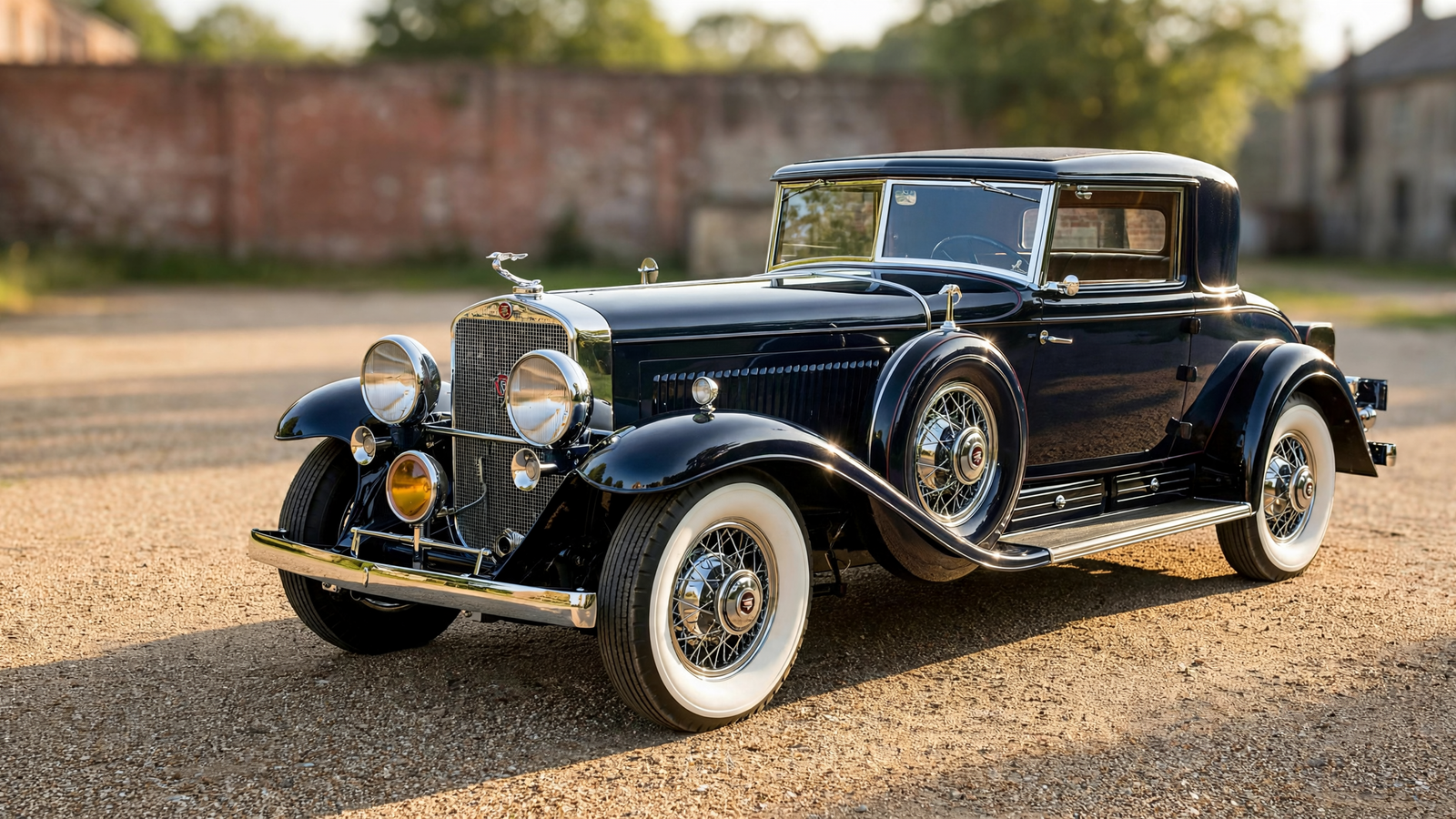
The V-16 gave this new design culture an enormous canvas. Its long hood, sweeping fenders, formal passenger compartments, and carefully finished details made the automobile seem almost architectural. Even at rest, it communicated motion, rank, and expense.
That visual drama mattered because luxury-car customers were not buying transportation alone. They were buying arrival. The V-16 turned a driveway, hotel entrance, or theater curb into a small public stage.
Power when the road was still demanding
Today, a large engine is often discussed in terms of acceleration figures and fuel consumption. In the early 1930s, the appeal of the V-16 was more closely tied to effortless travel. American roads were improving, but long-distance driving could still be tiring, noisy, and mechanically demanding.
The V-16’s purpose was to make speed feel unhurried. Its abundant power allowed the driver to move a heavy luxury automobile without the sensation that the engine was working at its limits. Cadillac emphasized smoothness as much as outright performance, and the sixteen-cylinder arrangement gave the car a refined mechanical character that smaller engines could not easily imitate.
That refinement came with considerable complexity. A sixteen-cylinder engine required more parts, more careful maintenance, and more expensive manufacturing than the six- and eight-cylinder cars that dominated the wider market. The V-16 was not an attempt to make motoring accessible. It was an exercise in what the company could build when exclusivity was part of the brief.
The timing could hardly have been worse
Cadillac introduced the V-16 at the beginning of a decade that would challenge nearly every assumption behind it. The Wall Street crash had occurred in 1929, but its full economic consequences were still unfolding. Industrial production fell, unemployment rose, banks failed, and the market for expensive goods contracted sharply.
That context makes the car’s existence especially striking. Cadillac had spent years developing a flagship for a high-spending market just as that market was shrinking. The V-16 was not responsible for the Depression, of course, and it was not the only luxury car affected by the crisis. But its history illustrates how quickly consumer confidence can change.
Early interest was strong for an automobile so expensive and specialized. Over time, however, sales became more difficult. The people who could afford a sixteen-cylinder Cadillac became more cautious, while the broader public faced entirely different concerns. Cadillac continued refining the model, but the economic world that had made such a car imaginable was disappearing.
Production figures vary by accounting method and model grouping, but the first-generation V-16 remained a low-volume automobile. Only a few thousand were built across its production life, making surviving examples rare today. Its limited numbers were part of the original appeal—and later became one reason the car assumed a place in the history of American design.
More than a rich person’s automobile
It would be easy to treat the V-16 as a symbol of excess and leave the story there. But the car also reveals how the American automobile industry was becoming a culture of specialized choices.
Mass production had made cars more affordable and more consistent, but it did not eliminate individuality. Instead, large manufacturers developed increasingly elaborate ways to offer distinction within a production system. Cadillac’s catalog of bodies and finishes allowed the V-16 to remain connected to industrial manufacturing while preserving the feeling of a custom commission.
That tension—standardized underneath, personalized on top—would shape American automobiles for decades. It appeared in color programs, trim packages, annual styling changes, special editions, and increasingly expressive brand identities. The V-16 was an extreme early example of the idea that a car could be both a manufactured product and a piece of personal theater.
The second act
Cadillac did not immediately abandon the sixteen-cylinder idea. The company continued developing the engine and later introduced a redesigned V-16 for the late 1930s. The second version was more modern in appearance and engineering, but it faced an even narrower market.
By then, the luxury automobile business had been reshaped by the Depression. Buyers were more conservative, production costs were harder to justify, and the automobile industry was moving toward designs that offered status with less mechanical extravagance. Cadillac’s V-16 remained an important prestige statement, but the age of the giant American multi-cylinder automobile was nearing its end.
The company eventually returned to more practical engine configurations for its flagship cars. Yet the V-16’s influence did not disappear. The model established a lasting association between Cadillac and technical ambition, while its styling helped demonstrate that automotive design could be treated as a serious industrial art.
Why the V-16 still matters
The Cadillac V-16 was not a practical answer to a transportation problem. It did not make driving cheaper, safer, or easier for most Americans. Its contribution was different. It expanded the imaginative boundaries of what an American automobile could be.
It showed that Detroit could build a car with the mechanical smoothness of a great touring machine, the presence of a formal coach, and the visual confidence of a modern design object. It also preserved a particular moment in American history: the instant when technological possibility and luxury consumption still seemed capable of growing without limit.
That is why surviving V-16s attract attention far beyond the collector-car world. They are not merely large old cars. They are rolling documents of engineering, industrial design, social aspiration, and economic change.
When one appears at a concours or museum, visitors often notice the obvious things first—the length, the grille, the polished engine, the remarkable bodywork. But the deeper story is written into the contradiction. Cadillac created one of America’s greatest symbols of abundance just as abundance was becoming uncertain.
The V-16 did not conquer the market. It did something more unusual: it made ambition tangible. In sixteen cylinders, Detroit built a dream large enough to reveal both the confidence of its time and the limits of that confidence.