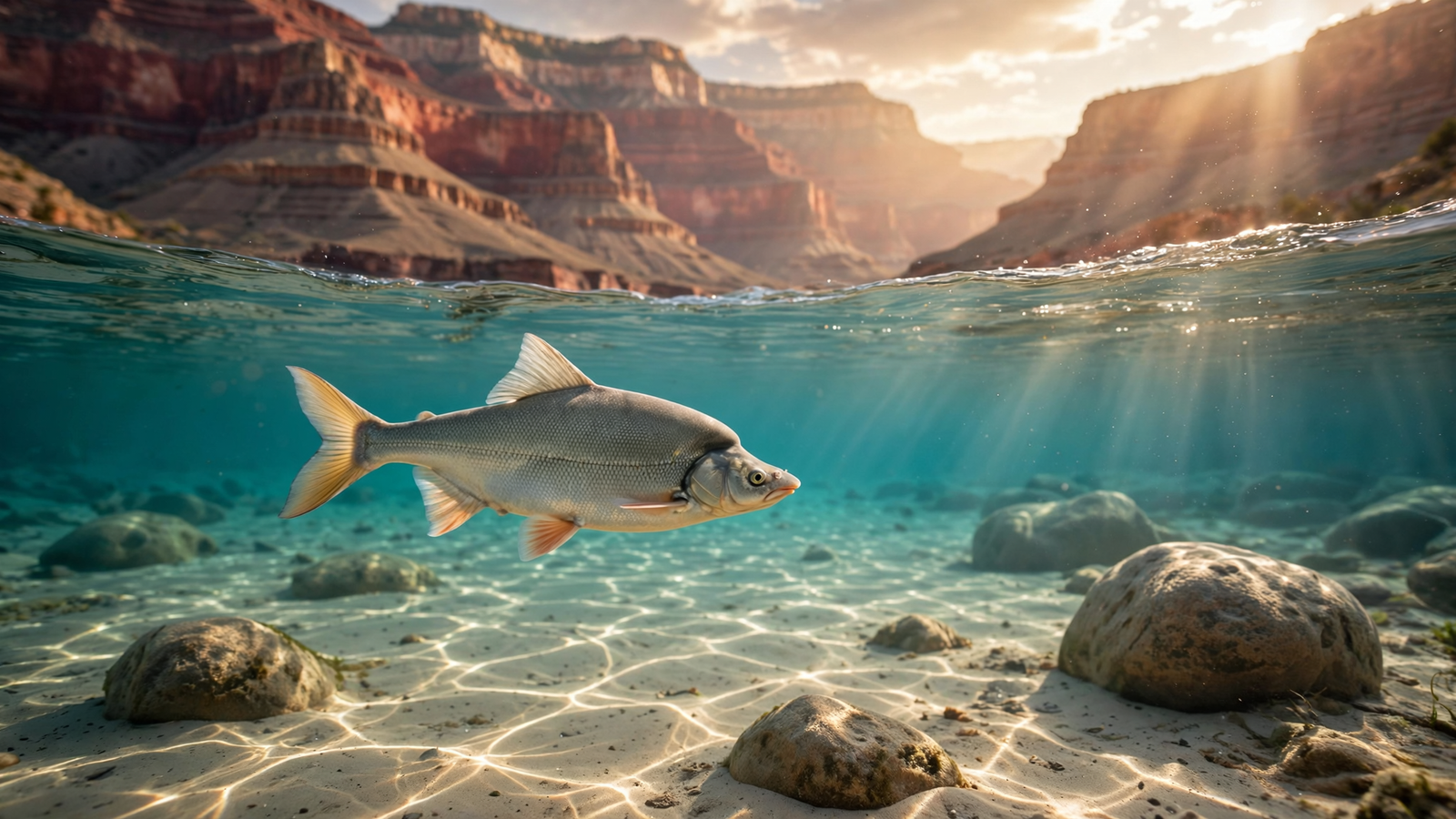
In the deepest reaches of the Grand Canyon, a small fish with a strangely shaped back is becoming one of the Colorado River’s quiet conservation successes. For related reading, see Mary Colter: How an Arizona Architect Made the Grand Canyon Feel Human.
The humpback chub is not colorful like a tropical reef fish or large enough to attract the attention of most visitors. It is a river fish, olive-gray and streamlined, built for life in fast, turbulent water. A fleshy hump rises behind its head, giving the species its name. For decades, however, the fish’s future was shaped less by its remarkable adaptations than by the changes humans made to its river. For related reading, see Arizona’s Condor Comeback: How the Grand Canyon Became a Second Chance for North America’s Largest Flying Bird.
Dams altered the Colorado’s temperature and flow. Introduced fish competed with the chub or preyed on its young. Habitat became fragmented, and populations declined across the species’ already limited range. In 1967, the humpback chub was listed under the federal Endangered Species Preservation Act, an early warning that a fish found only in a handful of canyon rivers could disappear. For related reading, see Grand Canyon: How a Landscape Became an American Icon.
Today, the species is still protected. But its status has improved. In 2021, the U.S. Fish and Wildlife Service moved the humpback chub from endangered to threatened, recognizing a substantial increase in populations and a reduction in some of the dangers that once pushed it closer to extinction.
A fish built for canyon water
Gila cypha evolved in the turbulent rivers of the Colorado River Basin. Its body is designed for currents that would challenge many other fish. The low, flattened head and large fins help it hold position in swift water, while the hump behind the head may improve stability as the fish moves through rapids and eddies.
Adults usually occupy deep, fast-moving habitats near canyon walls, boulders and other structures that break the current. Young fish use somewhat quieter areas, where they can feed and grow before moving into stronger flows. The species’ life history is closely tied to the natural complexity of southwestern rivers: riffles, backwaters, tributary mouths and pockets of slower water all have a role.
That specialization helped the humpback chub survive in an environment that looks harsh to people. It also left the fish vulnerable when the river was simplified or its natural rhythm was interrupted.
How the river changed
The Colorado River through the Grand Canyon is controlled upstream by Glen Canyon Dam. The dam provides water and power for millions of people, but it also transformed the river below it. Water released from deep within Lake Powell is much colder than the river was under natural conditions, and the timing and size of flows changed.
Those changes affected the entire aquatic community. Native fish evolved with the seasonal rise and fall of a southwestern river. Non-native species, including trout and other introduced predators, found new opportunities in the altered system. In some places, native fish had to compete for food and shelter with species that had never been part of the Colorado River’s original community.
The humpback chub also faced a basic geographic problem: its strongest remaining populations were separated from one another. The species was never widespread across North America. It lived in particular stretches of the Colorado and its tributaries, including the Little Colorado River, where warm water and complex canyon habitat offered conditions different from the main stem.
By the late twentieth century, biologists were concerned that the Grand Canyon population might not be large enough to survive long term. The fish’s listing under federal law brought funding, monitoring and a coordinated recovery effort. It also changed the question conservationists were asking. The goal was not simply to keep a few fish alive in a remote canyon, but to restore the conditions that would allow the species to reproduce and persist in the wild.
Counting a recovery in a difficult place
Humpback chub recovery has required unusually patient fieldwork. The fish live in remote stretches of river accessible primarily by boat, and researchers must work around rapids, changing water levels and the difficulty of observing an underwater animal in canyon water.
Scientists use several methods to understand the population, including capture, tagging and repeated surveys. They examine the age and size of fish, track where individuals are found and look for evidence of reproduction. The aim is not to produce one perfect number. It is to detect a reliable trend: Are adults surviving? Are young fish recruiting into the population? Are the different river groups stable enough to withstand drought, floods or a bad spawning year?
Over time, those measurements began to point in a better direction. The Grand Canyon population increased, and the fish continued to reproduce in the Little Colorado River and other important habitats. Populations elsewhere in the upper Colorado River Basin also contributed to the species’ improved outlook.
The Fish and Wildlife Service’s 2021 decision to downlist the humpback chub did not mean the work was finished. It meant that the species no longer met the agency’s definition of endangered across its range, while still facing enough risk to require protection. That distinction matters. Conservation success is not always a clean transition from danger to safety. Often, it is a move from emergency intervention to careful stewardship.
What helped the fish return
No single project rescued the humpback chub. Its progress came from several efforts operating together.
- Protection under the Endangered Species Act: Federal listing created a framework for recovery planning and required agencies to consider the fish when managing water projects and river habitat.
- Long-term monitoring: Repeated surveys gave biologists a way to distinguish a genuine population increase from a short-term fluctuation.
- Management of non-native fish: In parts of the Grand Canyon, agencies have removed or reduced introduced predators and competitors when they threatened native fish.
- Attention to tributaries: Tributaries such as the Little Colorado River provide warmer water and important spawning and nursery habitat.
- Coordinated river management: Decisions about dam operations, water releases and ecosystem protection can influence whether native fish have access to the conditions they evolved to use.
These measures illustrate a broader lesson about river conservation. A species may be described as endangered because of a single visible threat, but its recovery usually depends on a network of connected places and decisions. The fish needs suitable spawning grounds, safe nursery habitat, food, tolerable temperatures and enough adult survival for the population to replace itself.
The Grand Canyon as a living laboratory
The humpback chub’s story is also changing how the Grand Canyon is understood. The canyon is often presented as a monument of geology, a landscape carved by water over immense spans of time. But the river at its bottom is not simply a remnant of the past. It is a living system, influenced by dams, drought, invasive species, recreation and decisions made hundreds of miles upstream.
That makes the chub an important indicator. Its condition reflects whether management is creating room for native river life, not merely whether water is moving through the canyon. The species connects the visible landscape above the rim with the less visible ecological story below it.
Researchers still face serious challenges. Climate change is bringing greater heat and uncertainty to the Colorado River Basin. Prolonged drought reduces water supplies and can intensify disputes over how the river is used. Reservoir operations continue to influence temperature and flow. Non-native fish remain part of the system, and the humpback chub’s distribution is still limited.
Downlisting therefore comes with an obligation: keep watching. The Fish and Wildlife Service’s decision requires continued recovery work and review. If populations decline again or threats worsen, the species could need stronger protections. The improvement is real, but it is not a declaration that the river has returned to its pre-dam condition.
A small fish with a large meaning
The humpback chub does not offer the easy drama of a species that can be seen from a road or recognized in a backyard. Its recovery is mostly hidden from public view, unfolding in deep water beneath canyon walls. Yet that is part of what makes it encouraging.
The species shows that conservation can succeed even in a river system shaped by enormous infrastructure and competing human needs. Progress came through decades of surveys, legal protection, habitat management and cooperation among agencies and scientists. It came slowly enough that no single moment could claim credit.
For now, the humpback chub remains a threatened fish, not a recovered one. But the distinction between those labels contains a meaningful achievement. A species once moving toward disappearance is now maintaining larger populations in some of its most important strongholds. In the Colorado River’s difficult, engineered and still-changing future, the fish has been given something conservation cannot guarantee but can make possible: time.
Use: Species status, biology, range and federal conservation information.
Use: The 2021 status change and the agency’s explanation of population improvement and continuing threats.
Use: Grand Canyon habitat, river-system context and conservation challenges.
Use: Population monitoring, field research and ecological information.
U.S. Fish and Wildlife Service — Humpback Chub Species Profile — https://www.fws.gov/species/humpback-chub-gila-cypha — Species status, biology, range and federal conservation information.
U.S. Fish and Wildlife Service — Humpback Chub Downlisted From Endangered to Threatened — https://www.fws.gov/press-release/2021-09/humpback-chub-downlisted-endangered-threatened — The 2021 status change and the agency’s explanation of population improvement and continuing threats.
National Park Service — Humpback Chub — https://www.nps.gov/articles/000/humpback-chub.htm — Grand Canyon habitat, river-system context and conservation challenges.
U.S. Geological Survey — Humpback Chub Research and Monitoring — https://www.usgs.gov/centers/southwest-biological-science-center/science/humpback-chub — Population monitoring, field research and ecological information.