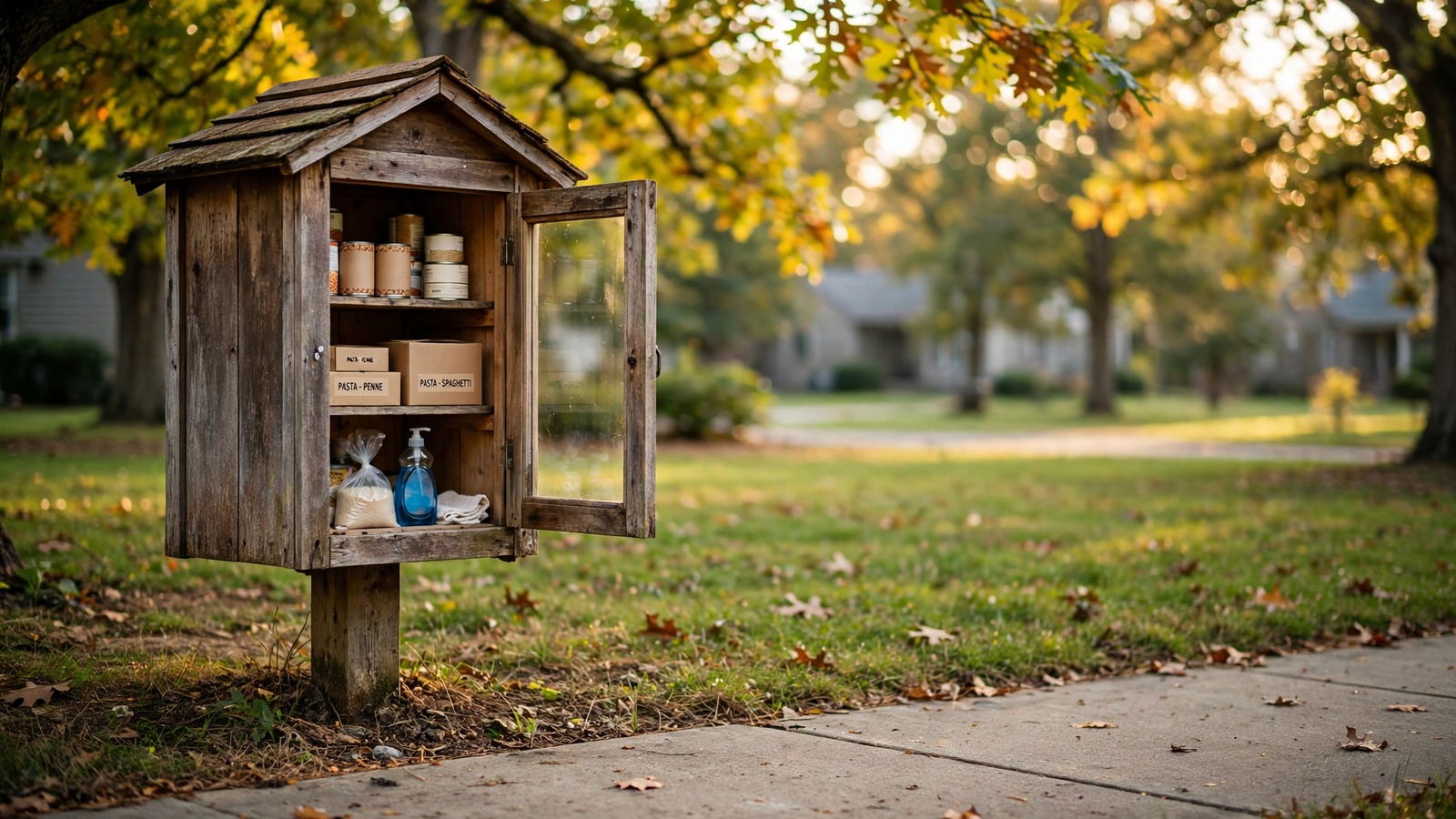
On a residential street, a small cupboard can become a surprisingly powerful piece of neighborhood infrastructure.
It may look like a weatherproof cabinet mounted on a post, painted with flowers, covered in bright colors, or decorated to match the home behind it. Inside are often familiar things: pasta, cereal, canned vegetables, soap, diapers, toiletries, or a note offering encouragement. The arrangement is informal. There is no application, membership card, or posted schedule. A neighbor leaves something. Another neighbor takes what is useful.
These are little free pantries, and their appeal lies partly in their modesty. They do not attempt to replace food banks, public benefits, school meal programs, or other essential services. Instead, they create a small, local way for people to respond to one another’s everyday needs.
A small idea with a clear purpose
The Little Free Pantry movement began in Fayetteville, Arkansas, in 2016. Organizer Jessica McClard created an outdoor pantry after seeing the popularity of Little Free Libraries, which make books available through small neighborhood structures. The pantry adapted that familiar format for a different kind of exchange: take what you need, leave what you can.
The model spread because it is easy to understand and relatively easy to adapt. A pantry can be built from a repurposed cabinet, a weather-resistant box, or a purpose-built structure. It can stand near a home, church, community center, apartment building, or other location where people can safely reach it. The local organizer decides what the pantry can accommodate and how often it can be checked.
That flexibility matters. A neighborhood with many families may find diapers and school snacks especially useful. In another community, shelf-stable meals, personal-care products, pet food, or cold-weather supplies may be more appropriate. The pantry becomes a kind of household-to-household conversation, expressed through objects rather than formal meetings. For related reading, see The 1950 Census: How a Household Form Became a Time Machine for American Life.
Why the format feels different
Traditional assistance programs are indispensable, but they can involve hours, transportation, paperwork, eligibility requirements, or the discomfort of asking for help in a public setting. A little pantry offers a different experience. Someone can stop while walking the dog, pick up one needed item, and continue on without explaining a personal situation.
That privacy does not make the exchange impersonal. In many cases, the pantry is visibly connected to a home or a group of nearby homes. The person stocking it may recognize the people who use it. A handwritten sign might say “Take what you need,” while another invites neighbors to leave suggestions for useful items.
The result is not charity flowing in only one direction. The basic design allows people to participate in different ways at different times. Someone may need canned food one week and contribute toiletries the next. A gardener may leave extra produce. A child may help decorate the cabinet. A local business may donate surplus shelf-stable goods. A retired neighbor may take responsibility for checking the shelves.
This shared-use quality is one reason the pantry can feel like part of home life rather than an institution set apart from it. It turns surplus into a resource and makes generosity visible at street level.
What belongs on the shelves
There is no single national rulebook for every little pantry. Each organizer has to consider local regulations, weather, pests, storage conditions, and the needs of the surrounding community. Still, the safest and most useful pantries usually focus on unopened, commercially packaged items that are clearly labeled and within their usable dates.
Good choices can include:
- Rice, pasta, oats, cereal, and other dry staples
- Canned beans, vegetables, fruit, and soups
- Peanut butter and other shelf-stable spreads, when clearly labeled for common allergens
- Tea, coffee, and individually packaged snacks
- Toothbrushes, toothpaste, soap, shampoo, and menstrual products
- Diapers, wipes, and unopened household supplies
- Pet food in its original packaging
Fresh food can be more complicated. A pantry without refrigeration should generally not be used for meat, dairy, prepared meals, or other foods that require temperature control. The U.S. Department of Agriculture advises consumers to follow label directions, avoid foods with damaged packaging, and pay attention to safe storage and handling. Those principles are especially important in an unattended outdoor cabinet, where heat, humidity, insects, and animals can quickly create problems.
Many organizers also avoid homemade food, opened packages, alcohol, medication, and anything that could be mistaken for a safe or suitable donation without more information. A simple posted list of accepted items can prevent confusion and reduce waste.
Building one is only the beginning
A successful pantry is less about the appearance of the box than the care around it. Before installing one, organizers can look at the immediate surroundings and ask practical questions. For related reading, see StoryCorps: How Ordinary Conversations Became an American Archive.
Is the pantry easy to reach but not blocking a sidewalk? Does it have a stable base? Can the door close securely? Will the location receive extreme sun or standing water? Is there enough visibility for people to use it comfortably? If the structure is on private property, is it clear that the owner has permission and understands the responsibility?
Weather protection is particularly important. Moisture can ruin cardboard packaging, while summer heat can damage food and make the cabinet unsafe for certain products. Raised shelves, a sloped roof, ventilation, and regular cleaning can help. Some organizers use a separate section for hygiene products or household supplies so that food remains clean and easy to identify.
Routine maintenance is the quiet work that makes the gesture dependable. A volunteer can inspect the pantry several times a week, remove spoiled or damaged goods, sweep out crumbs, wipe surfaces, and note which items disappear quickly. The pattern of use provides useful information. If canned meals vanish but baking ingredients remain, future donations can become more targeted.
That feedback loop is one of the pantry’s strengths. Unlike a one-time donation drive, a neighborhood pantry can adjust continuously.
A lesson in dignity and design
The most important feature of a little pantry may be the absence of a gatekeeper. People do not need to prove that they are having a difficult month. They do not need to predict exactly what they will need before arriving. The arrangement leaves room for ordinary fluctuations in household life: a delayed paycheck, a sudden expense, an empty cupboard near the end of the week, or simply the chance to make groceries stretch a little farther.
That does not mean every pantry serves everyone equally well. A cabinet reached only by stairs will not work for every neighbor. Small print can make labels difficult to read. A pantry located far from apartments or public transit may be less useful to the people who need it most. Thoughtful organizers can improve access by considering height, lighting, language, visibility, and whether the site is reachable by wheelchair, stroller, or bicycle. For related reading, see The Pollinator Garden: How an Ordinary Yard Became a Small Refuge.
They can also invite input without requiring people to identify themselves. A weatherproof suggestion box, a simple sign, or a posted email address can help reveal what is missing. In some neighborhoods, the pantry becomes a gateway to other forms of connection: a free seed exchange, a winter-coat rack, a community garden, or a list of nearby food resources.
Small enough to join
The movement’s optimism comes from its low barrier to participation. Not everyone can organize a large food drive or volunteer every week. Many people can add an extra can of beans to a grocery trip, bring unopened hygiene supplies, or spend ten minutes checking a neighborhood cabinet.
Schools, scout groups, artists, woodworkers, and families have all found different ways to contribute to these projects. Building the structure can become a shared activity. Painting it can give children a visible role. A nearby store can provide a collection bin. A block association can create a rotating maintenance calendar.
Even the pantry’s ordinary appearance carries a message: help does not always have to arrive through a grand program. Sometimes it can be built into the route home.
Little free pantries work best when they are treated neither as decorations nor as complete solutions. They are small tools in a larger network of food access and mutual aid. Their value is precisely that they do something smaller and more immediate. They make it possible for neighbors to notice a need, respond with what they have, and keep the exchange going.
In a time when household life can feel increasingly private, a little cabinet at the edge of a yard creates a gentle opening. It says that one home’s extra supplies may help another home, that receiving is not a failure, and that generosity can be practical, local, and as ordinary as putting something on a shelf.
Use: Primary source for the movement’s purpose, origins, and practical model of neighborhood sharing.
Use: Food-safety guidance used for recommendations about packaging, storage, labeling, and temperature-sensitive foods.
Use: Context for distinguishing small neighborhood pantries from larger food-access and hunger-relief systems.
Little Free Pantry — https://www.littlefreepantry.org/ — Primary source for the movement’s purpose, origins, and practical model of neighborhood sharing.
U.S. Department of Agriculture Food Safety and Inspection Service — https://www.fsis.usda.gov/food-safety/safe-food-handling-and-preparation/food-safety-basics — Food-safety guidance used for recommendations about packaging, storage, labeling, and temperature-sensitive foods.
Feeding America — https://www.feedingamerica.org/hunger-in-america — Context for distinguishing small neighborhood pantries from larger food-access and hunger-relief systems.