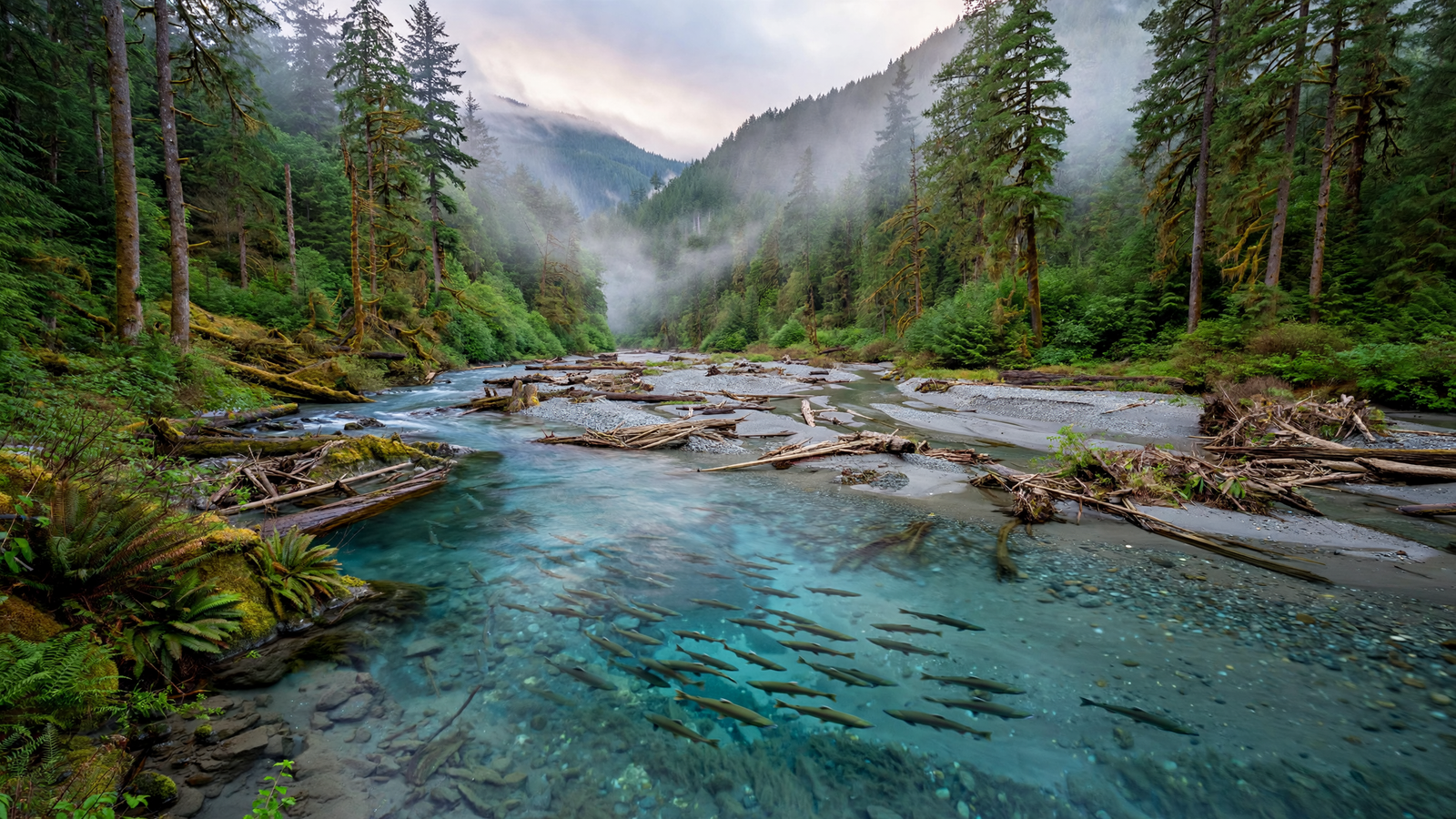
On Washington’s Olympic Peninsula, the Elwha River is offering a hopeful lesson in ecological repair: sometimes a river can begin healing when people stop trying to hold it in place.
For nearly a century, two hydroelectric dams blocked the river’s natural course through what is now Olympic National Park. The Elwha Dam, completed in 1913, and the Glines Canyon Dam, completed in 1927, provided electricity but prevented migrating fish from reaching much of the upper watershed. Neither dam included a fish ladder.
The result was a river divided between its lower reaches and more than 70 miles of upstream habitat. Salmon runs declined, beaches lost the sediment that normally moves downstream, and forests and wildlife above the dams became separated from the river’s natural cycles.
A river given back to itself
Beginning in 2011, crews started taking the dams apart. The work was completed in stages, with the Elwha Dam removed in 2012 and the taller Glines Canyon Dam removed in 2014. It was one of the largest dam-removal projects ever carried out in a national park—and one of the most ambitious attempts in the United States to restore an entire river system.
The project did not simply clear a channel and walk away. Scientists monitored sediment, water quality, vegetation, fish and wildlife as the river adjusted. The newly exposed reservoir areas were replanted with native species, while engineers allowed the river to reshape itself.
That reshaping has been central to the recovery. Dams trap sediment that would otherwise travel toward the coast. Once the barriers were gone, sand and gravel began moving downstream again, rebuilding beaches and creating new habitat along the river and its estuary. The changing river also opened side channels and pools that fish can use during different stages of their lives.
Salmon are finding the way upstream
The clearest sign of change has come from fish. Chinook, coho, chum and pink salmon, along with steelhead, have begun using sections of the watershed that had been inaccessible for generations. Fish have also been observed spawning above the former dam sites.
That does not mean the Elwha’s recovery is finished. Salmon still face challenges from climate change, changing ocean conditions and the long-term effects of habitat loss. But the river once again has the physical connection needed for a stronger population: access to cold upper-water habitat, gravel for spawning and a functioning route between forest and sea.
Researchers have also documented broader changes. Sediment has reached the coastline, native plants have colonized former reservoir sites, and the river is developing a more natural pattern of channels and floodplains. Each process is gradual, but together they show what restoration can look like when the goal is not to recreate one fixed landscape, but to restore the forces that allow a landscape to keep renewing itself.
The optimism in the experiment
The Elwha project is important because it demonstrates that environmental damage does not always have to be permanent. Removing the dams required years of planning, public investment and careful scientific observation. It also required accepting that a healthy river might look less predictable than a reservoir or a concrete channel.
Today, the Elwha is still a work in progress. That is precisely what makes it encouraging. A river that was cut off for a century is once again carrying fish toward mountain habitat, sediment toward the sea and new possibilities through a recovering valley. Its return is a reminder that conservation success can begin with a remarkably simple act: making room for nature to move again.