For generations, the Klamath River carried a contradiction toward the Pacific. It was one of the great salmon rivers of the American West, yet a series of dams blocked fish from reaching much of the upper basin. The river still flowed, but an essential part of its life cycle had been cut apart.
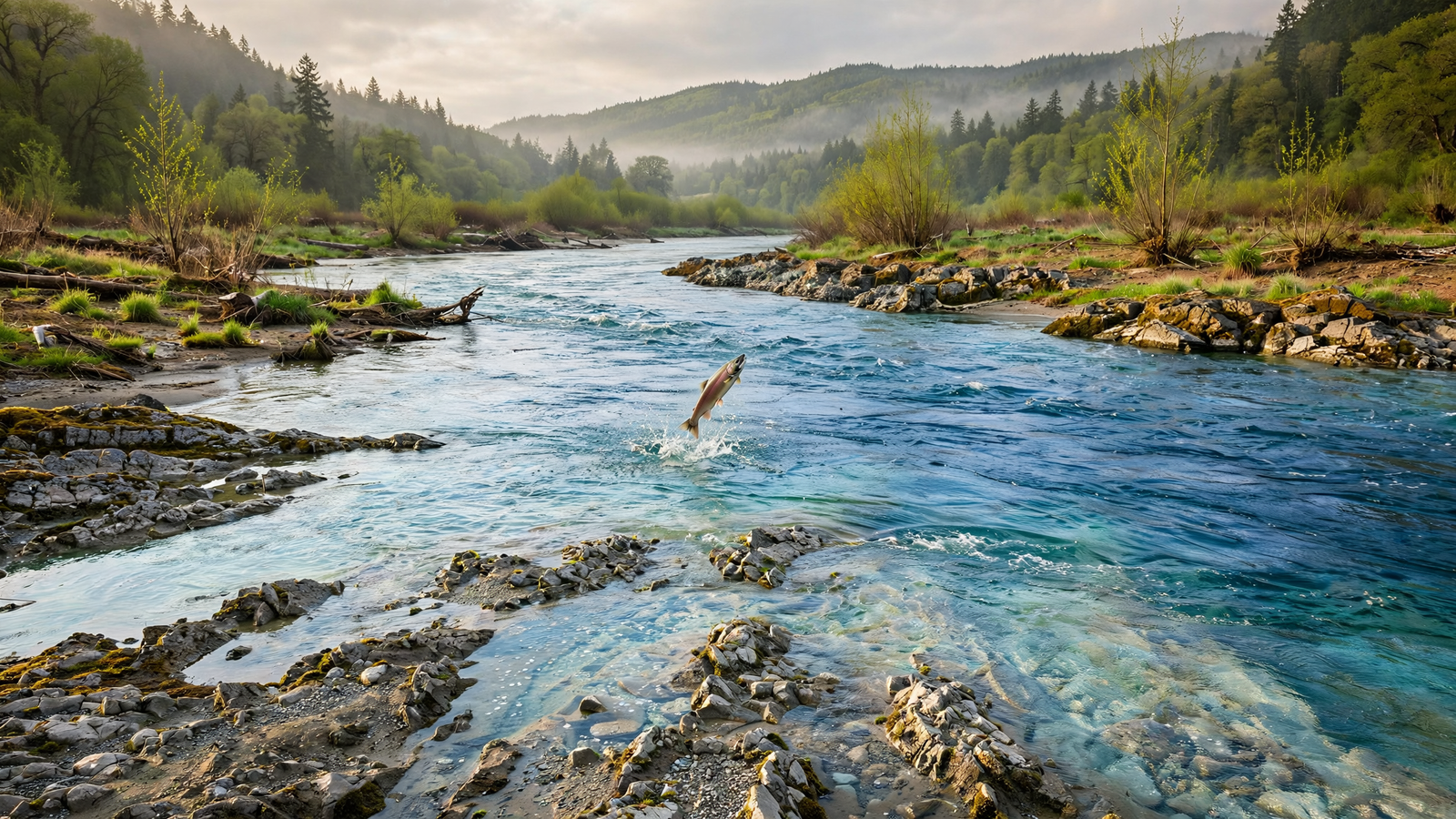
That began to change in 2023, when crews started removing four hydroelectric dams on the river. By late 2024, the structures were gone, the reservoirs behind them had been drained, and the Klamath once again ran through stretches of its historic channel.
The project is widely described by federal and state agencies as the largest dam-removal effort in United States history. Its importance is not measured only in concrete and cubic yards of earth. The removal reconnects hundreds of miles of habitat for salmon and steelhead, restores the movement of sediment and nutrients, and fulfills a goal that tribal nations along the river pursued for decades.
A river divided by dams
The Klamath begins in southern Oregon and travels roughly 250 miles before reaching the Pacific coast in Northern California. Its basin crosses state lines and several distinct ecological regions, from high-elevation lakes and wetlands to dry interior valleys, mountain forests, and coastal waters.
Salmon historically moved through these connected places as part of a remarkable natural circuit. They were born in cold freshwater, migrated downstream to the ocean, spent part of their lives at sea, and then returned to the river to spawn. Their bodies carried marine nutrients back inland, where those nutrients became part of the food web for birds, mammals, forests, and people.
The four dams at the center of the removal project were built between 1903 and 1967. They generated electricity but did not provide fish passage around their reservoirs. As a result, salmon and steelhead were cut off from more than 400 miles of potential spawning and rearing habitat in the upper Klamath Basin. For related reading, see The Elwha River Is Running Free Again—and Life Is Returning With It.
The reservoirs also changed the river’s conditions. Slow-moving, warm water can favor disease and algae in ways that a freely flowing river does not. For salmon, whose survival depends on cold, oxygen-rich water and access to many kinds of habitat, the effects accumulated over time.
Tribal leadership shaped the effort
The Klamath dam-removal story is not simply a tale of engineers undoing an old infrastructure decision. For the Yurok, Karuk, and Klamath peoples, the river is central to culture, foodways, ceremony, and community life. Salmon are not merely a species to be managed; they are part of a relationship that predates the dams by thousands of years.
Tribal citizens and governments were among the most persistent voices calling for the dams to come down. Their advocacy connected ecological restoration with treaty rights, cultural renewal, and the ability of future generations to continue practices tied to the river.
The Yurok Tribe, whose reservation lies along the lower Klamath, has worked for years on salmon restoration, habitat monitoring, and river stewardship. The Karuk Tribe has also documented the consequences of water-quality decline and the loss of access to traditional resources. The Klamath Tribes of Oregon have pressed for the return of fish to the upper basin, where salmon once formed an important part of tribal life.
That leadership matters because restoration is not finished when a dam is removed. It requires continued observation, planting, water-quality work, fish management, and attention to the people who depend on the river. The project’s strongest promise lies in treating the river as a living system rather than as a collection of separate problems.
Four dams, one connected project
The structures removed from the Klamath were the J.C. Boyle Dam in Oregon and Copco 1, Copco 2, and Iron Gate Dam in California. Although each dam had its own reservoir, power equipment, and construction history, their combined effect was to divide a single river into disconnected sections.
Copco 2 was the first of the four to come down. Work then expanded to the larger structures, including Iron Gate, the lowest dam and the final major barrier between the ocean and the upper basin. The reservoirs were drained in stages so crews could safely remove the structures and manage the sediment that had accumulated behind them.
Removing a dam is more complicated than demolishing a wall. Sediment must be monitored as it moves downstream. Roads, power lines, bridges, and nearby communities must be protected. The exposed reservoir footprints need to be stabilized so that bare soil does not simply wash into the river or become dominated by invasive plants. For related reading, see The Wildlife Overpass: How Arizona Is Making I-17 Safer for Animals and Drivers.
Project partners therefore combined demolition with landscape restoration. Native seeds were collected, propagated, and spread across exposed ground. Crews began reshaping shorelines and reestablishing vegetation intended to hold soil, shade streams, and provide cover for wildlife.
What the river can do now
The most visible change is that fish can once again move upstream into areas that had been inaccessible for roughly a century. That does not mean salmon immediately returned in historic numbers, or that every mile is suddenly ideal habitat. It means the biological possibility has been restored.
That distinction is important. Salmon recovery will depend on many factors beyond the dams: ocean conditions, drought, water temperatures, disease, predation, habitat quality, harvest management, and the health of tributaries throughout the basin. A connected river gives salmon a better starting point, but it cannot erase every pressure acting on them.
Researchers and tribal fisheries programs are watching for several signs of progress. They can track whether adult fish reach newly accessible areas, whether they spawn successfully, and whether young fish survive their migration downstream. They can also measure changes in temperature, sediment, insects, vegetation, and other parts of the river ecosystem.
In the first seasons after removal, the river’s appearance was expected to be unsettled. Water could carry large amounts of fine sediment, and exposed reservoir lands would look raw before plants took hold. Such changes can seem like damage when viewed in isolation. In a restoration project, however, disturbance can be part of the transition from an artificial lake back toward a flowing river landscape.
A broader lesson about infrastructure
The Klamath project also demonstrates how the meaning of infrastructure can change. The dams were once seen primarily as permanent machines for producing electricity. Over time, their costs became harder to separate from their benefits. They altered fish habitat, water quality, tribal access, and the character of the river, while producing relatively modest amounts of power compared with modern energy systems. For related reading, see Watson Woods: The Prescott Preserve Where a Desert Creek Still Makes Room for Life.
The decision to remove them followed years of negotiation among tribes, farmers, conservation groups, state and federal agencies, and PacifiCorp, the utility that owned the dams. Not every disagreement disappeared, and the wider Klamath Basin continues to face difficult questions about water allocation and drought. But the dam agreement created a path toward a shared goal that had once seemed politically unreachable.
That may be one of the project’s most useful lessons: large environmental repairs rarely come from a single dramatic decision. They emerge from long campaigns, technical studies, legal agreements, local knowledge, and a willingness to reconsider what an older system was built to do.
The return will take time
A restored river is not a time machine. Removing the dams cannot instantly recreate the forests, gravel bars, wetlands, and side channels that existed before construction. Nor can it guarantee that salmon will recover in a basin affected by warming water, drought, and changing ocean conditions.
But the river now has room to begin. Fish can explore habitat that had been sealed away. Sediment can move downstream instead of collecting behind concrete. Tributaries can reconnect with the main stem. Native plants can take root on the former reservoir floors. Tribal communities can continue restoring a relationship that the dams interrupted but never erased.
The Klamath’s next chapter will be measured in years and generations, not in a single season. Its success will depend on patient monitoring and continued work across the basin. Still, the removal of four dams has accomplished something concrete and rare: it has made a major river more whole.
For a species that lives by returning home, that reconnection is a meaningful beginning.
Use: Background on salmon habitat, endangered species, and restoration needs in the Klamath Basin.
Use: State information on the Klamath River, fishery resources, and dam-removal-related restoration.
Use: Project details on the four-dam removal, reservoir drawdown, site restoration, and habitat reconnection.
Use: Scientific context on Klamath Basin hydrology, water quality, sediment, and ecosystem monitoring.