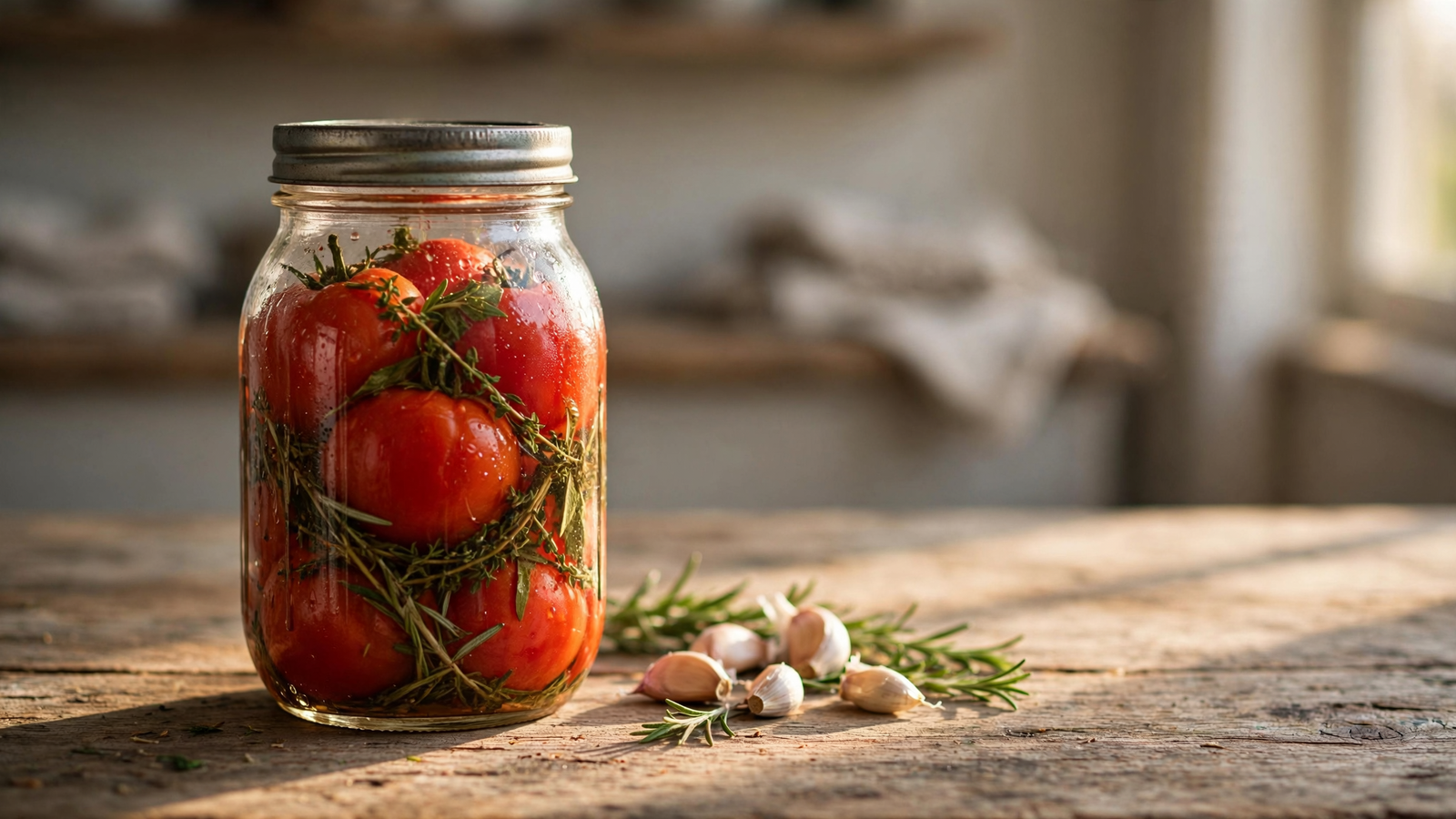
Before the Mason jar became a vase, candleholder, drinking glass, wedding favor, or dependable prop in a country-style photograph, it had a more urgent job. It was meant to hold summer’s harvest until winter.
That purpose sounds ordinary now, but food preservation was once a central household task. Families dried fruit, salted meat, fermented vegetables, stored grains, and sealed whatever the season provided. A successful harvest was only useful if some of it could survive the months when gardens stopped producing. The glass canning jar helped make that work more reliable, more visible, and eventually more democratic.
The jar did not invent home preservation. It did something just as important: it made a difficult household practice easier to repeat.
A better container for a seasonal problem
Glass containers had been used for food for centuries, but early storage vessels were not always easy to seal. The breakthrough associated with American inventor John Landis Mason was a jar with a threaded neck. Mason received a United States patent for his fruit jar in 1858.
The basic idea was straightforward. Instead of closing a jar with a cork or a permanently attached top, the user could screw a cap onto matching threads. That created a more consistent closure and allowed the container to be opened and used again. The jar’s transparency also gave households a useful advantage: people could see what had been preserved and whether something appeared to have spoiled.
Mason did not create the entire canning system by himself, and the name “Mason jar” eventually became broader than the original patent. Other manufacturers produced similar jars, and later designs refined the lid, sealing surface, and manufacturing process. The familiar two-piece lid used in modern home canning—often a flat metal lid paired with a separate screw band—developed through that larger evolution.
The significance was not that one inventor suddenly solved food storage. The significance was that a reusable, standardized container became part of ordinary household equipment.
From experiment to kitchen routine
Home canning expanded in the late nineteenth and early twentieth centuries as glass production improved and instructions became more widely available. Cookbooks, agricultural bulletins, demonstrations, and advice from extension services helped transform preservation from a local custom into a teachable process.
That change mattered. A technique passed from one neighbor to another could remain dependent on memory and local habit. A printed recipe or government bulletin could offer measurements, processing times, and warnings that traveled much farther. It gave families a way to compare methods—and, increasingly, a way to preserve food with greater consistency.
Women’s magazines and household manuals presented canning as both practical labor and evidence of good management. A well-stocked pantry represented foresight. Rows of jars offered a visible record of work already completed: peaches saved at their peak, tomatoes prepared for colder months, beans and pickles arranged for later use.
But the work was not effortless. Traditional home canning could require hours of preparation during the hottest part of the year. Produce had to be washed, peeled, cut, packed, and processed. Jars and lids had to be handled carefully. The kitchen could become a place of steam, heat, and constant attention.
The jar made preservation more manageable, not casual. Its success depended on following a safe method.
The science inside the pantry
Modern guidance from the National Center for Home Food Preservation emphasizes that canning is a science as well as a tradition. Heat treatment is used to destroy microorganisms and create a seal, but the correct method depends on the acidity and density of the food.
High-acid foods such as many fruits and properly acidified pickles can generally be processed in a boiling-water canner. Low-acid foods, including many vegetables, meats, and poultry products, require pressure canning to reach temperatures high enough for safe processing. The distinction is not a matter of personal preference. It is part of the safety system.
That advice also explains why old family recipes sometimes need careful updating. A method that worked in one kitchen may not account for modern jar sizes, food varieties, altitude, or the danger posed by Clostridium botulinum, the bacterium associated with botulism. Contemporary canning instructions are designed around tested combinations of ingredients, temperature, time, and pressure.
In this way, the Mason jar sits at the intersection of memory and measurement. It carries the emotional appeal of a grandmother’s pantry, but safe preservation depends on knowledge that can be checked and improved.
The jar becomes a household language
By the twentieth century, the canning jar had become familiar far beyond the farm. Urban households used it when produce was inexpensive or plentiful. Community gardens, school demonstrations, county fairs, and agricultural extension programs helped keep the practice visible. During periods of economic pressure, preservation offered a way to stretch food budgets and reduce waste.
Home canning also created a particular kind of household accounting. A family could look at its shelves and see not only food, but time: the afternoon spent preparing tomatoes, the neighbor who shared cucumbers, the orchard trip that became jars of peaches. Labels recorded dates and contents. The pantry became a quiet archive of a growing season.
Commercial food production eventually made many preserved foods easier to buy. Supermarkets reduced the need for every household to maintain a large supply of homemade canned goods. Refrigeration and freezing changed the rhythm of food storage as well. Yet the jar did not disappear. It adapted.
Some people continued to use it for serious preservation. Others used it for dry goods, leftovers, lunches, cut flowers, or homemade gifts. The same object could move from a cellar shelf to a craft table without losing its identity. Its shape was practical enough for the pantry and recognizable enough to become decorative.
Why the Mason jar still feels personal
Many household objects become invisible through familiarity. The Mason jar has taken the opposite path. Its plain form has made it unusually easy to recognize and reuse, while its connection to food gives it a strong emotional charge.
It suggests abundance, but not extravagance. It suggests self-reliance, but also exchange: the jar of jam given to a friend, the pickles shared at a neighborhood gathering, the produce preserved because someone had more than they could eat alone. Even when the jar is used as a drinking glass, it carries an echo of the pantry and the garden.
That symbolism can sometimes make the object seem more nostalgic than practical. The reality is more interesting. The Mason jar became an icon because it performed a useful job over and over again. Its cultural afterlife rests on a technological achievement that was modest, durable, and easy for ordinary people to understand.
It also represents a larger American habit: turning household knowledge into a shared system. An invention entered kitchens, manufacturers refined it, public institutions published guidance, and families made the process their own. The result was not a single tradition but a network of habits that could be passed between generations.
A small object with a long shelf life
The Mason jar’s story is not really about nostalgia for an older America. It is about how domestic technology changes the meaning of everyday work.
A jar could not grow a tomato, pick a bean, or prepare a meal. What it offered was time. It allowed food gathered in one season to remain available in another. It gave households a durable container, a visible result, and a method that could be taught.
More than a century after Mason’s patent, the jar remains useful because the original problem has not vanished. People still want to save food, reduce waste, share what they make, and keep a little of one season for the next. The glass is clear, the shape is simple, and the idea is still remarkably strong: preserve what is good now, and make it part of home life later.