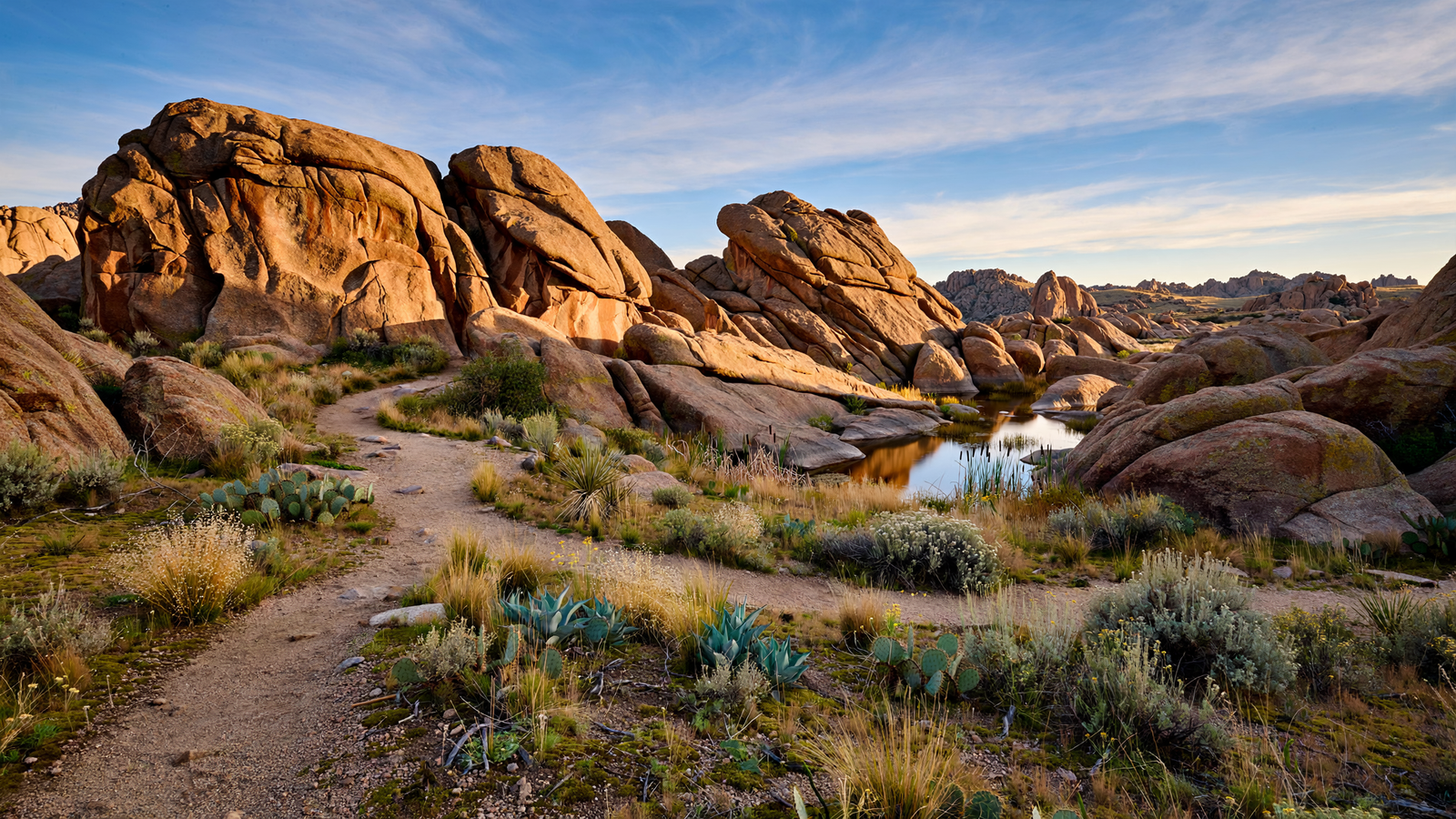
In Prescott, the Granite Dells can look almost too rugged to be a city park. Rounded granite boulders rise above the landscape in weathered stacks, while Watson Lake and Willow Lake gather water among the rocks. Yet this distinctive corner of Yavapai County is increasingly being understood not as scenery beside the city, but as part of the city’s public life.
The Granite Dells Regional Park protects a large, unusual landscape close to Prescott’s neighborhoods. Its value is easy to see in photographs, but the deeper achievement is quieter: land that might otherwise have been fragmented by development remains available for walking, paddling, wildlife watching and geological discovery.
A landscape shaped by time
The Dells’ granite formations were created through a long process of cooling, cracking and erosion. Water and weather rounded the exposed rock into the forms that now define the area. The result is a landscape that feels both monumental and approachable. Visitors do not need to travel deep into a national forest to encounter it; the formations sit within a network of community recreation areas and regional trails.
That closeness gives the Dells an important role in everyday life. It is a place for a short morning walk as well as a longer outing, and it offers residents a natural setting without requiring a distant road trip. The same accessibility, however, makes stewardship essential. Popular trails, sensitive desert vegetation and shoreline habitat all have to share the same limited space.
Conservation becomes public infrastructure
Prescott’s work to protect the Granite Dells reflects a broader idea about what public infrastructure can be. A park is not only a field with amenities. It can also be a long-term decision to preserve geology, views, habitat and opportunities for future residents.
The protected area connects with trails and recreation sites around Watson and Willow lakes, creating a larger outdoor setting rather than a single isolated attraction. That network helps visitors experience the Dells in different ways: from a shoreline, along a rocky path or from the water. It also gives the city room to manage use gradually instead of treating every popular location as a standalone destination.
For Yavapai County, the project is especially meaningful because growth is changing how people experience open land. Prescott and the surrounding communities continue to attract residents and visitors seeking access to the outdoors. Preserving a major landscape near town means that growth does not have to erase every nearby view or replace every informal outdoor tradition.
The next chapter is stewardship
Protection is not the end of the story. The Dells still depends on maintenance, responsible recreation and decisions about where access should be improved—and where the landscape should remain quiet. Trails must be clear without becoming overbuilt. Water access must be enjoyable without damaging shoreline habitat. Visitors must be welcomed without turning the area into something it was never meant to be.
That balance is what makes Granite Dells a useful model for places facing growth. Its future will not be measured only by the number of visitors. It will also be measured by whether the rocks, water, plants and open views remain recognizable for people who have not yet arrived in Prescott.
The Granite Dells offers something increasingly rare: a dramatic natural landscape that is close enough to belong to daily life, yet protected enough to retain its sense of discovery. In Yavapai County, that is more than a scenic amenity. It is a public promise that the landscape will remain part of the community’s future.