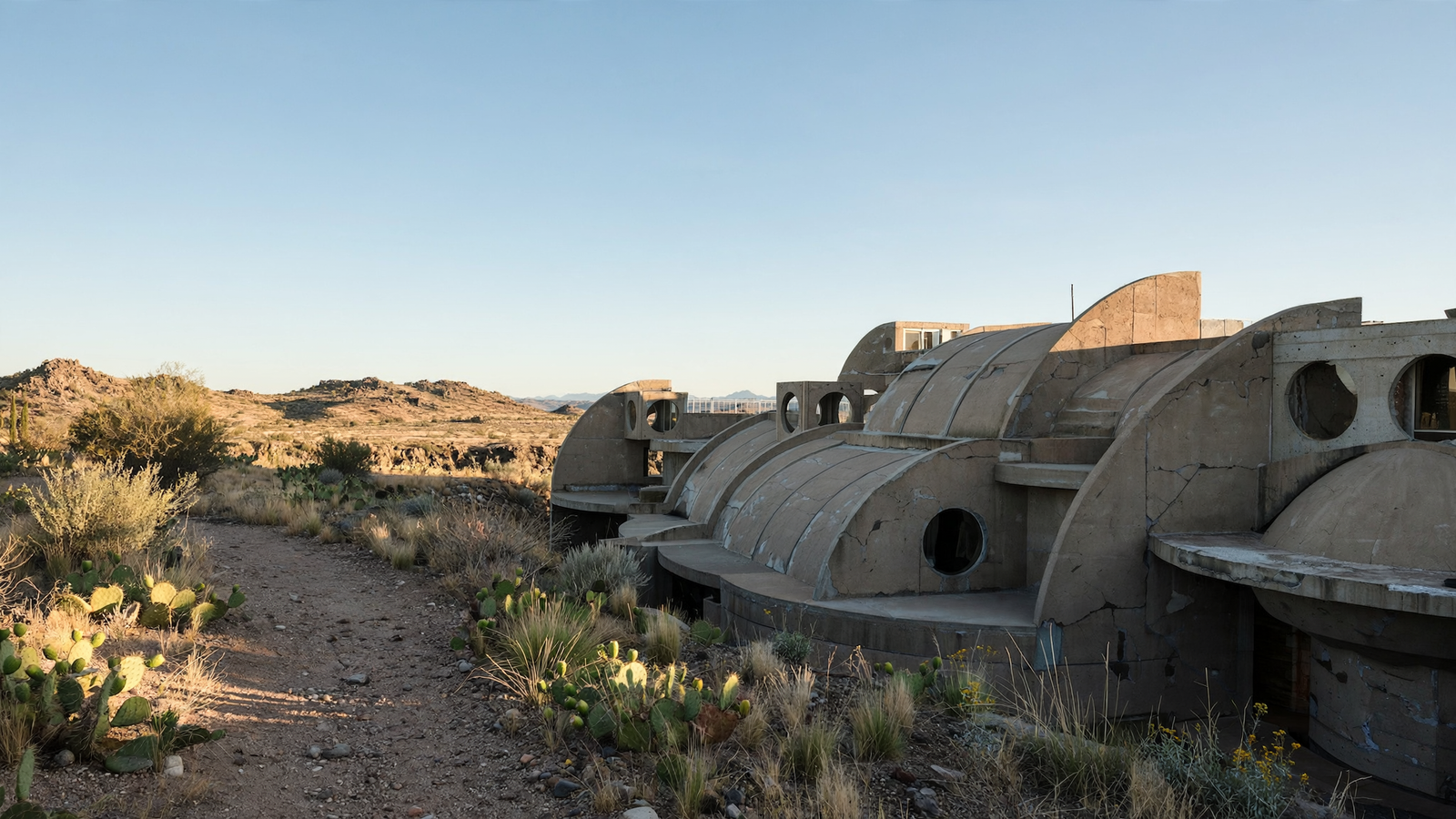
On a high desert mesa in Yavapai County, the buildings do not look like a conventional town. Concrete vaults curve toward the sky. Arched structures frame the distant landscape. Narrow passages open into courtyards, while workshops and gathering spaces sit among the raw shapes of an unfinished settlement.
This is Arcosanti, an experimental community founded by architect Paolo Soleri in 1970. It was never intended to be an ordinary subdivision or a complete city waiting for residents to arrive. Instead, Arcosanti was designed as a working demonstration of an idea Soleri called “arcology”—a combination of architecture and ecology.
More than five decades after construction began, the project remains incomplete. That may sound like a failure if measured against the original vision. But Arcosanti’s continuing value lies partly in its unfinished condition. It gives visitors, students, architects and residents a place where questions about urban life can be tested in physical form.
A city imagined before it was built
Soleri developed his architectural philosophy during a period when American cities were spreading outward through low-density development. Roads, parking lots and separate residential areas were consuming land, while daily life increasingly depended on cars. Soleri believed a different pattern was possible: compact, walkable communities that brought housing, work, culture and public life closer together.
His term “arcology” described more than an unusual building style. It was a proposal for treating a city as an ecological system. A successful urban settlement, in this view, would use land, water, energy and materials more carefully while creating opportunities for social contact. Density was not simply a planning tool; it could also preserve open space and make a city more connected.
Soleri had already begun exploring these ideas at Cosanti, his studio and former home in Scottsdale. Arcosanti gave him a larger landscape in which to develop them. The site sits near Interstate 17, roughly 70 miles north of Phoenix, on land selected for its broad views and rugged desert setting.
The name combines “architecture” and “cosanti,” the name of Soleri’s Scottsdale studio. It also signals the project’s purpose: to examine how buildings and natural systems might coexist rather than treating the environment as an obstacle to construction.
Construction as an experiment
Arcosanti was not built through a conventional real-estate development model. Its construction relied heavily on workshops, apprenticeships, volunteer labor and educational programs. People came to learn by taking part in the physical work, from concrete construction to ceramics, metal casting and landscape projects.
That approach made the building process part of the institution’s mission. Arcosanti was not merely a finished object meant to illustrate Soleri’s theories. It was also a school, studio and laboratory where design ideas could be tested through use.
Several of the site’s best-known structures demonstrate Soleri’s preference for making buildings do more than enclose rooms. The Arcosanti Vaults, with their large curved forms, create shaded gathering areas and accommodate events. The Ceramics Apse and Foundry Apse reflect the project’s long relationship with craft production. Soleri’s bronze bells, made at Arcosanti and sold around the world, became one of the community’s most recognizable artistic products.
The structures were also shaped by the desert climate. Thick concrete walls, shade and carefully placed openings help create different temperatures and patterns of light. The architecture is expressive, but it is not only decorative. Its forms are connected to questions about heat, shelter, airflow, materials and the use of outdoor space.
Why the project remains unfinished
Soleri’s original proposals envisioned a much larger urban complex, potentially accommodating thousands of people in a dense settlement. What exists today is only a portion of that ambition. Arcosanti became a substantial collection of buildings, studios, public spaces and infrastructure, but not the fully realized arcology shown in Soleri’s drawings.
Several explanations belong in that story. The project was highly ambitious, construction was labor-intensive, and its educational model did not resemble the financial structure of a conventional city. Building in a remote desert location also required constant attention to roads, utilities, water and maintenance. As with many experimental projects, the distance between a compelling vision and the resources needed to realize it proved significant.
Yet calling Arcosanti simply incomplete misses what makes it unusual. The site was conceived as an ongoing experiment rather than a product with a fixed delivery date. Its unfinished edges make the process visible. Visitors can see where the built environment is deliberate, where it is improvised and where the original plan remains larger than the physical community.
A place where architecture becomes public life
Arcosanti’s importance is not limited to its buildings. The project has hosted tours, lectures, workshops, performances and educational programs that invite people to think about cities as shared environments. The site’s plazas and vaulted spaces are designed for gathering, allowing architecture to function as a setting for public life rather than as a collection of private interiors.
This matters because Soleri’s ideas were ultimately social. Compact cities were supposed to make more room for conversation, culture and cooperation. A city could be efficient without becoming merely mechanical; density could support community rather than only congestion.
The experiment has never provided a universal answer. Arcosanti does not demonstrate that one architectural model can solve every urban problem. Its location, scale and unusual history make it difficult to compare directly with a conventional municipality. But it does provide a rare physical setting for considering questions that remain urgent: How much land should a city consume? How can buildings respond to heat? What should public space do? Can construction teach as well as produce?
The desert as part of the design
The landscape around Arcosanti is not a blank backdrop. It is part of the experience and part of the argument. The site’s elevated position exposes the project to dramatic light, strong seasonal changes and wide views across the high desert. The buildings appear embedded in the terrain, even when their concrete forms are deliberately monumental.
That relationship with the surrounding land also reveals one of the project’s tensions. Arcosanti seeks to concentrate human activity, but it exists in a remote place that requires people to travel there. The community’s environmental ideas therefore unfold within the practical realities of the automobile-dependent American West.
Rather than hiding that contradiction, the site makes it visible. Arcosanti is a place where ideals meet logistics. It asks visitors to imagine compact urban life while standing in a sparsely developed landscape. That contrast is not a flaw in the story; it is one of the reasons the place remains intellectually useful.
Paolo Soleri’s legacy in Yavapai County
Soleri died in 2013, but the project continued through the Cosanti Foundation, the organization responsible for carrying forward his work at Arcosanti and Cosanti. The foundation’s role has included maintaining the site, supporting educational activity and preserving the ideas and creative work associated with Soleri.
His influence extends beyond Arizona. Architects and planners have continued to debate the relationship between density, sustainability and quality of life. Some of Soleri’s predictions about resource use and urban growth now sound familiar, while other parts of his vision remain difficult to translate into everyday planning.
That mixture of influence and uncertainty is appropriate for Arcosanti. It was never intended to be a finished answer. It is a built question, large enough to walk through and old enough to have accumulated its own history.
Why Arcosanti still matters
Yavapai County is often associated with historic forts, mining towns, red-rock landscapes and ancient settlements. Arcosanti belongs to a different layer of the region’s story: the history of ideas that people tried to build.
Its concrete vaults and open courtyards preserve a moment when architects were searching for alternatives to suburban expansion. But the project has outlasted that moment because its central questions have not disappeared. Cities still face pressure to use less land, consume fewer resources and create more meaningful public spaces.
Arcosanti offers no simple blueprint. Instead, it shows what happens when an architect treats a community as a long-term experiment and accepts that the work may remain unfinished. In the high desert north of Phoenix, the unfinished city continues to function as a place for making, learning and reconsidering what a city can be.