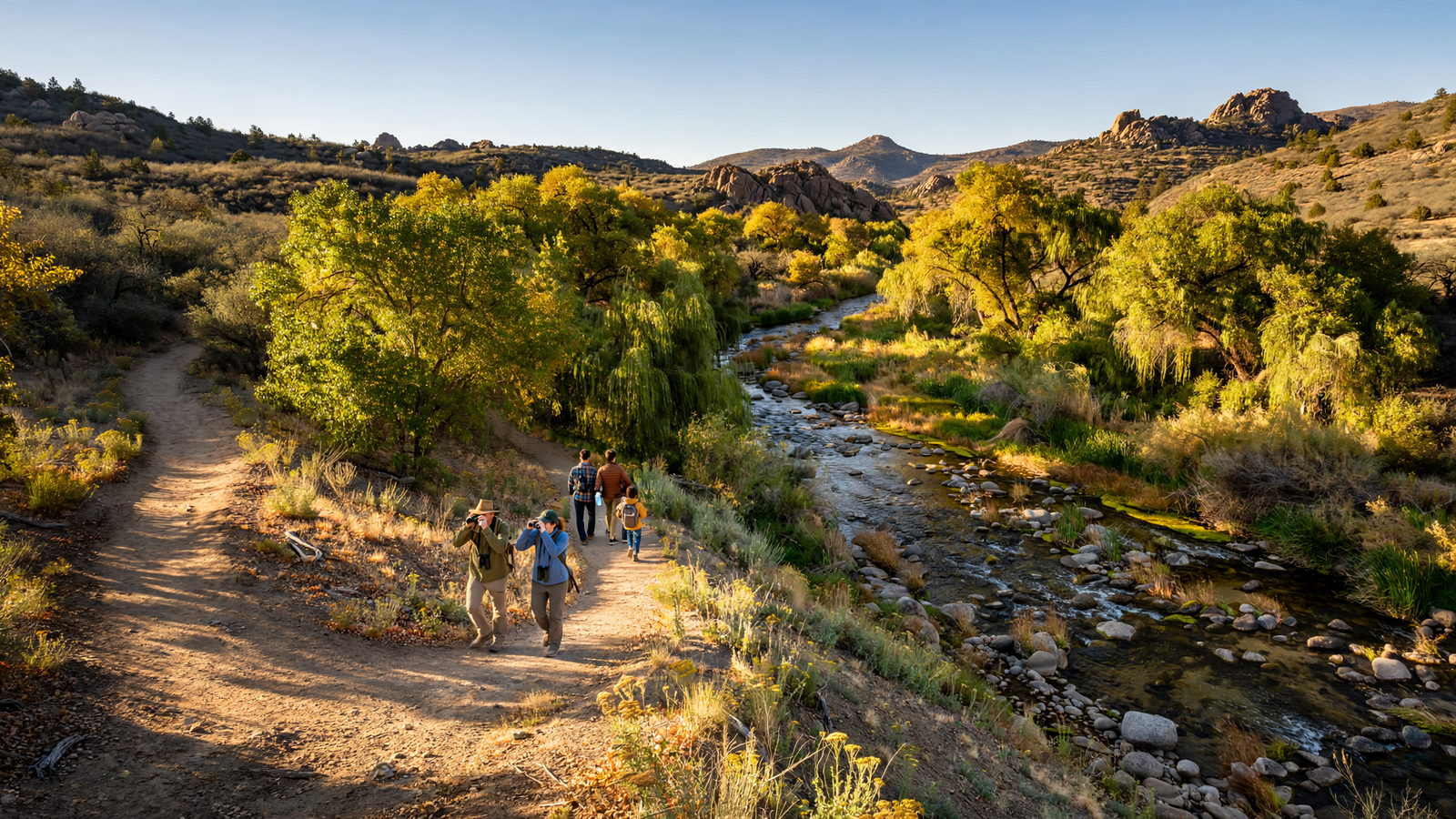
In Prescott, the landscape can change quickly. Dry hills rise beyond town, granite appears beneath the pines, and summer storms can send water rushing through normally quiet channels. Along one of those channels, however, the city has made room for a slower kind of landscape: a green corridor of cottonwoods, willows, ponds and shaded paths.
Watson Woods Riparian Reserve follows Granite Creek near the southern edge of Prescott. It is not a wilderness far from town. Roads, neighborhoods and working landscapes surround it. Yet within the reserve, water and vegetation create a distinct world—one where birds gather, insects pollinate flowering plants, and visitors can experience a creekside ecosystem without leaving the city.
The reserve is one of Yavapai County’s clearest examples of what a community can accomplish by treating a waterway as more than a drainage channel. Watson Woods protects habitat, offers public trails and serves as an outdoor classroom. Its story is not about a single dramatic transformation. It is about the patient work of preserving a place that might otherwise have been fragmented or overlooked.
A creek corridor in a high-desert city
Riparian areas are narrow bands of land shaped by water. In Arizona, they are disproportionately important because trees and dense vegetation can survive along streams even when the surrounding terrain is dry. These corridors provide shade, shelter, food and nesting areas for wildlife. They also help slow runoff, stabilize streambanks and connect separate patches of habitat.
Granite Creek is one of Prescott’s defining waterways. It drains part of the Prescott area before continuing toward the broader Verde River system. Like many urban and semi-urban streams in the Southwest, it has experienced pressure from development, roads, altered drainage and the legacy of past land uses.
Watson Woods occupies roughly 160 acres of this creekside environment, according to the Prescott Creeks Preservation Association, the nonprofit organization that manages the reserve. The preserve includes wetlands, open water, riparian woodland and upland edges. Those varied conditions are important: wildlife does not use a stream corridor for just one purpose. Birds may feed in shallow water, nest in mature trees and cross open ground between patches of cover.
For people, the variety makes the reserve feel larger than its footprint. A short walk can pass from open meadow to shaded woodland and then toward water where reeds and other wetland plants soften the edges of the creek.
Restoration as a long-term civic project
Watson Woods was not simply left untouched. Its current character reflects years of conservation, land protection, restoration and maintenance. The reserve grew out of efforts to protect the Granite Creek watershed and preserve land that could continue to function as habitat in the middle of a growing community.
That work is easy to underestimate because successful restoration often looks natural when it is finished. A healthy riparian corridor may appear to be something that happened on its own. In reality, maintaining it can involve removing invasive plants, managing trails, monitoring water and vegetation, repairing damage after storms and balancing public access with wildlife needs.
The goal is not to freeze the creek in place. Desert waterways are dynamic. Floods reshape channels, fallen trees become habitat, and seasonal changes alter how much water is visible. Conservation in a place like Watson Woods means allowing those natural processes to continue while reducing the pressures that can overwhelm them.
The Prescott Creeks Preservation Association describes the reserve as a place for watershed education as well as habitat protection. That combination matters. A protected place can be valuable for wildlife, but a protected place that residents know, visit and understand has a broader civic life. People who walk beside a creek are more likely to notice when it is healthy, when it is stressed and why its protection matters.
A small reserve with a large bird list
Birds are among the most visible signs of a functioning riparian landscape. The preserve’s trees offer perches and nesting sites, while ponds, muddy edges and dense vegetation provide places to forage. Prescott Creeks materials report that more than 200 bird species have been observed at Watson Woods over time.
That figure does not mean every species is present every day. Some birds are residents; others pass through during migration or appear seasonally. But the range reflects the value of a green corridor in an otherwise dry region. A preserved creek can serve as a local home, a stopover and a link between larger habitats.
Visitors may come looking for birds and find themselves paying attention to other forms of life as well. Dragonflies patrol the water. Native plants flower along the edges. Small mammals move through cover. Insects and seeds support the food web that makes the visible wildlife possible.
The reserve also illustrates why habitat is more than a collection of individual species. A cottonwood grove, a shallow wet area and a brushy bank work together. Remove one part and the entire system becomes less useful. Protect the pieces together, and an urban creek can support a surprising amount of life.
Public access without turning nature into a backdrop
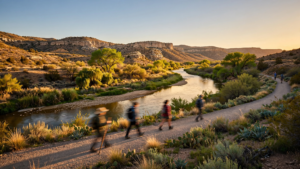
Watson Woods is designed for people as well as wildlife. Trails allow visitors to move through the reserve on foot, with routes that bring them close to the creek and wetlands without requiring a long backcountry trip. The city and the preserve’s managers provide information intended to help visitors understand the area and use it responsibly.
That accessibility is part of the reserve’s importance. Many people cannot regularly travel to a national forest or remote wildlife area. A place within city limits can introduce children to water ecology, give birders a dependable local destination and offer residents a quiet walk close to home.
At the same time, a public preserve must resist the temptation to make every part of nature convenient. Riparian habitat needs undisturbed areas. Birds need quiet nesting sites. Wet ground can be fragile, and seasonal flooding can make conditions change. Staying on established paths, keeping dogs controlled where required and leaving plants, rocks and wildlife in place are small actions that help preserve the experience for everyone.
The reserve’s design reflects a useful middle ground: people are invited into the landscape, but they are not meant to dominate it. The creek remains the central character.
Why places like Watson Woods matter
Urban conservation is sometimes described as a compromise—less protection than a remote wildland, but better than development. Watson Woods suggests a more generous idea. A city creek can be both protected habitat and public infrastructure. It can store ecological value, support outdoor learning and give residents a daily relationship with the natural systems around them.
Riparian preserves also make environmental change visible. Drought, wildfire, extreme heat and intense storms are not abstract issues when a community has a living creek corridor nearby. Visitors can see how water determines where trees grow, how shade changes the ground beneath it and how quickly a landscape responds when water is scarce or abundant.
These lessons are especially meaningful in Yavapai County, where communities are connected by rivers, creeks and washes but separated by dry terrain. Protecting each remaining wetland or streamside woodland helps preserve the larger ecological network. Even a relatively compact preserve can function as a link for wildlife and as a place where people learn to recognize the county’s water-dependent landscapes.
Watson Woods also demonstrates that conservation does not have to begin with an untouched landscape. Places shaped by roads, neighborhoods and earlier land uses can still be repaired. The work may take years, and the result may never look exactly like a historic ecosystem. But restoration can recover function: cleaner water, more stable banks, more habitat and a stronger connection between people and place.
A place that keeps teaching
The most lasting achievement of Watson Woods may be the way it changes the scale at which residents see Prescott. The city is not only streets, buildings and distant mountains. It is also a watershed, and the watershed is alive.
Along the trails, that idea becomes tangible. Water gathers in low places. Cottonwoods cast shade. Birds move through the canopy. A child can look into a pond and begin asking where the water came from and where it will go next. An experienced birder can return in a different season and find a different community of species. A neighbor can simply walk for a while and notice that the city has made space for something other than itself.
That is what makes Watson Woods a notable place in Yavapai County. It is not only a preserve on a map. It is a working example of conservation woven into everyday life—proof that a creek can be protected, restored and shared without losing its wild character.