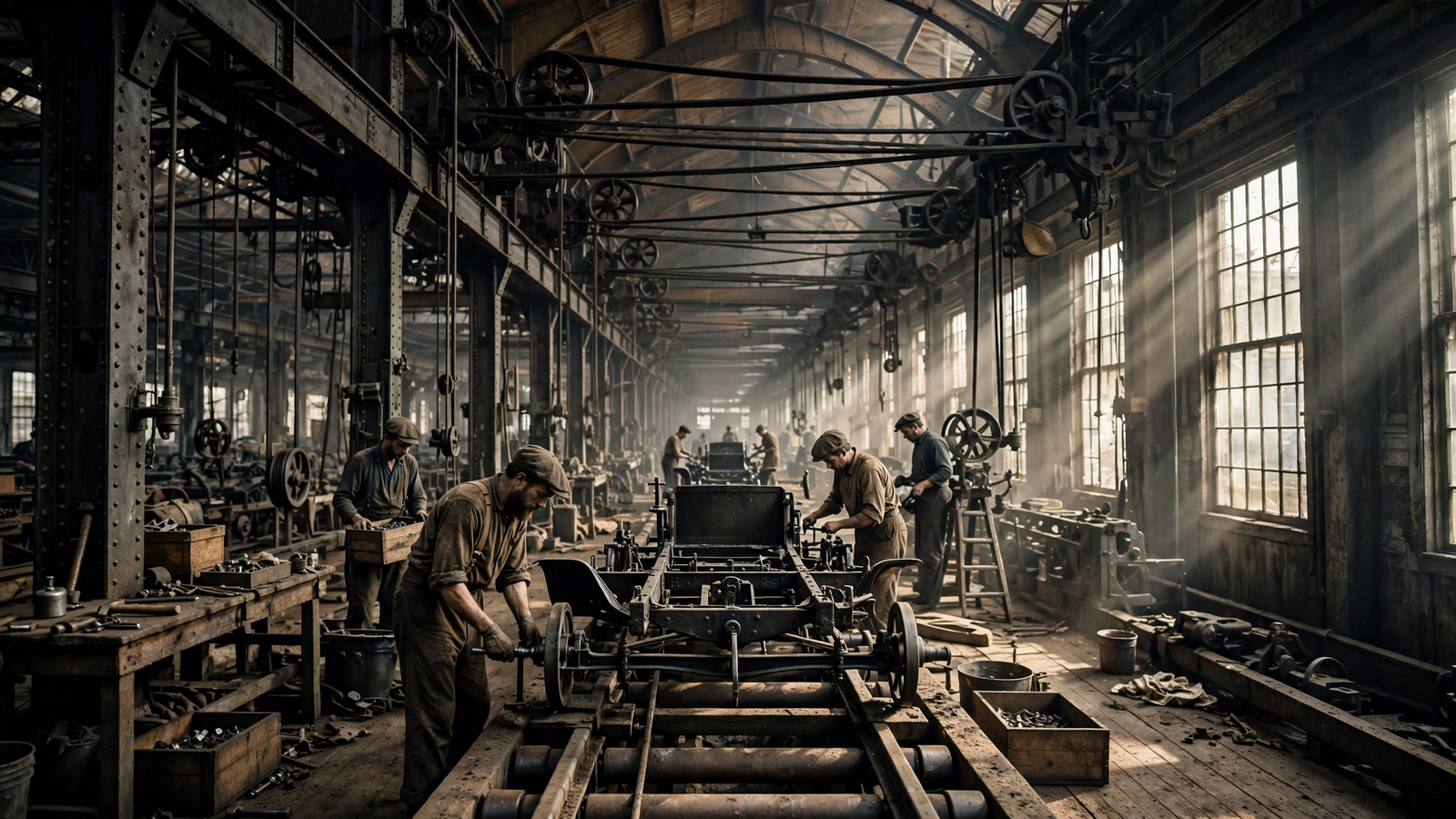
Before the automobile became an American habit, it was largely an American aspiration. Cars were expensive, mechanically temperamental machines assembled in small numbers by skilled workers. They belonged to wealthy enthusiasts, businesses, and people willing to tolerate the cost and uncertainty of early motoring.
That began to change in a brick factory north of Detroit.
At Ford Motor Company’s Highland Park plant, the moving assembly line reorganized automobile production around a simple but powerful idea: instead of having workers move around a stationary car, let the car come to them. The change did not invent mass production by itself, and Henry Ford was not the first manufacturer to use every part of the method. But Ford combined a moving line, interchangeable parts, specialized tasks, and a car designed for standardized production in a way that reshaped American life.
The result was more than a cheaper automobile. It was a new relationship between people, machines, distance, and time.
A car designed for repetition
Ford’s Model T, introduced in 1908, was not the first automobile, the fastest automobile, or the most luxurious. Its importance came from how thoroughly it was designed for practical use and repeatable manufacture.
The car used a relatively simple design, sturdy construction, and standardized components. Ford gradually reduced the number of variations available to buyers, concentrating production on the familiar black Model T. That limitation made the factory’s work more predictable. Workers could perform the same operation again and again while parts moved through an increasingly organized system.
Ford’s Highland Park complex, designed by architect Albert Kahn, became the setting for the company’s most influential production experiments. The factory included large, open industrial spaces that allowed materials and partially completed vehicles to move through the building in a planned sequence.
Industrial efficiency was the goal, but the effect reached well beyond the factory walls. Each improvement in production had the potential to lower the price of the finished car. Each lower price widened the circle of people who could imagine owning one.
When the line began to move
Ford had already been experimenting with progressive assembly, in which a vehicle was built through a sequence of specialized steps. The decisive breakthrough came in 1913, when the company introduced a continuously moving assembly line for Model T production at Highland Park.
The idea was visually simple. A conveyor carried the automobile chassis past workers positioned along the line. Each worker performed a limited task before the vehicle moved onward. The same logic was applied to other sections of production, including the assembly of components and the movement of materials.
According to The Henry Ford museum, the Highland Park system dramatically reduced the time required to assemble a Model T. What had once taken more than 12 hours could eventually be completed in roughly 93 minutes. The gain came not from one miraculous machine, but from coordinating hundreds of small actions into a continuous flow.
This was an important distinction. The assembly line was not simply a conveyor belt. It was a complete production system. Factory layout, parts supply, worker assignments, timing, and product design all had to work together. If one stage slowed down, the effects could travel through the entire line.
Ford’s achievement was therefore both mechanical and organizational. He made the automobile factory behave less like a workshop and more like a carefully timed network.
The price of becoming mobile
The Model T’s falling price helped turn mass production into a social force. The car sold for $825 when it was introduced in 1908. By the mid-1920s, the price of a basic Model T had fallen to around $260, according to Ford’s historical materials.
Lower prices did not make automobile ownership effortless. Families still needed money for fuel, maintenance, insurance, and repairs. Roads were often poor, especially outside established towns. Many rural drivers became skilled at improvising, adapting their cars for farm work, deliveries, and travel over rough ground.
But the economic threshold had changed. The automobile was no longer only a rich person’s carriage without horses. It became a tool that could connect a farm to a market, a worker to a job, a family to a distant town, or a physician to patients scattered across the countryside.
The Model T also gave Americans a new degree of personal mobility. Railroads remained essential for long-distance travel, but trains followed fixed routes and schedules. A car could leave the station behind. It could turn onto a dirt road, stop at a farmhouse, carry tools, or take a family somewhere the railroad never reached.
A new map of everyday America
Mass automobile ownership changed the shape of communities. Businesses appeared to serve motorists: filling stations, repair shops, roadside restaurants, tourist cabins, and dealerships. Towns competed for paved roads and bridges. Rural mail delivery expanded through the use of motor vehicles, making regular service possible across wider territories.
The car also changed the meaning of distance. A destination that had once required a full day by wagon might become an afternoon trip. Vacations became less dependent on rail timetables. Young people found new forms of independence, while families gained access to parks, lakes, stores, schools, and workplaces beyond walking distance.
Not every consequence was equal or automatically beneficial. Roads and public space were increasingly redesigned around motor vehicles, sometimes at the expense of pedestrians, streetcars, and older neighborhood patterns. Traffic injuries became a serious public concern. The same machine that opened access also demanded new rules, infrastructure, and responsibilities.
Still, the automobile’s cultural position was secured by the production system Ford helped popularize. The car was no longer merely a product. It became part of the American household economy and imagination.
The workers inside the system
The moving line changed work as profoundly as it changed products. Specialized tasks could be learned more quickly than the broad range of skills required in a traditional workshop, but the work could also become repetitive and tightly timed.
Ford’s famous decision in 1914 to raise the basic daily wage to five dollars is often remembered as a landmark of industrial compensation. The policy helped the company recruit and retain workers during a period when assembly-line jobs could be demanding and employee turnover was high. It also supported the idea that industrial workers might become consumers of the products they built.
The policy came with conditions and did not create an equal workplace for everyone. Ford’s labor practices included extensive supervision of workers’ private lives, and the company resisted independent unionization for years. The production system’s legacy therefore includes both increased access to consumer goods and difficult questions about control, dignity, pace, and power at work.
Those tensions are part of the assembly line’s real history. Industrial progress was not a smooth story in which technology simply made life better. It was a negotiation between efficiency and human limits, repeated across factories and generations.
Why the line still matters
The Highland Park assembly line helped establish a pattern that spread throughout American manufacturing. Other automakers adopted and refined mass-production techniques. The approach influenced appliances, aircraft, electronics, food processing, and countless other industries.
It also shaped the expectations people brought to modern life. Products could be standardized, repaired with interchangeable parts, and produced at a scale that made them available to millions. Manufacturing became a system of flows: raw materials entering, components being transformed, and finished goods leaving on a schedule.
Today’s factories may look very different. Robots perform tasks that once required teams of workers. Computer systems track parts and adjust production. Electric vehicles bring new battery and software challenges. Yet the underlying question remains familiar: how can a complex product be built reliably, repeatedly, and affordably?
Ford’s answer was to organize the factory around movement. The chassis moved. The parts moved. The work moved from one specialized station to the next. And, eventually, the automobile moved millions of Americans into a new era of daily life.
The most lasting monument to the Model T may not be any individual car. It is the expectation that mobility can be made ordinary—that a machine once reserved for the few can become part of the landscape of nearly everyone.