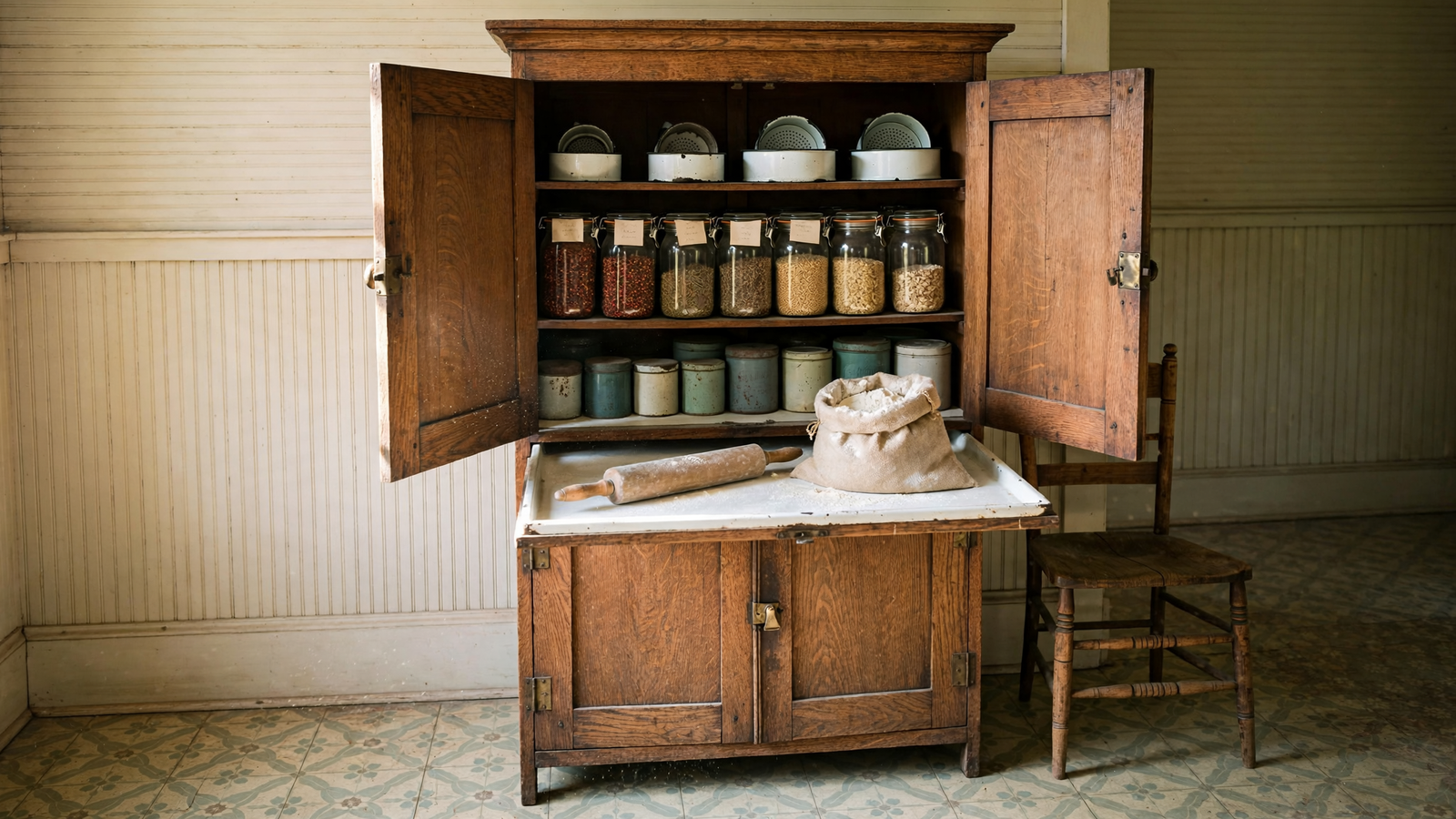
Before the modern fitted kitchen, before countertops ran continuously from one wall to another, many cooks worked with furniture that had to do several jobs at once. A table served as a work surface. A cupboard stored dishes. A pantry held flour and sugar. Small tools were scattered wherever space allowed.
Then, around the turn of the twentieth century, a new kind of cabinet began bringing those tasks together. It stood like a compact cupboard, but opened into a working station. Its upper section held shelves and small containers. Its lower section stored larger supplies and equipment. Between them was a counter where ingredients could be measured, mixed, and prepared.
It became known as the Hoosier cabinet, named after the Indiana company that helped make the form famous. The cabinet did not create the American kitchen by itself, and it was never found in every home. But it offered something increasingly valuable to households with limited space: a way to organize kitchen work without building a permanent fitted room.
A kitchen assembled from separate pieces
In the nineteenth century, American kitchens were often functional but not standardized. Some were located in basements or separate service wings. Others occupied small rooms where the cook had to move between a stove, a table, storage cupboards, and a pantry. Kitchen furniture was commonly purchased as separate pieces, and the arrangement depended on the size and shape of the room.
That arrangement created a practical problem. Cooking required the repeated handling of the same ingredients and tools, but those objects did not necessarily live near one another. Flour might be stored in a sack, spices in a drawer, and utensils on a wall rack. A cook could spend as much time walking and searching as preparing food.
The Hoosier cabinet approached the problem as one of organization. Instead of treating storage, preparation, and measurement as unrelated activities, its designers placed them together. The cabinet’s work surface could be pulled forward or extended. Its shelves could hold commonly used supplies. Some models included flour bins, sugar containers, spice racks, glass doors, sifters, recipe-card holders, and specialized drawers.
These features varied from model to model. That variation matters: the Hoosier cabinet was not one single design, but a family of kitchen workstations made by several manufacturers. What united them was the idea that a cabinet could be planned around the movements of the person using it.
Why Indiana became associated with the cabinet
The Hoosier Manufacturing Company of New Castle, Indiana, was among the businesses that turned this furniture form into a recognizable product. The company began making cabinets in the late 1890s, when industrial production, mail-order selling, and national advertising were making household goods available to a much wider market.
New Castle was well placed for manufacturing. Indiana had access to rail connections, timber, metalworking, and a growing network of factories that could produce standardized household goods. A cabinet assembled in one Midwestern town could be advertised and shipped far beyond its immediate region.
The name “Hoosier” connected the product to its place of manufacture, but the cabinet’s appeal was national. It fit the needs of households that wanted more order without the expense of a fully remodeled kitchen. It could be delivered as a finished piece or in sections, placed against a wall, and used immediately.
Other companies produced similar cabinets, including manufacturers in Indiana, Ohio, and elsewhere. Some adopted different brand names and added their own arrangements of drawers, bins, and work surfaces. The commercial success of the form encouraged manufacturers to compete over convenience: more storage, easier cleaning, stronger hardware, and better ways to keep ingredients within reach.
The cabinet as an early efficiency system
The Hoosier cabinet is sometimes remembered mainly as an attractive antique, with painted surfaces, patterned doors, and rows of small drawers. Its deeper importance lies in the way it treated kitchen work as a sequence that could be studied and improved.
Ingredients were placed near the work surface. Frequently used tools could be stored at arm’s length. Bins reduced the need to handle large sacks of flour or sugar. A built-in sifter could save a separate step. A recipe holder kept instructions visible instead of forcing the cook to balance a book on the table.
That approach reflected a larger shift in American household culture. During the early twentieth century, advertisers, home economists, and domestic reformers increasingly presented the kitchen as a place where careful planning could reduce wasted effort. They promoted standardized measurements, scientific management, sanitation, and labor-saving devices.
The language of efficiency could be limiting. It often placed the responsibility for household order almost entirely on women, even as industrial manufacturers sold new products as solutions to domestic labor. The cabinet did not eliminate cooking, cleaning, or the unequal distribution of household work. It made some tasks more organized and sometimes less physically demanding, but it remained part of a culture that expected women to manage the home.
Seen in that context, the Hoosier cabinet was both useful furniture and a product of its era. It embodied the promise that domestic work could be improved through design, while also revealing how much work households expected one person to coordinate.
Advertising the organized home
Manufacturers did not sell the cabinet merely as a box for storing dishes. They presented it as a calmer, cleaner, more capable way to run a kitchen. Advertisements emphasized convenience and order, often showing a bright domestic interior in which the cabinet appeared to bring control to a busy room.
The cabinet’s design also helped manufacturers sell a modern idea of the household. The home did not need to be large to be efficient. A compact kitchen could still contain specialized storage. A family could purchase a single piece of furniture instead of hiring builders to create permanent cupboards.
Some cabinets were sold through dealers, while others were promoted through catalogs and direct advertising. The same national retail culture that distributed sewing machines, stoves, and other household equipment also helped spread the kitchen cabinet. Customers could compare models, finishes, and features without relying entirely on a local cabinetmaker.
For many families, however, the purchase was still significant. The best-equipped cabinets could be expensive, and not every household had the room or money for one. A cabinet might also be passed from one home to another, modified, repainted, or used in a different room after a kitchen renovation.
From movable workstation to fitted kitchen
The Hoosier cabinet belonged to a transitional period. It arrived when kitchens were becoming more central to household planning, but before built-in cabinets and continuous counters became the standard arrangement in many American homes.
As electricity, plumbing, refrigeration, and modern building practices spread, kitchens changed around the cabinet. New homes increasingly included permanent storage and designated places for appliances. Countertops extended across walls. Cabinets could be designed as part of the room rather than purchased as individual pieces.
That shift made the freestanding Hoosier cabinet less essential. A built-in kitchen could offer more storage and a more efficient work triangle between stove, sink, and refrigerator. By the middle of the twentieth century, the cabinet was no longer the default answer to kitchen organization that it had once been.
Yet its basic idea survived. Modern kitchens still place ingredients, tools, preparation surfaces, and appliances according to how people move through a meal. Pull-out shelves, pantry drawers, spice racks, countertop appliances, and recipe displays all continue the cabinet’s central argument: a kitchen works better when the things used together are kept together.
A piece of furniture that still explains home life
Today, surviving Hoosier cabinets appear in museums, antique shops, private kitchens, and restored historic homes. Some are valued for their craftsmanship. Others are used again as practical storage, especially in houses where built-in cabinets are limited.
Their appeal is partly visual, but it is also emotional. A Hoosier cabinet makes domestic work visible. Its drawers and bins suggest the daily rhythm of measuring, mixing, baking, preserving, and cleaning. Unlike a modern wall of cabinets, it presents the kitchen as a distinct workstation with a clear beginning and end.
It also tells a larger American story about improvement through ordinary objects. The cabinet did not depend on a dramatic invention. It did not transform cooking by replacing the cook. Instead, it rearranged familiar activities so that a household could complete them with fewer steps and less searching.
That modest achievement is why the Hoosier cabinet remains more than an antique. It was an early attempt to design the home around the work that happened inside it. Long before the fitted kitchen became standard, it offered a portable version of the organized kitchen—and helped Americans imagine domestic efficiency as something that could be built into furniture.