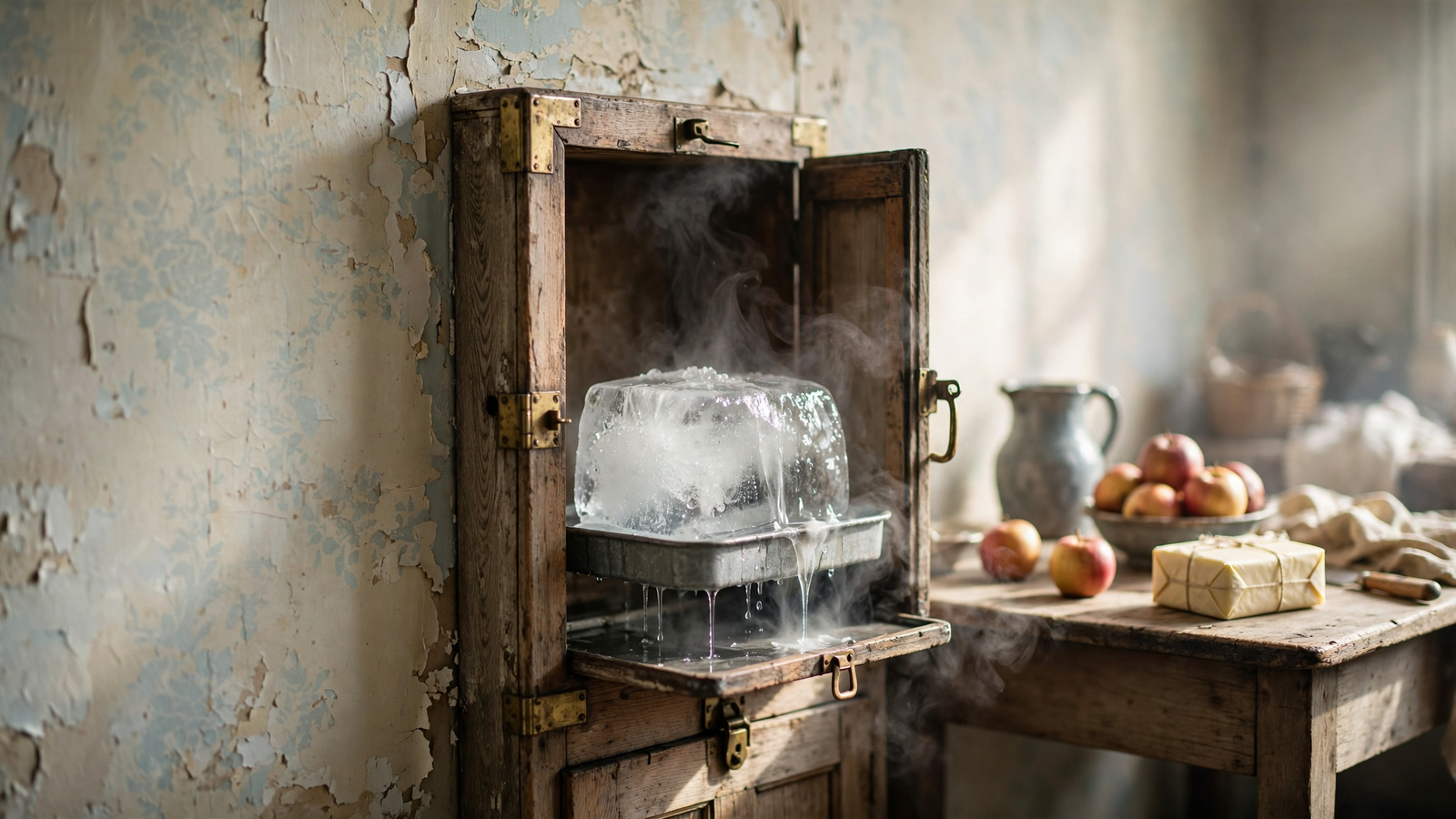
Before a refrigerator became a familiar kitchen appliance, keeping food cool was a household routine built around a block of ice. The icebox—a cabinet insulated to slow melting—made it possible to store perishables at home without electricity. But it also brought a new set of chores, deliveries and small calculations into everyday life.
In many American homes, ice arrived by wagon or truck. The iceman carried a heavy block from the vehicle to the kitchen, sometimes using tongs and a shoulder pad. Families could indicate how much ice they wanted with a sign in a window or door, though local customs varied. The delivery was a practical service, but also a regular interruption of domestic life: someone had to be home, clear a path and make sure the ice went into the right compartment.
Inside the cabinet, the block sat above or beside the food compartment. As it melted, cool air circulated through the insulated interior; a pan or drain collected the water. Details differed from one design to another, but the principle was simple: use ice to draw heat away from food and an insulated case to slow the process. The cabinet’s placement mattered, too. It needed to be convenient for cooking, yet its warmth and meltwater had to be managed.
A household system, not just a box
The icebox changed how a kitchen could be organized. Leftovers and ingredients could stay cool between meals, and households had more flexibility than they would with no cold storage. Still, an icebox was not a modern refrigerator in disguise. Its temperature was less controlled, storage space was limited, and keeping it useful depended on regular replenishment and attention to drainage and cleanliness.
That made cold storage part of a household’s schedule. The amount of ice to order could depend on the weather, the size of the family and how much food needed preserving. A larger block might last longer, but it took space and cost more. If the ice melted faster than expected, the family had to adjust. Food storage was not a set-and-forget task; it was one more piece of the daily work of running a home.
Iceboxes also connected kitchens to a much larger supply chain. Natural ice could be cut in winter from frozen water, stored in insulated icehouses and moved to customers when needed. In places where natural ice was unavailable or unreliable, manufactured ice and other supply arrangements could fill the gap. What looked like a plain wooden cabinet in a kitchen depended on labor and infrastructure well beyond the house.
From delivered ice to household electricity
Mechanical refrigerators eventually offered a different arrangement: cooling produced by a machine rather than replenished by a delivery. Their arrival did not erase the icebox overnight. Cost, access to electricity and household circumstances shaped how quickly families made the change. For a time, old and new systems overlapped.
The transition is easy to summarize as a leap from ice to electricity. At home, it was also a change in routine. A refrigerator reduced dependence on an ice delivery and gave households more continuous cooling, while the icebox asked residents to plan around a resource that arrived, melted and had to be replaced.
Today, the icebox can seem like a minor predecessor to a much larger appliance. Its history offers a closer view of domestic life: technology is not only what sits in a kitchen, but also the labor, timing and shared services that make everyday tasks possible. Before cold storage became an electrical hum in the background, it arrived in a block carried through the door.