For much of the 19th century, receiving a letter in the countryside meant making a trip. A farmer, farmhand, or family member might ride or walk several miles to the nearest post office, often located in a general store, a crossroads settlement, or a small town. Mail was not delivered to the farmhouse because the cost of reaching scattered rural homes seemed too high.
That arrangement made the post office more than a place to collect correspondence. It was a destination, a source of news, and one of the few regular links between isolated households and the wider country. But it also meant that rural Americans paid for mail with time, weather, and distance.
At the end of the 19th century, the United States began testing a different idea: rural free delivery, or RFD. Instead of requiring country residents to come to the mail, the federal government would send a carrier along a route to bring it to them. The change was quiet compared with a railroad opening or a new invention in a laboratory. Yet it altered the rhythm of everyday life for millions of Americans.
A service designed for scattered households
Free delivery already existed in many cities by the 1860s, where compact neighborhoods allowed a carrier to serve many homes in a short walk. Rural communities presented the opposite challenge. Houses were spread across farms and unpaved roads, and some routes became difficult or impassable during snow, rain, or mud season.
The federal Post Office Department began experimenting with rural delivery in 1891. Early tests demonstrated that a route could connect farm families with a nearby post office without requiring each household to maintain a private box there. The system was not instantly nationwide, and it demanded decisions about roads, carrier schedules, equipment, and the placement of mailboxes. Still, the experiment showed that rural service could become a practical part of the national postal network.
In 1896, the department began establishing regular rural free delivery routes. The first routes were limited, but the principle was important: a home did not have to stand inside a town to receive dependable government mail service.
RFD was not simply an act of convenience. It reflected a growing belief that the postal system should serve the country as a whole, including people who lived beyond the boundaries of incorporated towns. The service also rested on a distinctly American postal tradition: newspapers, letters, and later packages could move through a common public network at relatively predictable prices.
The mailbox changed the front gate
Rural delivery required a new object at the edge of the property. Families needed a place where the carrier could leave mail and collect outgoing letters. The mailbox became a small piece of household infrastructure, positioned beside a road, attached to a post, or mounted near a gate.
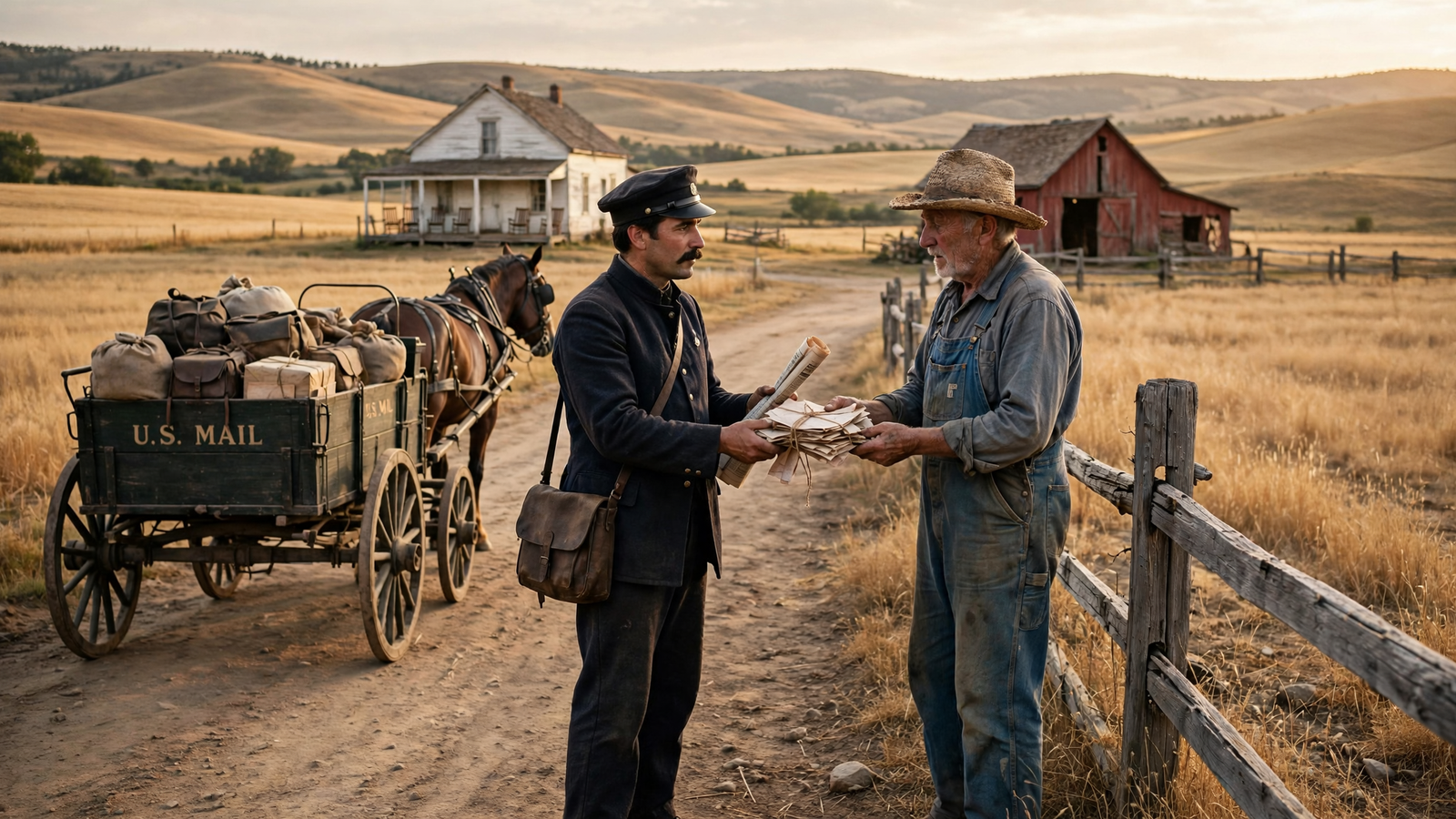
That box changed the daily experience of correspondence. Instead of planning a special trip to town, a resident could check the mail while walking to a barn, returning from a field, or passing through the yard. A flag or other signal could tell the carrier that a letter was waiting to be sent.
The arrangement also created a new kind of expectation. Mail no longer arrived only when someone had time to visit the post office. It arrived according to a route and a schedule. The carrier became a familiar figure whose movements helped structure the day, much as a train whistle or a town newspaper once marked the passage of time.
That relationship depended on practical cooperation. Roads had to remain usable. Boxes had to be placed where carriers could reach them safely. Residents had to address mail clearly and follow postal rules. In return, a family farm became part of a delivery network that connected it to nearby towns, state capitals, distant relatives, and national institutions.
Letters, newspapers, and the feeling of connection
The most immediate beneficiaries were people who depended on written communication but lived far from town. Families separated by migration could exchange news more easily. Farmers could receive newspapers and market information without making a journey for every issue. Rural residents could write to government offices, schools, businesses, and relatives on a more regular basis.
Newspapers were especially important. A paper delivered to the farm carried national politics, local announcements, weather reports, agricultural information, advertisements, and stories from places many readers might never visit. RFD helped make the countryside less dependent on news that happened to circulate through a local store or church gathering.
The service also strengthened the relationship between rural households and the federal government. The postal carrier was a visible representative of a national institution, traveling roads that otherwise served mostly local purposes. The mail itself carried forms, notices, checks, and official information. A distant government became easier to encounter in ordinary life.
Mail-order America
Rural free delivery expanded at the same moment that large mail-order companies were offering an astonishing range of goods through catalogs. Before dependable home delivery, ordering from a catalog could still require a trip to town or a complicated arrangement for receiving a shipment. As rural routes grew, the relationship between country households and mail-order commerce became much more practical.
Catalogs brought clothing, household goods, tools, toys, books, and other merchandise into homes that might be many miles from a substantial store. A family could compare products on the kitchen table, send an order by mail, and wait for a package to arrive through the postal system or another carrier.
RFD did not eliminate rural stores, and catalogs did not make every purchase inexpensive or simple. But together they widened the choices available to country consumers. Rural residents were no longer limited to what happened to be stocked at the nearest crossroads. The mailbox became a point of access to a national marketplace.
That change affected more than shopping. Catalogs also became objects of imagination. Their pages showed readers different kinds of clothing, furniture, farm equipment, and domestic life. For children, they could function as picture books of a larger world. For adults, they offered practical comparisons and glimpses of changing standards of comfort.
A public service with ordinary difficulties
Rural delivery was never effortless. Carriers traveled routes that could be long, exposed, and physically demanding. Horses and wagons were common in the early years, while automobiles gradually became more useful as roads improved. Winter weather, flooding, poor bridges, and rough surfaces could delay service.
Those difficulties reveal something important about the system. RFD depended on more than postal policy. It relied on a broader transformation in public infrastructure. Better roads made delivery more reliable; improved vehicles extended the reach of routes; standardized addresses and boxes made the network manageable. The mailbox at the roadside was the most visible part of a much larger effort to make rural circulation routine.
There were also debates over cost and fairness. Extending delivery to sparsely settled areas required public money and careful administration. Supporters argued that rural Americans deserved access to the same national communications system available in cities. The eventual expansion of RFD reflected the idea that public infrastructure could serve social and economic goals even when individual routes were not as dense or profitable as urban ones.
From letters to packages
The role of rural delivery continued to grow in the 20th century. The introduction of Parcel Post in 1913 made the postal system more useful for sending and receiving larger packages, including goods ordered from catalogs. Rural routes became part of a logistics network as well as a communications network.
Later, rural carriers delivered magazines, medicines, household supplies, forms, and personal letters. They also became familiar with the changing technology of the road: horse-drawn wagons gave way to automobiles, and simple roadside boxes evolved into standardized designs intended to protect mail from weather and make carrier service more efficient.
The basic principle, however, remained recognizable. A public route would bring the outside world to homes that were too dispersed to support a conventional town post office at every corner.
The quiet revolution at the end of the road
Rural free delivery did not arrive with the drama of a single famous invention. It was built through trials, routes, boxes, roads, carriers, and millions of small daily exchanges. Its importance can be measured in the habits it made possible: checking the mailbox after breakfast, reading a newspaper at the kitchen table, sending a letter without leaving the farm, or ordering something that could not be found nearby.
The system helped change what “connected” meant in the United States. Connection no longer required living in a dense neighborhood or traveling into town every time a message needed to move. A farmhouse at the end of a dirt road could participate in national commerce, receive distant news, and maintain family ties across state lines.
Today, the rural mailbox is easy to overlook. It stands beside roads used by cars, school buses, delivery vans, and farm equipment, often blending into the landscape. But its presence reflects a major change in American everyday life: the decision that distance should not, by itself, determine who gets dependable access to the nation’s shared channels of information and exchange.
Use: Background on the origins, purpose, and expansion of rural free delivery in the United States.
Use: Historical context for the development of rural delivery and its place in the national postal system.
Use: Context on the 1913 expansion of package delivery and the relationship between postal routes and mail-order commerce.
Use: Primary-source newspaper archive used for historical context on rural newspapers, postal service, and mail-order life.
Smithsonian National Postal Museum, “Rural Free Delivery” — https://postalmuseum.si.edu/exhibition/america-becomes-a-nation-of-immigrants/rural-free-delivery — Background on the origins, purpose, and expansion of rural free delivery in the United States.
United States Postal Service, Postal History: Rural Free Delivery — https://about.usps.com/who/profile/history/rural-free-delivery.htm — Historical context for the development of rural delivery and its place in the national postal system.
Smithsonian Institution, National Postal Museum, “Parcel Post” — https://postalmuseum.si.edu/exhibition/behind-the-stamp/parcel-post — Context on the 1913 expansion of package delivery and the relationship between postal routes and mail-order commerce.
Library of Congress, Chronicling America — https://chroniclingamerica.loc.gov/ — Primary-source newspaper archive used for historical context on rural newspapers, postal service, and mail-order life.