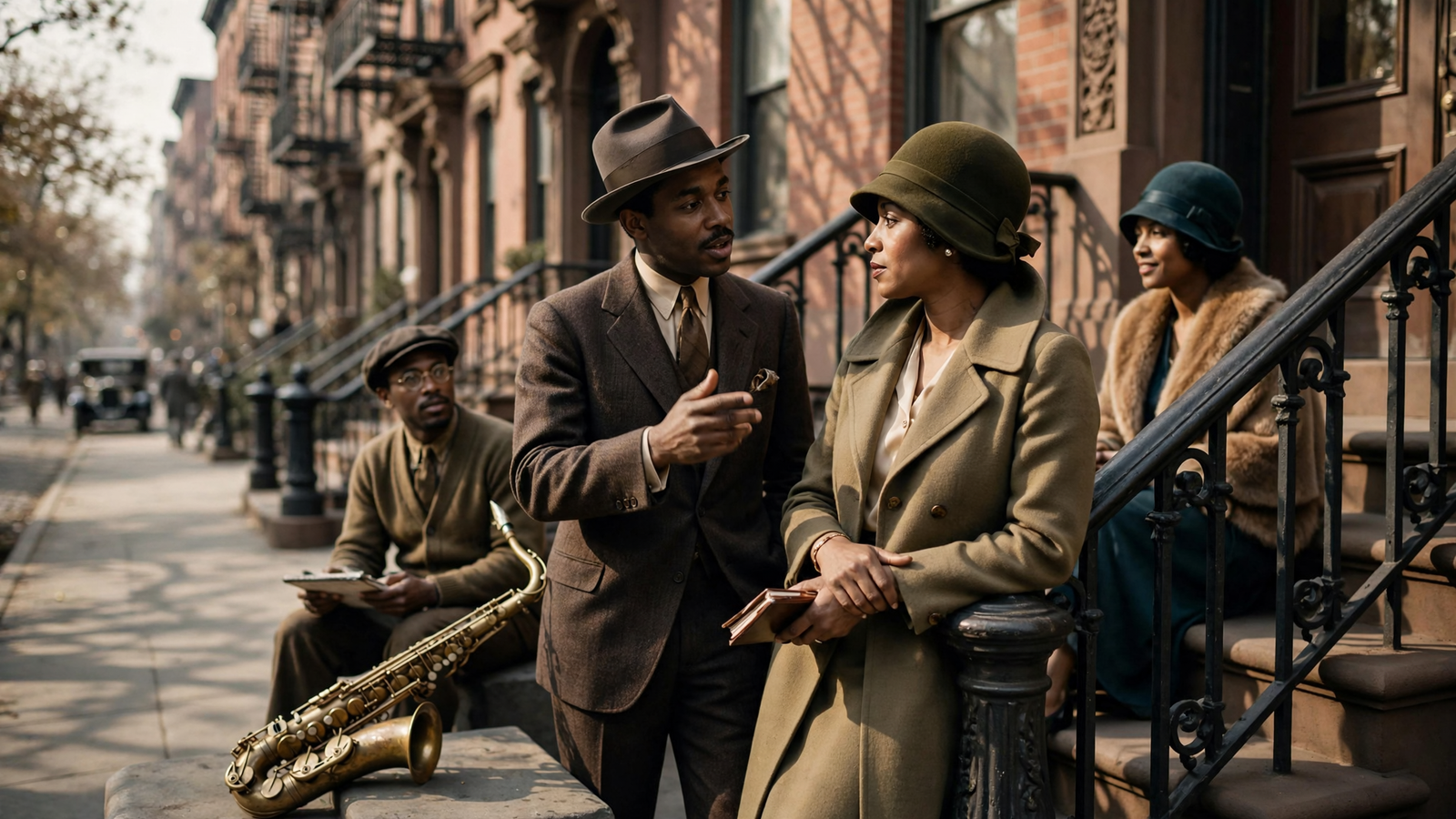
In the 1920s, Harlem became more than a neighborhood in northern Manhattan. It became a meeting place for ideas, talent, ambition, and community—and one of the clearest demonstrations in American history of what artists can build when they have room to work. For related reading, see The Green Book: How Black Travelers Built a Safer Road Across America.
The Harlem Renaissance was not a single organization or movement with a membership list. It was a broad flowering of Black literature, music, theater, visual art, journalism, and political thought, centered mainly in Harlem but reaching across the United States and beyond. For roughly two decades, Black creators developed new ways to describe modern life, challenged racist assumptions, and made African American culture impossible for the country to ignore.
Its legacy remains hopeful because it was not simply a story of individual genius. The Renaissance grew from networks: newspapers that published new writers, libraries that preserved Black history, clubs that gave musicians an audience, salons that brought intellectuals together, and readers who made a market for work that traditional publishers had often overlooked.
A neighborhood becomes a cultural crossroads
Harlem’s transformation was closely connected to the Great Migration, as millions of Black Americans moved from the rural South to cities in the North and Midwest during the early twentieth century. New York attracted workers, families, students, musicians, journalists, and entrepreneurs. Harlem, in particular, became a center of Black life.
The neighborhood was not free from poverty, discrimination, or political tension. But its growing population created something powerful: an audience. People who had been separated by geography could now attend the same performances, read the same newspapers, debate the same ideas, and recognize one another’s experiences in art.
That audience helped make cultural production a shared project. A poem could move from a magazine to a reading. A song could travel from a club to a national recording. A painting could be discussed alongside a political essay. The boundaries between art, journalism, entertainment, and public argument were unusually porous.
Literature gave the movement a public voice
Writers associated with the Harlem Renaissance brought Black interior life, history, humor, anger, romance, and ambition into American literature with unprecedented force.
Langston Hughes wrote poems that could sound conversational and musical while carrying the weight of a national history. His work reached readers through books, newspapers, magazines, and public performances. Zora Neale Hurston drew on the speech, folklore, and storytelling traditions of Black communities, especially in the South, and turned them into a distinctive literary art. Jean Toomer’s Cane, published in 1923, combined poetry, prose, and drama to portray Black life in the rural South and the urban North.
Other writers expanded the movement’s range. Countee Cullen brought formal lyric poetry into conversation with racial identity and classical tradition. Claude McKay wrote about migration, desire, resistance, and urban life. Nella Larsen explored questions of race, gender, class, and belonging in novels that remain widely read.
In 1925, philosopher and critic Alain Locke edited The New Negro, an anthology of essays, fiction, poetry, and visual art. The book helped give a name and intellectual shape to a movement already taking place. Locke argued that Black Americans were not merely asking to be included in an existing national culture; they were actively creating new cultural forms of their own.
That distinction mattered. The Harlem Renaissance treated art as a way to claim modernity, dignity, and self-definition. Its writers did not agree about what Black art should do. Some emphasized racial pride and political protest. Others wanted creative freedom without being required to represent an entire people. The disagreement itself reflected a vibrant artistic community thinking seriously about its responsibilities.
Art found institutions, teachers, and patrons
The movement also depended on institutions that helped artists meet one another and reach the public.
The 135th Street Branch of the New York Public Library—now part of the Schomburg Center for Research in Black Culture—became one of Harlem’s most important intellectual spaces. The library supported lectures, exhibitions, readings, and research. In the 1920s, it acquired the remarkable collection assembled by Arturo Alfonso Schomburg, a Puerto Rican-born Black bibliophile and historian who spent years gathering books, manuscripts, prints, and other records of the African diaspora.
Schomburg’s collection answered a damaging old assumption: that Black people had contributed little to world history, literature, and science. The library made evidence of those contributions available to researchers, students, writers, and the public. It helped transform historical recovery into a creative resource.
Visual artists developed their own language as well. Aaron Douglas created bold, streamlined illustrations influenced by African art, modern design, and Egyptian imagery. His silhouettes and rhythmic compositions appeared in books, magazines, and cultural publications, helping define the visual identity of the period.
Augusta Savage, a sculptor and educator, became one of the movement’s most important advocates for Black artists. She created portraits of prominent figures, taught younger artists, and helped establish opportunities for Black creators who faced exclusion from major institutions. Her work demonstrated that building an artistic community could be as important as producing individual objects.
Photographers such as James VanDerZee documented Harlem’s residents in carefully composed portraits and street scenes. His images showed people presenting themselves with style, seriousness, elegance, and joy. They became an enduring visual record of a community that was too often represented by outsiders through stereotypes.
Music made Harlem impossible to ignore
Music carried the Harlem Renaissance far beyond literary circles. Jazz offered a living example of artistic experimentation: musicians could improvise within shared structures, absorb influences from different regions, and create something that changed from performance to performance.
Harlem’s clubs and theaters helped turn jazz into a national cultural force. Duke Ellington’s orchestra established a sophisticated musical presence at the Cotton Club, while performers such as Bessie Smith, Ethel Waters, and Josephine Baker brought new emotional and theatrical possibilities to popular entertainment. Louis Armstrong’s recordings, though his career was not confined to Harlem, helped make jazz improvisation central to modern music.
The nightlife economy was complicated. Some venues catered to white audiences while restricting Black patrons, and Black performers often received less control and compensation than the popularity of their work deserved. Yet musicians and singers still used the stage to expand what American performance could sound and look like.
Music also connected the Renaissance to everyday life. Jazz was heard in theaters, dance halls, rent parties, restaurants, and homes. It was not simply an elite art form. It belonged to a social world in which people gathered, danced, argued, celebrated, and made community.
A movement built through collaboration
One of the most encouraging lessons of the Harlem Renaissance is how many forms of support mattered. Editors published emerging writers. Teachers trained young artists. Librarians preserved evidence of the past. Photographers recorded ordinary lives. Musicians created demand for new sounds. Patrons purchased work. Readers and audiences made the culture sustainable.
Philanthropic organizations and white patrons played a role, including through funding for publications, schools, and artists. Their support could open doors, but it also sometimes came with expectations about what Black art should be. The Renaissance was therefore shaped by negotiation as well as opportunity. Black creators repeatedly pushed beyond the limits placed around them.
Women were central to this cultural world, even when later accounts gave them less attention. Hurston, Larsen, Savage, Baker, Waters, and many others were not supporting figures. They were authors, performers, organizers, teachers, and innovators who expanded the movement’s subjects and forms.
The Renaissance also reached beyond Harlem. Its books circulated nationally. Its music traveled through records and touring performances. Its ideas influenced Black newspapers, colleges, political organizations, and later generations of artists. The movement’s center was local, but its audience became national and international.
What remained after the Renaissance
The Harlem Renaissance began to lose momentum during the Great Depression. Publishing opportunities contracted, entertainment industries changed, and the economic foundations of Harlem weakened. The period did not end with a single announcement, and its artists did not stop creating. Instead, the networks and ideas of the 1920s and 1930s flowed into later movements.
Its influence can be seen in the writers of the mid-century Black literary revival, the musicians of bebop, the visual artists of the Black Arts Movement, and the cultural activism of the civil rights era. The insistence that Black history, speech, beauty, and imagination belonged at the center of American culture became one of the Renaissance’s most durable achievements.
Today, the Harlem Renaissance is sometimes presented as a glamorous collection of famous names. Its deeper story is more useful. A community created conditions in which many kinds of talent could meet. Institutions preserved memory while artists invented the future. Audiences did not merely consume culture; they helped bring it into being.
That is why the movement still feels alive. It shows that cultural change does not always begin with a powerful institution or a single celebrated genius. Sometimes it begins when a neighborhood becomes a place where people can find one another—and when the resulting work is given enough attention, care, and freedom to travel.
Use: Background on the Harlem Renaissance, its artists, cultural networks, and international context.
Use: Information about the library’s role in preserving and presenting Black history and culture, including the Schomburg collections.
Use: Historical context on the movement’s writers, musicians, artists, institutions, and continuing influence.
Use: Context on visual art, artists, and the relationship between Harlem Renaissance art and modernism.
Library of Congress — The Harlem Renaissance and Transatlantic Modernism — https://www.loc.gov/exhibitions/harlem-renaissance-and-transatlantic-modernism/about-this-exhibition/ — Background on the Harlem Renaissance, its artists, cultural networks, and international context.
New York Public Library — Schomburg Center for Research in Black Culture — https://www.nypl.org/about/divisions/schomburg — Information about the library’s role in preserving and presenting Black history and culture, including the Schomburg collections.
Smithsonian National Museum of African American History and Culture — Harlem Renaissance — https://nmaahc.si.edu/explore/stories/harlem-renaissance — Historical context on the movement’s writers, musicians, artists, institutions, and continuing influence.
The Metropolitan Museum of Art — The Harlem Renaissance — https://www.metmuseum.org/toah/hd/harl/hd_harl.htm — Context on visual art, artists, and the relationship between Harlem Renaissance art and modernism.