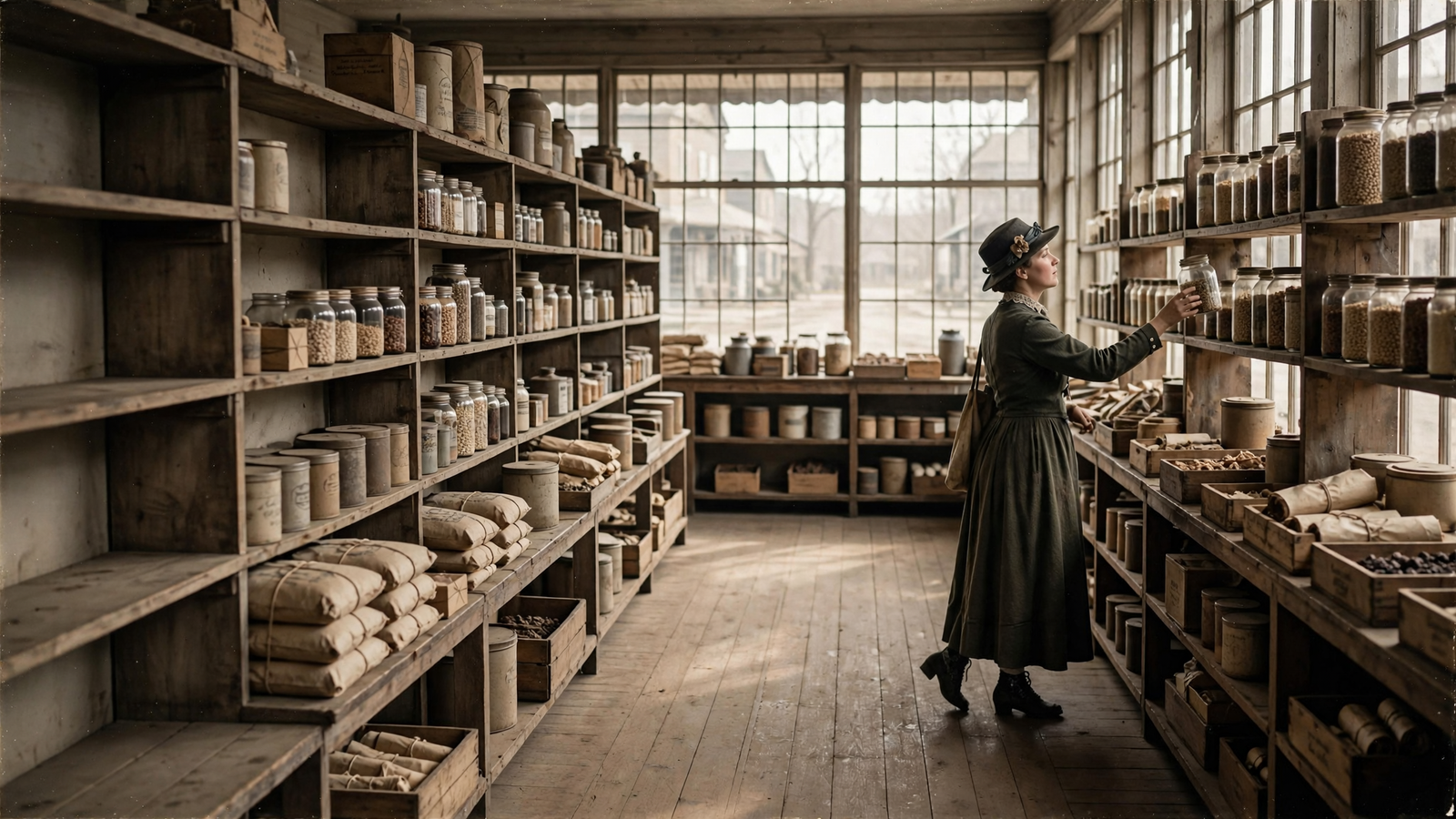
Before the modern grocery store, shopping for food was largely a conversation.
A customer entered a shop, stood at a counter, and told a clerk what was needed. The clerk moved around the store or into a stockroom, gathered the items, and brought them back. Shopping could be social, but it was not especially quick—and customers could buy only what they knew to ask for. For related reading, see The Matchstick: How a Tiny Flame Changed Everyday Life.
That arrangement changed dramatically in Memphis, Tennessee, in the fall of 1916. At a new store called Piggly Wiggly, shoppers were invited to enter through a turnstile, take a basket, walk among the shelves, select their own goods, and pay at a cashier on the way out. For related reading, see The Tucson Loop: How a Desert Trail Became Part of Everyday Life.
The idea sounds ordinary now because it became ordinary. But self-service grocery shopping was once a radical redesign of everyday life. It changed the layout of stores, the role of the shopkeeper, the way products were packaged and advertised, and the way Americans moved through the ordinary task of buying dinner. For related reading, see Luxembourg Made Everyday Travel Free—and Turned a Commute Into a Public Service.
A Grocery Store Built Around Movement
Clarence Saunders, the Memphis businessman behind Piggly Wiggly, did not invent the idea of selling food. His innovation was to reorganize the experience.
The first Piggly Wiggly opened on September 6, 1916, at 79 Jefferson Avenue. Its design guided shoppers along a controlled path. Instead of approaching a counter and waiting for service, customers passed through the store themselves. Wire baskets gave them a way to carry purchases. Shelves placed merchandise within reach. A checkout area concentrated payment at the end of the trip.
The arrangement solved several problems at once. A store needed fewer clerks to retrieve goods. Customers could see more of the inventory. And products that might never have been requested by name could now attract attention simply by being placed in a shopper’s path.
That last change mattered. In the older counter-service model, the customer generally arrived with a list or a familiar request: flour, coffee, soap, canned peaches. In a self-service store, the shelves became part of the sales process. Packaging, labels, color, price, and placement all began to influence the decision.
Shopping was becoming less like ordering from a shopkeeper and more like navigating an environment.
The Customer Became Part of the System
Piggly Wiggly’s layout placed more responsibility on customers. They had to find products, compare options, carry their selections, and bring everything to the register. In exchange, they gained privacy and control. They did not have to announce every purchase to a clerk or wait while someone searched for it.
The store’s name was playful, but the operating principles were serious. Saunders used the store to test a more efficient retail system, and he protected elements of that system through patents. A 1923 patent associated with Saunders described a self-serving store in which customers selected merchandise from displays and brought it to a cashier.
That patent points to an important feature of the invention: self-service was not just a matter of removing a counter. It was a coordinated system involving store architecture, product placement, customer circulation, baskets, checkout, and inventory control.
In other words, Piggly Wiggly made the customer part of the labor-saving design. The shopper performed tasks that clerks had previously handled, while the store made those tasks feel convenient and independent rather than burdensome.
Why Groceries Were Ready for a New Model
The timing was significant. By the early twentieth century, American households were buying more food in packaged, canned, bottled, and standardized forms. A shopper did not need a clerk to measure every item from a bulk container or judge every product by sight.
Packaged goods could sit on shelves with printed labels and set prices. Brand names helped customers recognize products from one store to another. Cans, cartons, boxes, and bottles also made merchandise easier to display and transport.
Self-service retail and packaged food therefore reinforced each other. The more goods arrived in recognizable packages, the easier it became for shoppers to choose them without expert assistance. The more shoppers selected goods for themselves, the more important packaging became as a form of information and persuasion.
This helped move grocery shopping toward a world of branded competition. A store no longer sold only “coffee” or “soap.” It offered multiple brands, sizes, prices, and claims. The shelf became a place where manufacturers competed for attention.
From Novelty to Business Model
Piggly Wiggly expanded beyond its first Memphis location, and the self-service principle spread through the grocery trade. The company also helped popularize franchising, allowing independently operated stores to use the Piggly Wiggly name and system under agreement.
The idea did not immediately replace every traditional grocery store. Retailers had to learn how to organize inventory, control shoplifting, maintain shelves, and process a larger number of small customer-selected purchases. Shoppers also had to become comfortable with a new routine.
But the model fit broader changes in American life. Urban populations were growing. More households had access to automobiles, which made it easier to travel to larger stores and carry more groceries home. Refrigeration improved, allowing families to store perishable food for longer periods. Roads and distribution networks made it possible for stores to stock a wider range of goods.
By the 1930s, large supermarkets were becoming a recognizable part of American retail. They combined self-service with broad inventories, lower prices, parking, and increasingly efficient supply chains. Piggly Wiggly was not the only influence on the supermarket, but it helped establish the basic customer journey that remains familiar today.
The Aisle Became a New Kind of Public Space
The grocery aisle may seem like a neutral setting, but it is carefully organized. Shelves direct attention. Endcaps announce promotions. Frequently purchased items may be placed farther inside, encouraging customers to pass other products. Small items often appear near the checkout, where waiting shoppers can notice them.
These practices developed from the central self-service insight: when customers move through the store, the store can communicate with them through its physical arrangement.
That changed the culture of shopping. A grocery trip could still be planned and practical, but it also allowed discovery. Children could see colorful cereal boxes. Adults could compare competing brands. A new canned food or household product could become part of a family’s routine because it was encountered on a shelf rather than requested in advance.
The shift also altered the relationship between shopper and merchant. The clerk was no longer the constant intermediary. Instead, the store’s identity moved into its signs, shelves, prices, packages, and layout.
Convenience Had a Hidden Cost
Self-service brought clear conveniences, but it also changed the distribution of work. Customers now spent time walking the aisles, lifting products, reading labels, and transporting purchases. Store employees moved from personal service toward stocking, pricing, checkout, cleaning, and inventory management.
As stores grew larger, the benefits of scale became more important. Bigger retailers could buy in greater volume, offer more products, and spread operating costs across many transactions. Smaller neighborhood stores faced new competition, especially when shoppers could drive to a supermarket and buy most of a week’s food in one trip.
The supermarket therefore made shopping more efficient while helping reshape local commerce. It offered abundance and choice, but it also encouraged standardization and concentration. The familiar neighborhood grocer did not disappear everywhere, yet the center of gravity in food retail moved toward larger, more systematized stores.
An Ordinary Errand Rewritten
The enduring importance of Piggly Wiggly is not that every modern supermarket looks exactly like its first store. It is that the store helped make a new idea feel normal: customers could be trusted to navigate a retail environment and serve themselves.
That idea later appeared in department stores, cafeterias, warehouse clubs, convenience stores, and online shopping. Each version reduces the need for a salesperson to mediate every choice. The customer searches, compares, selects, and completes the transaction with increasing independence.
In 1916, that independence required a turnstile, a basket, a carefully arranged store, and a cashier waiting at the end. Today, it is so familiar that the older counter-service system can be difficult to imagine.
Piggly Wiggly’s great legacy was not a particular brand of groceries. It was a new choreography for everyday life: enter, browse, choose, carry, pay, and leave. The modern supermarket still follows that rhythm.
Use: Background on Clarence Saunders, the first Memphis store, its 1916 opening, and the company’s development.
Use: Primary patent record describing features of a self-service or “self-serving” store.
Use: Context on the development and characteristics of the modern supermarket.
Tennessee Encyclopedia of History and Culture, “Piggly Wiggly” — https://tennesseeencyclopedia.net/entries/piggly-wiggly/ — Background on Clarence Saunders, the first Memphis store, its 1916 opening, and the company’s development.
Google Patents, U.S. Patent No. 1,479,446, Clarence Saunders — https://patents.google.com/patent/US1479446A/en — Primary patent record describing features of a self-service or “self-serving” store.
Encyclopaedia Britannica, “Supermarket” — https://www.britannica.com/topic/supermarket — Context on the development and characteristics of the modern supermarket.