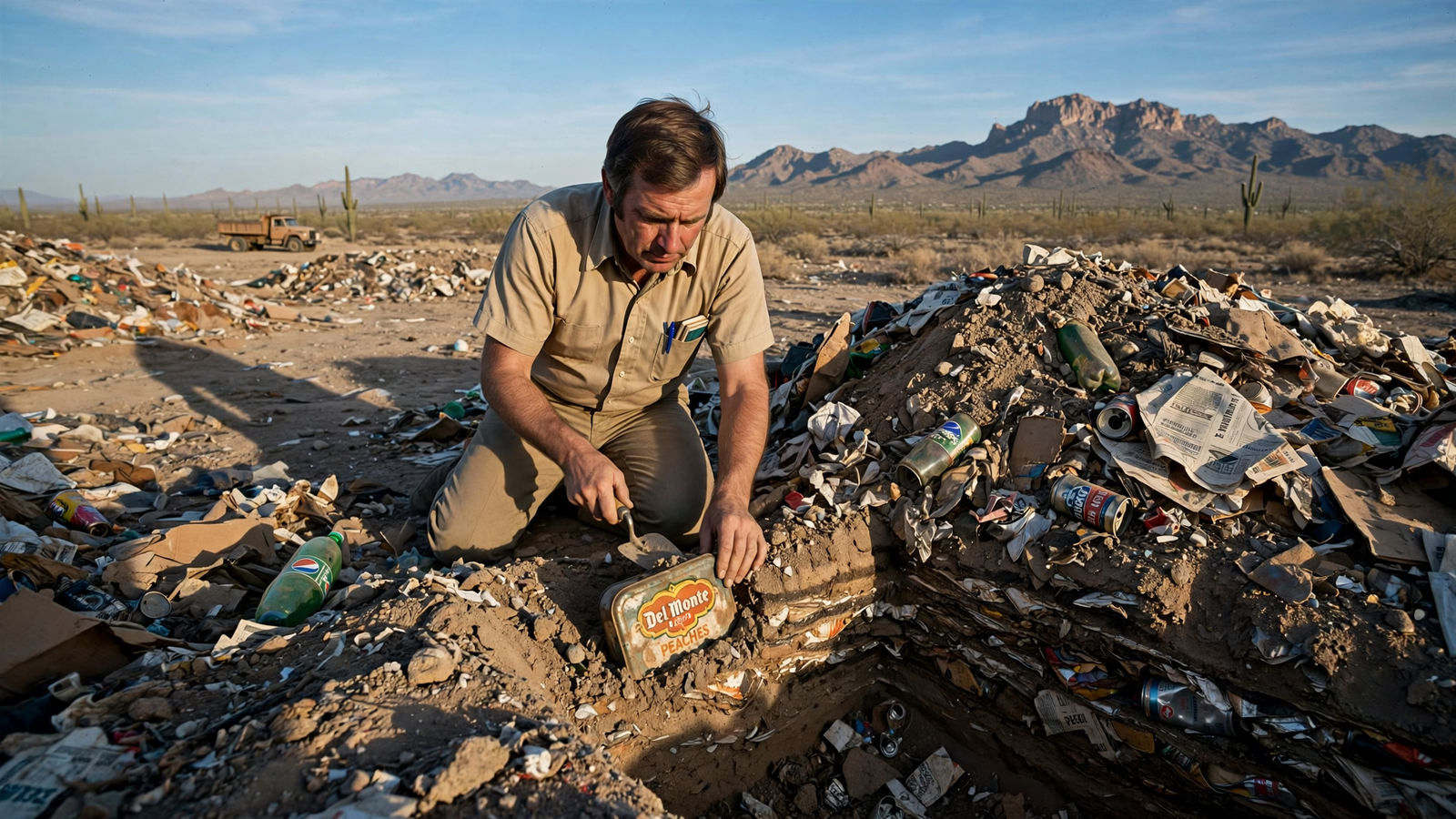
Archaeology usually begins with the distant past: a buried settlement, a broken pot, a wall slowly emerging from the soil. In Tucson, an archaeologist proposed looking somewhere much closer to home.
In 1973, William Rathje of the University of Arizona began a research project that treated contemporary household garbage as an archaeological record. Students collected and analyzed refuse from Tucson-area homes, businesses, and landfills. They sorted cans, bottles, food waste, packaging, and other discarded objects—not as curiosities, but as evidence.
The project became known as the Tucson Garbage Project. Its work helped establish a new way of studying modern life, one that examined what people actually threw away rather than what they remembered buying, eating, or wasting. Rathje’s research eventually reached beyond Arizona, influencing environmental education, consumer research, museum exhibits, and the broader field sometimes called “garbology.”
A different kind of archaeological site
Rathje was trained as an archaeologist of ancient societies. Like many archaeologists, he understood that discarded objects could reveal daily behavior more clearly than official records or grand monuments. A cooking vessel, tool fragment, or animal bone might show what people ate and how they lived, even when written accounts were silent.
His unusual step was to apply that logic to the present.
Modern households already produced enormous quantities of material evidence. The problem was that most people did not regard their own waste as a historical record. Once a garbage truck carried a bag away, the contents seemed to vanish from ordinary life. Rathje argued that the discarded material remained valuable because it represented behavior in physical form.
The idea also offered a way to test the limits of memory. People might underestimate how much alcohol they consumed, forget how often they relied on convenience food, or report that they recycled more than their discarded materials suggested. Such discrepancies did not necessarily mean people were deliberately lying. Memory is selective, and people tend to describe the lives they intend to lead as well as the lives they actually live.
Garbage provided a different kind of record: messy, incomplete, and sometimes difficult to interpret, but tangible.
The Tucson experiment
The University of Arizona project organized waste collection and analysis as a systematic research program. Teams examined samples from selected households and other sources, recording the types and quantities of materials they found. Researchers compared the physical evidence with interviews and surveys.
This was not simply a matter of opening random trash bags and making observations. The project’s value depended on sampling, classification, careful measurement, and an understanding of what the material could represent. A single household’s refuse could not stand for an entire city. A landfill sample could be affected by commercial waste, construction debris, seasonal changes, or the way material had been compacted and buried.
Those complications made the work more scientific, not less. Rathje and his colleagues had to ask basic archaeological questions: Who produced this material? When was it discarded? What was missing from the sample? How might collection and burial have altered it? Which conclusions were reasonable, and which went beyond the evidence?
That discipline helped the Tucson Garbage Project distinguish between what trash could reveal and what it could not. Waste could offer strong evidence about quantities and material composition. It could show patterns in packaging, food disposal, and household consumption. It was less reliable for explaining motives. A discarded food item might indicate excess, spoilage, changing plans, or a meal that no one wanted to finish. The object needed context.
What people said—and what they discarded
One of the project’s most memorable findings was the gap between public perceptions and physical evidence. Americans often described themselves as more frugal, healthier, or more environmentally responsible than their garbage suggested. The contrast became especially striking when researchers compared survey answers with measured waste.
Food waste received considerable attention. People tended to remember the groceries they used and overlook the items that spoiled in the refrigerator, remained uneaten, or were thrown away with other refuse. The project’s findings suggested that household waste contained a substantial record of overbuying and avoidable disposal.
The researchers also studied the relationship between recycling claims and discarded materials. Recycling programs and public awareness campaigns could change habits, but the material record made it possible to see how far intentions had translated into behavior. In this sense, the project was not merely criticizing consumers. It was creating a way to measure whether environmental messages were working.
Rathje’s research also challenged the popular image of the landfill as a place where everything rapidly decomposes. Landfills are engineered environments, often compacted and covered in ways that limit oxygen and moisture. Organic materials can remain recognizable for long periods. Newspapers, food, and other items may survive in forms that surprise people who assume that “biodegradable” means “quickly gone.”
That insight mattered because it changed the way people imagined waste. A discarded object did not disappear when it left the curb. It entered another landscape—one that could preserve evidence of everyday life while also concentrating the environmental consequences of consumption.
From Tucson to a wider public
The project attracted attention because it made archaeology feel immediate. Ancient ruins could seem remote, but everyone had a kitchen trash can. By studying familiar objects, Rathje and his students showed that archaeology was not limited to temples, tombs, or lost civilizations. It was also a method for asking how people organize their lives through material things.
The work became the subject of Rathje’s 1992 book, Rubbish! The Archaeology of Garbage, written with journalist Cullen Murphy. The book helped bring the project’s methods and conclusions to a broad audience. Rathje later served as a professor at the University of Arizona and continued to write and speak about waste, consumption, and the evidence hidden in discarded materials.
The term “garbology” became widely associated with the approach, although the research itself was more rigorous than the playful label might suggest. It drew on archaeology, anthropology, statistics, environmental studies, and public education. Its central question was simple: What can the material record tell us that people do not—or cannot—tell us about themselves?
The answer was not that trash revealed a single, complete truth. Garbage has its own biases. It reflects access to goods, local collection systems, household size, income, cultural practices, and decisions about what to donate, compost, burn, recycle, or throw away. Informal disposal can leave material out of the official sample. A landfill is not a perfect mirror of society.
But those limits are part of the lesson. Archaeologists do not treat an ancient site as a transparent record of the past. They reconstruct behavior from partial remains. Rathje’s project brought that careful reasoning into a world that people assumed they already understood.
A legacy in the everyday
William Rathje died in 2011, but the questions raised by the Tucson Garbage Project remain current. Cities still debate landfill capacity, recycling markets, food waste, packaging, and the environmental cost of disposable products. Researchers still need ways to measure behavior rather than rely entirely on intention or memory.
The project’s lasting contribution was not simply a list of surprising items found in garbage. It was a change in perspective. Rathje demonstrated that the ordinary and overlooked could become historically important when examined carefully.
A landfill is not a museum in the conventional sense. It has no labels, galleries, or carefully arranged cases. Yet it preserves a record of choices made every day: what households bought, used, saved, wasted, and replaced. In Tucson, an archaeologist taught students and the public to read that record.
His work made modern life newly visible. The history of a society, it suggested, is not found only in speeches, monuments, and official documents. Sometimes it is waiting in the discarded material left behind after dinner.
Use: Background on Rathje’s University of Arizona career, the Tucson Garbage Project, and its archaeological approach.
Use: Institutional archival context for Arizona researchers, projects, and historical materials.
Use: Independent historical and scientific context on Rathje’s garbage research and its significance.
Use: Publication information and scholarly context for Rathje and Cullen Murphy’s 1992 book.
University of Arizona Department of Anthropology — William Rathje and the Garbage Project — https://anthropology.arizona.edu/ — Background on Rathje’s University of Arizona career, the Tucson Garbage Project, and its archaeological approach.
University of Arizona Libraries, Special Collections — https://speccoll.library.arizona.edu/ — Institutional archival context for Arizona researchers, projects, and historical materials.
Smithsonian Magazine — The Archaeology of Garbage — https://www.smithsonianmag.com/ — Independent historical and scientific context on Rathje’s garbage research and its significance.
University of Arizona Press — Rubbish! The Archaeology of Garbage — https://uapress.arizona.edu/ — Publication information and scholarly context for Rathje and Cullen Murphy’s 1992 book.