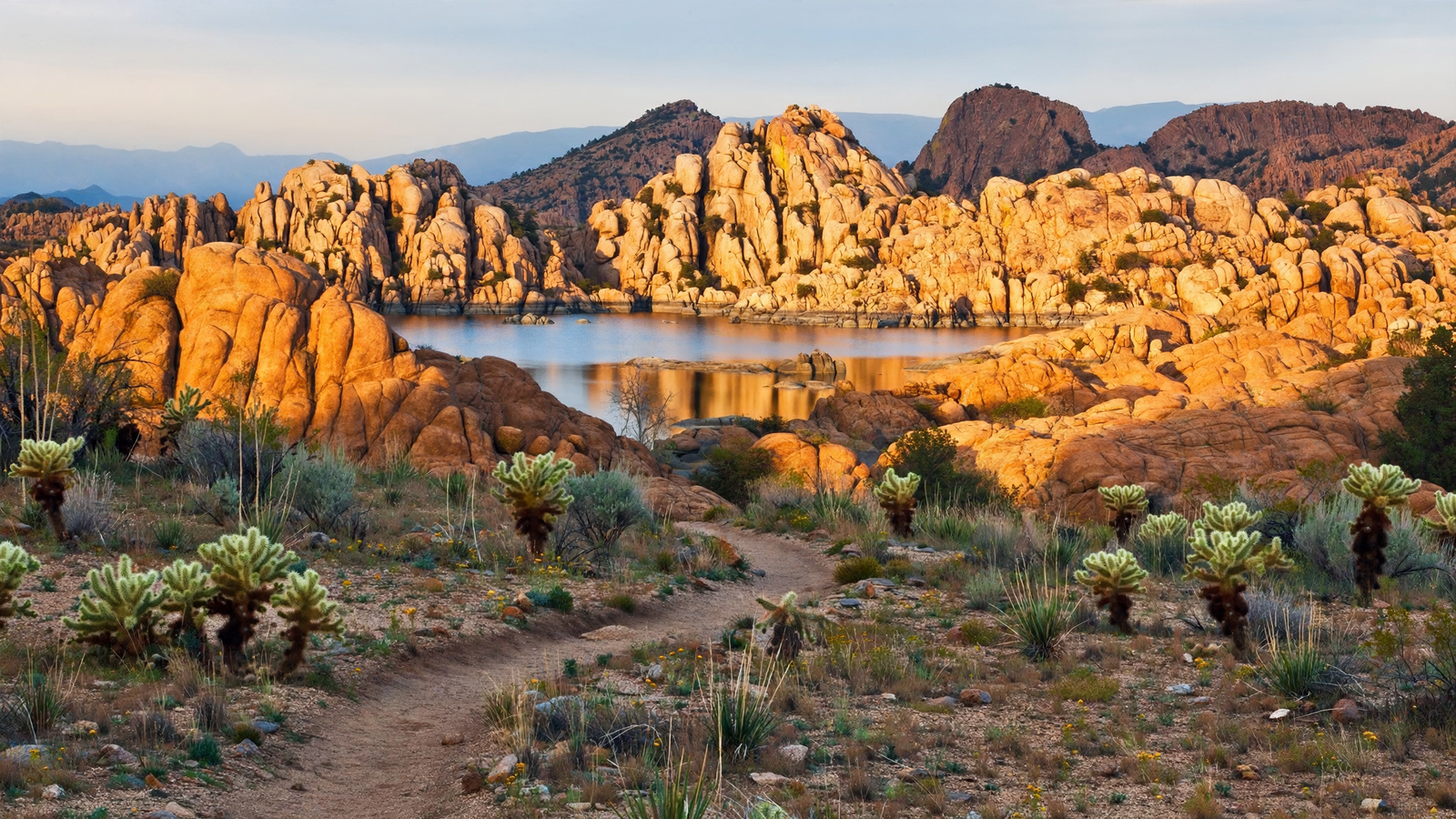
On the northern edge of Prescott, the land seems to have been broken open and left in place. Rounded granite slabs rise from the high-desert floor. Narrow seams divide the rock into pale, weathered blocks. Juniper and pinyon pine grow wherever a little soil has collected, while seasonal water gathers in hollows polished by wind, rain, and time. For related reading, see Prescott’s Granite Dells Shows What a Public Landscape Can Become.
This is the Granite Dells, one of Yavapai County’s most recognizable landscapes and one of Prescott’s most important public outdoor spaces. It is close enough to town for a short outing, yet its broad views and exposed rock give it the feeling of a much larger wilderness. For related reading, see Sahuaro Ranch: How a Glendale Farm Became a Public Historic Landscape.
The Dells are not simply a scenic backdrop. They are a meeting place for geology, recreation, wildlife habitat, water, and local conservation. Their importance comes partly from what visitors can see immediately—the dramatic formations and trails—but also from the less visible decision to keep a distinctive piece of the Prescott landscape available for public use. For related reading, see Montezuma Well: The Desert Spring That Became an Ancient Waterway.
A landscape shaped by weather, not spectacle
Granite is often imagined as a hard, unchanging material. In the Dells, its long transformation is easier to read. Water enters joints and cracks in the rock. Temperature changes widen those openings. Surface layers gradually loosen and peel away, leaving the rounded forms that define the area.
The result is a landscape that appears both massive and delicate. Some formations stand like low domes. Others lean into one another, creating passages, shelves, and natural overlooks. The rock’s pale color contrasts with the darker greens of juniper and pine and the muted grasses that fill the spaces between the outcrops.
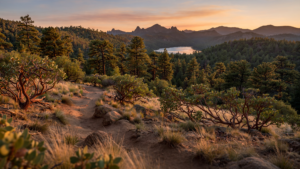
That combination gives the Granite Dells a character different from the forested slopes farther south and the open desert country farther down the Verde watershed. Prescott sits in a transition zone, and the Dells make that transition visible. High-elevation woodland, exposed stone, shallow soils, and seasonal water all occupy the same frame.
The formations also show why a place can be geologically old but still environmentally active. Every storm moves sediment. Every freeze affects a crack. Every footstep on a fragile soil surface can influence how quickly a small patch of vegetation recovers.
Close to town, but not ordinary parkland
The Granite Dells are valuable partly because they are accessible. Residents do not need to plan a long expedition to reach the area, and visitors can experience a distinctly northern Arizona landscape within minutes of Prescott’s developed neighborhoods.
Trails lead through the formations and along the nearby shoreline of Watson Lake. Depending on the route, a walk may involve smooth rock, uneven ground, narrow passages, or short climbs. The terrain rewards curiosity, but it also demands attention. A route that looks easy from a distance can become more technical when it reaches a steep slab or a jumble of boulders.
The area’s variety is one reason it supports different kinds of outdoor use. Some people come for a brief walk and a view. Others explore longer trail connections, photograph the formations, paddle on the lake, or use the rocky landscape as a place to slow down and watch the light change.
That range of experiences creates a management challenge. A popular public landscape must remain welcoming without being treated as indestructible. Trails need to be clear enough to follow, but informal shortcuts can spread across shallow soils. Popular overlooks can become crowded. Wildlife needs room even when people are nearby.
Prescott’s parks and open-space planning treats places such as the Granite Dells as more than isolated attractions. They are part of a larger network of public lands and trail corridors that gives the city much of its identity. The goal is not to make the landscape look untouched. It is to allow people to use it while preserving the qualities that brought them there.
Water gives the rocks another story
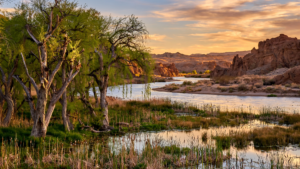
Watson Lake is one of the most visible features associated with the Dells. Its presence adds a strong contrast to the dry surroundings: blue or reflective water below, granite rising around it, and woodland extending toward the horizon.
The lake also changes how the landscape is experienced. From the water’s edge, the formations become a shoreline rather than a group of isolated outcrops. Reflections soften their hard outlines. Birds use the lake and its margins, while people find places to pause, fish, paddle, or begin a trail.
Water in a high-desert setting is never just scenery. It shapes where plants grow, where animals move, and where people gather. Seasonal flows and reservoirs cannot reproduce the full function of a natural river, but they can create habitat and open a different kind of public relationship with the land.
The presence of water can also make visitors more aware of limits. Prescott’s climate is relatively dry, and the surrounding vegetation reflects that reality. The Dells are not a lush landscape waiting to be developed. Their beauty comes from adaptation: plants rooted in thin soils, trees following pockets of moisture, and wildlife using a fragmented but valuable mosaic of cover and open ground.
Why connected open space matters
A scenic site can be protected as a destination. A connected landscape does something more. It gives wildlife more than a single viewpoint or isolated patch of habitat, and it gives people more ways to enter and understand the region.
The Granite Dells sit within a broader pattern of public land around Prescott. Nearby forests, trails, reservoirs, and open-space areas help make the city unusual among growing communities in the Southwest. Development has not erased every edge between town and country. Instead, the relationship remains visible in the trail system and in the abrupt change from streets and buildings to rock and woodland.
That connection has practical value. Natural areas can help protect drainage routes, reduce pressure on sensitive sites by distributing recreation, and preserve views that would otherwise be lost to construction. They also offer everyday access to nature for people who may not have the time, equipment, or transportation needed for a distant backcountry trip.
For children, the Dells can be an outdoor geology lesson. For longtime residents, they can be part of a familiar routine. For travelers, they provide an introduction to the landscape around Prescott without requiring a trip to one of Arizona’s better-known national parks.
A public place that asks for care
The Granite Dells are durable in one sense and vulnerable in another. The granite can withstand centuries of weather, but the thin soils between the rocks are easily disturbed. Plants growing in those pockets may take years to recover from repeated trampling. A new shortcut can become a permanent scar when enough people follow it.
Responsible use is therefore not an abstract conservation principle. It is a direct way of keeping the Dells recognizable. Staying on established routes where possible, avoiding fragile vegetation, carrying out waste, and giving wildlife space all help maintain the landscape’s ability to absorb visitors.
Visitors should also prepare for the conditions rather than judging the area by its proximity to town. Summer heat can arrive quickly. Rock surfaces can be slippery after rain or icy in winter. Cell service and shade are not guaranteed everywhere. Water, sun protection, suitable footwear, and a realistic sense of distance make a short outing safer and more enjoyable.
These simple precautions support the larger idea behind public open space: access works best when it is paired with stewardship. The community gets to experience the land, and the land retains enough integrity to remain meaningful for the next visitor.
The lasting value of an ordinary outing
Places such as the Granite Dells rarely announce their importance in a single dramatic moment. Their value accumulates through repeated use. A resident walks the same trail in different seasons. A family watches clouds move across the formations. A visitor sees the granite at sunset and understands, perhaps for the first time, the character of the country around Prescott.
That everyday accessibility is a form of conservation success. Protecting a landscape does not only preserve rare species or spectacular scenery. It can preserve a community’s ability to encounter the natural world as part of ordinary life.
In Yavapai County, where fast-growing communities meet forests, grasslands, desert waterways, and ancient rock, that ability matters. The Granite Dells offer a compact expression of the region’s larger story: geology setting the stage, water shaping movement, plants finding a foothold, and people deciding whether a remarkable place will remain public.
The rocks will continue to weather slowly. Trails will change with use and maintenance. Light will keep moving across the formations. The most important feature of the Dells, however, may be the continuing choice to treat this landscape as more than land waiting for another purpose.
It is already a purpose: a public place where Prescott can meet its geology, where recreation can coexist with conservation, and where a short walk can reveal how much life a high-desert landscape can hold.
Use: Public parks, trails, open-space access, and recreation information for Prescott, including the Granite Dells and Watson Lake area.
Use: Context on public lands, recreation, stewardship, and the high-country landscape surrounding Prescott.
Use: Geological background for Arizona landscapes and the processes that shape exposed rock formations.
City of Prescott Parks and Recreation — https://www.prescott-az.gov/parks/ — Public parks, trails, open-space access, and recreation information for Prescott, including the Granite Dells and Watson Lake area.
Prescott National Forest, U.S. Forest Service — https://www.fs.usda.gov/prescott — Context on public lands, recreation, stewardship, and the high-country landscape surrounding Prescott.
Arizona Geological Survey — https://azgs.arizona.edu/ — Geological background for Arizona landscapes and the processes that shape exposed rock formations.