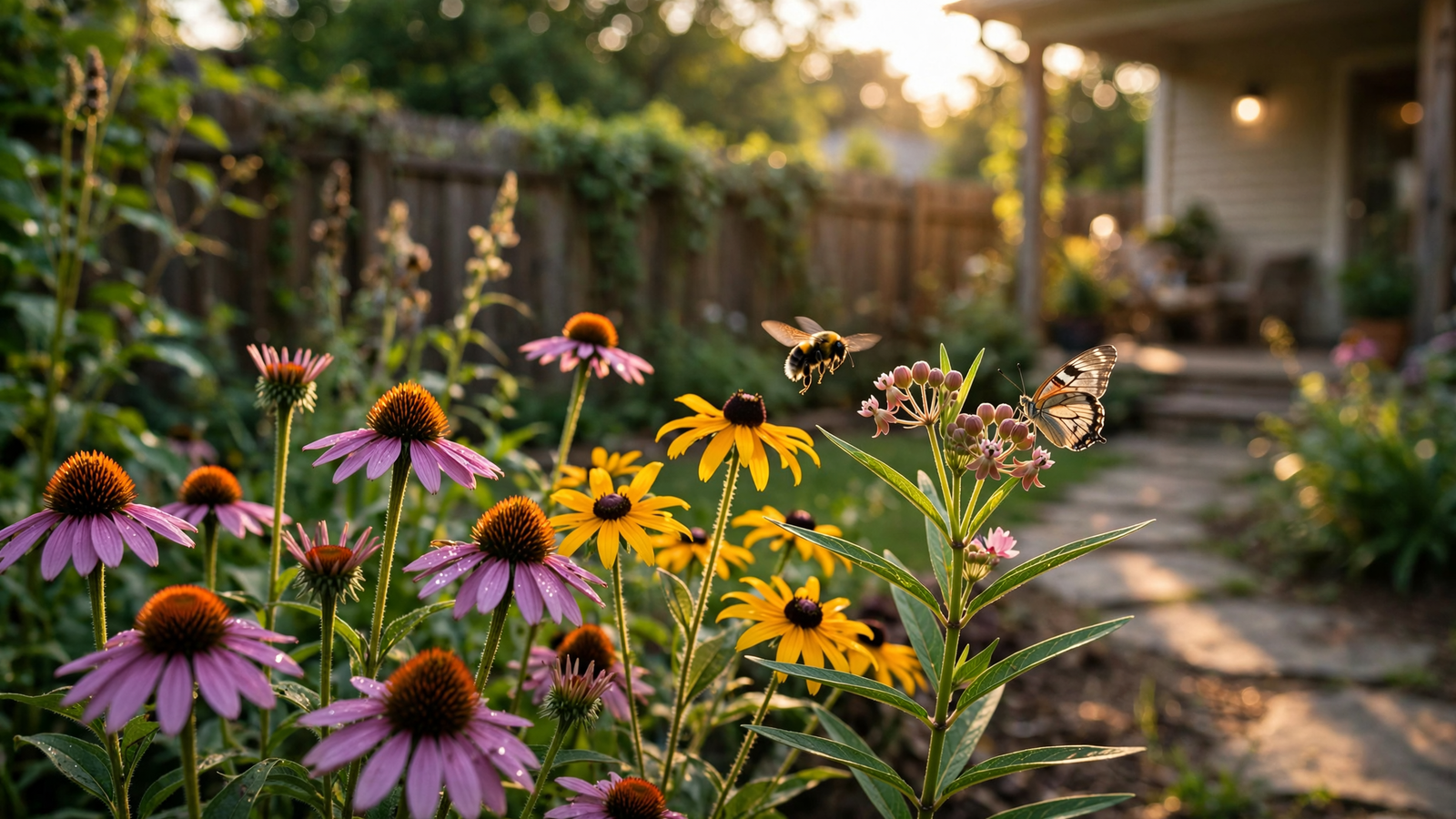
A garden does not need to be large, expensive, or professionally designed to become useful to wildlife. A strip beside a driveway, a few containers on an apartment balcony, or a corner of a suburban lawn can offer food and shelter to bees, butterflies, moths, hummingbirds, and other pollinators. For related reading, see StoryCorps: How Ordinary Conversations Became an American Archive.
That idea has helped turn the home garden into something more than decoration. Across the United States, homeowners, renters, schools, and communities are replacing small areas of grass or ornamental plants with habitat chosen for local conditions. The result is a quiet form of conservation: not a single grand preserve, but many small places connected across neighborhoods. For related reading, see Dead Horse Ranch State Park: How a Cottonwood Ranch Became a Verde Valley Refuge.
A garden can be part of a larger living network
Pollinators move through landscapes looking for flowers, nesting places, water, and shelter. Bees may visit several gardens in a single day. Butterflies can use one place for nectar and another for the plants their caterpillars need. Birds may depend on insects produced by a garden even when they never land on a flower themselves. For related reading, see The Honda Civic: How a Small Car Became America’s Everyday Global Car.
The U.S. Fish and Wildlife Service encourages gardeners to think of yards as potential wildlife habitat. That does not mean every garden must look wild or untidy. It means making deliberate choices about what grows there, when it blooms, and whether the space offers more than a short burst of flowers.
A successful pollinator garden is therefore less about collecting attractive plants than about creating continuity. Early-blooming plants can help insects emerge from winter. Summer flowers provide food during the busiest growing months. Late-season blooms help sustain pollinators before cold weather arrives.
Why native plants matter
Native plants are species that evolved in a particular region or ecosystem. They are not automatically the right choice in every location, and “native” does not mean a plant will thrive without care. But plants adapted to local conditions often provide a stronger ecological connection than purely ornamental species selected only for appearance.
Some insects can feed on a wide range of plants. Others have close relationships with particular species. Monarch caterpillars, for example, require milkweed. Adult monarchs also need nectar plants, but a garden without host plants cannot support the full life cycle.
The same principle applies beyond monarchs. Many native moths and butterflies lay eggs on specific plants, and their caterpillars become food for birds and other animals. A plant that appears ordinary to a person may be an important nursery for wildlife.
Regional guidance is essential. A plant native to the Great Plains may not be native to the Pacific Northwest, the Southeast, or the desert Southwest. Local botanical gardens, county extension offices, native-plant societies, and university horticulture programs can help gardeners identify species suited to their soil, rainfall, sunlight, and winter temperatures.
Start with the conditions that already exist
The easiest way to begin is to study the space before buying anything. Observe how many hours of direct sun it receives, where water collects, how quickly the soil dries, and whether nearby trees compete for moisture. A plant list should follow those conditions rather than fight them.
Gardeners can then choose a small group of plants that bloom at different times. A mixture of flower shapes is useful because pollinators vary in size, tongue length, and feeding behavior. Flat-topped flowers may be easy for some insects to land on, while tubular blooms may suit hummingbirds or long-tongued bees.
Color can make a garden inviting to people, but bloom time and structure matter just as much. A garden with flowers in spring, summer, and autumn generally offers more consistent support than one that produces a spectacular display for only a few weeks.
It is also worth including plants with foliage that remains useful after flowering. Seed heads can feed birds, stems can shelter overwintering insects, and fallen leaves can protect soil organisms. Cutting everything down and removing every leaf in autumn may make a garden look tidy, but it can also remove some of the habitat the garden was created to provide.
Small spaces count
Not everyone has a yard. Pollinator gardening can work in containers, window boxes, shared courtyards, and narrow planting beds. The limits are real: a container cannot replace a meadow, and a few pots will support fewer species than a larger connected planting. Still, small spaces can provide flowers where none existed before.
Containers should have drainage holes and be filled with a growing medium suited to the plants. Gardeners need to check them frequently because pots dry out faster than ground soil. A shallow dish of clean water with stones or twigs can give insects a place to drink without creating a deep pool in which they might drown.
Balcony gardeners can also think vertically. Climbing plants, tall stems, and varied heights create more structure than a row of identical pots. The plants must remain appropriate for the building and local climate, and containers should be secured against wind.
Less intervention can be better intervention
Pollinator gardens do not require neglect, but they often benefit from gentler maintenance. Water deeply when plants are establishing, then follow the needs of the species and local weather. Mulch can help retain moisture, though thick layers placed against plant stems can create problems.
Pesticides deserve particular caution. Products designed to kill insects can affect beneficial insects as well as pests, and treatments applied to flowers may expose visiting pollinators. The Xerces Society and federal conservation agencies recommend approaches that begin with prevention, monitoring, and nonchemical controls. If a treatment is unavoidable, gardeners should identify the problem carefully and follow the label exactly.
“No pesticides” is not the only measure of a healthy garden. A plant may be stressed by drought, poor drainage, crowding, or a disease that needs attention. The broader goal is to manage the space in a way that leaves room for insects and other wildlife rather than trying to eliminate every sign of them.
Gardeners should also avoid introducing plants known to spread aggressively in their region. A beautiful species can become an ecological problem if it escapes cultivation and displaces native vegetation. Local invasive-plant lists and extension offices are useful checks before planting.
Habitat needs more than flowers
Flowers provide food, but wildlife habitat also depends on shelter and places to reproduce. Bare patches of soil can be valuable to ground-nesting native bees. Hollow stems, fallen leaves, brush, and undisturbed corners can provide cover for insects during cold weather.
That does not mean a homeowner must install a commercial insect hotel. Some manufactured bee houses can collect parasites or require more cleaning than their owners expect. Natural features—healthy soil, plant stems, leaf litter, and a range of native plants—are often the simplest starting point.
Birds add another reason to grow plants for insects. Many young birds rely on caterpillars and other soft-bodied insects, especially during the nesting season. A garden designed only to produce nectar may look colorful while supporting less of the food web than one that includes host plants and shelter.
A more generous idea of home
Programs such as the National Wildlife Federation’s Certified Wildlife Habitat encourage people to provide food, water, cover, and places for wildlife to raise young. The certification itself is optional. What matters is the shift in perspective: a yard is not only private scenery but also one small piece of a shared landscape.
That shared landscape is especially important in developed areas, where roads, buildings, and closely mown lawns divide habitat into smaller pieces. A single garden cannot solve that problem. But many gardens can create steppingstones and corridors, particularly when they connect with street trees, parks, school grounds, community gardens, and natural areas.
The practical reward is immediate. Gardening brings seasonal change close to home. Children can watch a caterpillar disappear into a chrysalis, see bees return to the same patch of flowers, or learn that a plant has value even when it is not showy. Adults get a reason to spend time outdoors and a visible reminder that improvement can begin at a manageable scale.
How to begin this season
- Map the space. Note sunlight, shade, soil moisture, wind, and existing plants.
- Find local plant advice. Use a county extension service, native-plant society, botanical garden, or regional conservation group.
- Choose a manageable area. Begin with one bed or several containers rather than buying more plants than you can maintain.
- Plan for successive bloom. Select plants that flower at different times and include host plants for local butterflies and moths.
- Leave some habitat in place. Keep healthy stems, leaves, and bare soil where they serve a purpose.
- Watch before reacting. Identify insects and plant problems before using a pesticide or removing a plant.
A pollinator garden is a modest promise: to make one part of a home more useful to the living world around it. Its flowers may last only a season, but the idea is durable. When ordinary households make room for native plants, water, shelter, and a little untidiness, home life becomes connected to a much larger story of recovery and belonging.
Use: Guidance on providing food, water, cover, and places for wildlife to raise young in home landscapes.
Use: Habitat elements and practical criteria for making residential and community spaces more useful to wildlife.
Use: Background on pollinators, habitat needs, and conservation practices.
Use: Research-based guidance on pollinator habitat, native plants, pesticide care, and habitat management.
Use: Information on milkweed, nectar plants, and the different habitat needs of monarchs across their life cycle.
U.S. Fish and Wildlife Service — Gardening for Wildlife — https://www.fws.gov/story/gardening-wildlife — Guidance on providing food, water, cover, and places for wildlife to raise young in home landscapes.
National Wildlife Federation — Certified Wildlife Habitat — https://www.nwf.org/Garden-for-Wildlife/Certify — Habitat elements and practical criteria for making residential and community spaces more useful to wildlife.
USDA Natural Resources Conservation Service — Pollinators — https://www.nrcs.usda.gov/conservation-basics/natural-resource-concerns/animals/pollinators — Background on pollinators, habitat needs, and conservation practices.
Xerces Society for Invertebrate Conservation — Pollinator Conservation Resource Center — https://www.xerces.org/pollinator-conservation — Research-based guidance on pollinator habitat, native plants, pesticide care, and habitat management.
Monarch Joint Venture — Create Habitat for Monarchs — https://monarchjointventure.org/get-involved/create-habitat-for-monarchs — Information on milkweed, nectar plants, and the different habitat needs of monarchs across their life cycle.