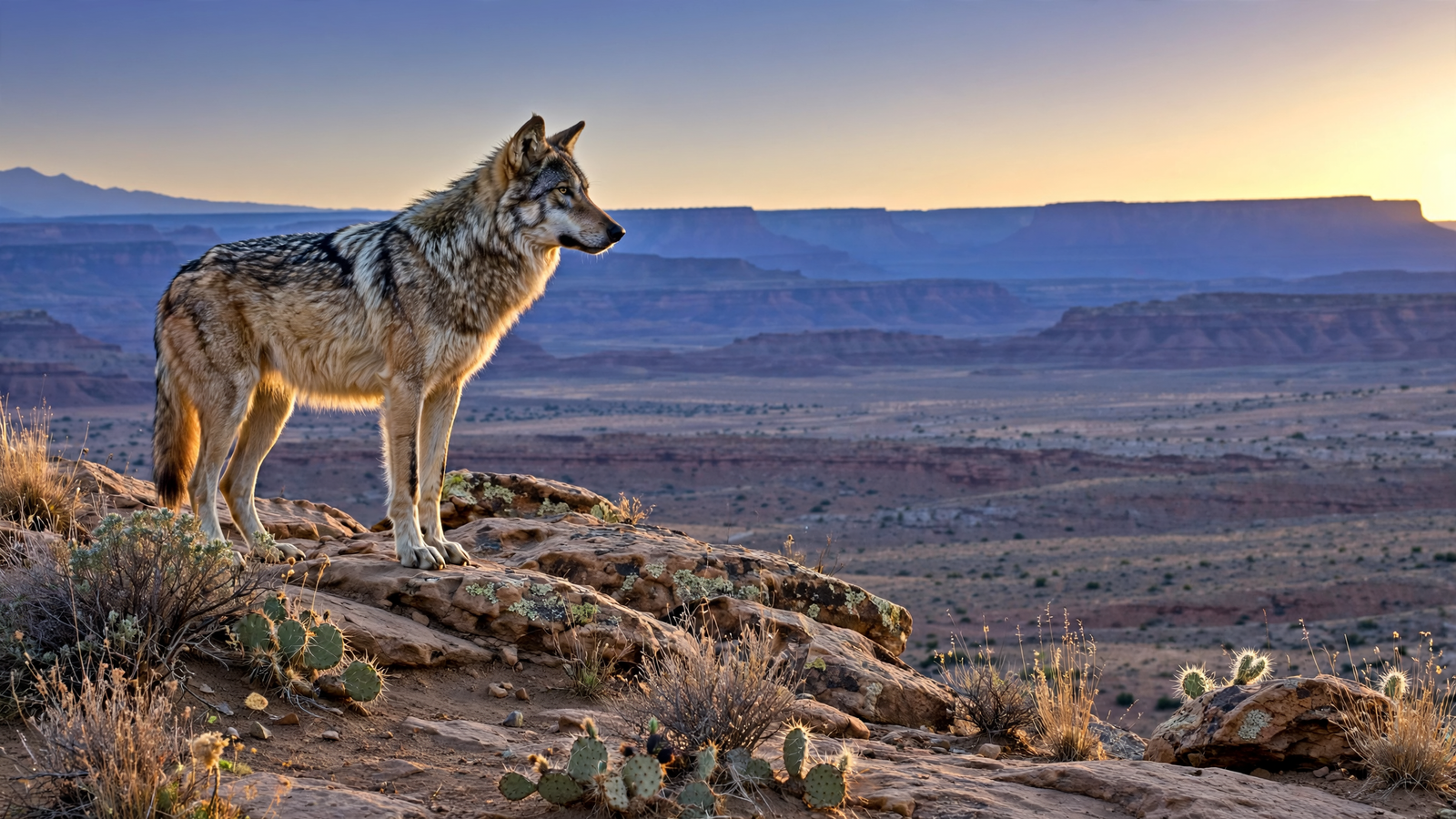
In the high forests of eastern Arizona and western New Mexico, a wolf can pass through a landscape without leaving much evidence behind. A track in the mud, a camera-trap photograph, or a radio signal may be the only sign that one of North America’s rarest mammals is still moving through the mountains. For related reading, see Mexican Gray Wolves Are Growing Their Families in the Southwest.
The Mexican gray wolf is not abundant. Its population remains small, closely monitored, and vulnerable to disease, vehicle collisions, illegal killing, and the loss of genetic diversity. Yet its presence in the Southwest is also a conservation success story. A wild population that once disappeared from the United States is now breeding, dispersing, and raising pups across a broad mountain ecosystem. For related reading, see Europe’s Wild Bison Are Reclaiming the Forest.
That progress did not come from a single dramatic rescue. It came from decades of patient work: protecting the last animals, building a captive-breeding program, releasing wolves into the wild, following their movements, and adjusting the program as scientists learned more about wolf behavior and genetics.
A wolf shaped by the Southwest
The Mexican gray wolf, or Canis lupus baileyi, is the smallest and most southern subspecies of gray wolf in North America. Adults generally weigh less than the larger northern gray wolves, and their coats can include gray, brown, rust, and cream tones. Their smaller size suits a landscape of rugged mountains, pine forests, oak woodlands, and dry valleys.
Historically, Mexican wolves ranged across parts of Arizona, New Mexico, Texas, and Mexico. They lived among elk, deer, javelina, livestock, and smaller prey. As settlement expanded across the Southwest, however, wolves came into conflict with ranching and government predator-control programs. Hunting, trapping, poisoning, and habitat changes pushed the subspecies toward extinction.
By the late 1970s, the remaining wild population in the United States had vanished. The recovery program was able to begin with only a few surviving animals captured in Mexico. Five wolves became the founders of the captive-breeding effort, a genetic bottleneck so narrow that every pairing and every future release mattered.
From five founders to a conservation population
Captive breeding can sound simple when reduced to a number: place animals together, raise pups, and release them. In practice, it is a complicated effort to preserve genetic variety while producing wolves capable of surviving in the wild.
Mexican wolves are managed through a cooperative program involving federal agencies, state wildlife departments, tribal governments, zoos, and other conservation organizations. Wolves in the breeding program are paired according to their family histories. Pups may be moved between facilities so they can be raised with other wolves and maintain a broader genetic representation.
The goal is not to create animals that remain dependent on people. Young wolves must learn the social behavior that allows a pack to function: following adults, traveling together, locating food, defending territory, and raising pups. Whenever possible, the program uses techniques that limit human contact and encourage natural behavior.
That work helped make the first releases possible. In 1998, federal wildlife managers began reintroducing Mexican wolves into the Blue Range Wolf Recovery Area, a large landscape spanning parts of eastern Arizona and western New Mexico. The region’s forests and public lands offered space for packs to establish territories, while radio collars and field teams made it possible to monitor the animals.
What the numbers now show
The population has grown in uneven steps. Some years bring new packs and many pups. Other years bring losses, dispersals, or setbacks. Wolves are long-lived compared with some smaller predators, but they reproduce slowly, and a population founded by so few animals cannot recover overnight.
Even so, the direction has changed dramatically since reintroduction began. The U.S. Mexican wolf population reached a minimum of 286 animals at the end of 2024, according to the annual population survey conducted by the U.S. Fish and Wildlife Service and its partners. That figure represents wolves known or estimated to be living in the wild in Arizona and New Mexico; it is a minimum count rather than a complete census.
The important measure is not only the total number. Biologists also track the number of packs, breeding pairs, pups, survival rates, and the movement of wolves between territories. A pack that produces pups and holds a territory can become the foundation for future growth. A young wolf that leaves its birth pack can connect populations that might otherwise become isolated.
In recent years, wolves have continued to produce pups in the wild, and some have established territories beyond the places where they were first released. That expansion is one of the clearest signs that the animals are doing more than simply surviving in a managed experiment. They are beginning to behave like a functioning wild population.
The value of a predator’s return
Mexican wolves are predators, and their return brings change to the places where they live. By hunting elk and other prey, wolves participate in the natural processes that shape animal numbers and movement. Their presence can influence where prey feed, rest, and travel. Those effects vary from place to place, and scientists continue to study them in the Southwest’s different habitats.
A wolf does not need to be numerous to matter ecologically. Predators help keep food webs connected, and their movements link large areas of public land. A single pack may travel across a territory that is far larger than an urban park or a small protected reserve. That range makes the Mexican wolf a reminder that conservation sometimes depends on landscapes rather than isolated landmarks.
The wolves also carry cultural meaning. For many Indigenous communities, wolves are part of longstanding traditions and relationships with the natural world. A recovery program that treats the animal only as a biological unit would miss that larger context. Conservation is strongest when it recognizes both the ecological role of a species and the human communities that live alongside it.
Recovery requires coexistence
Mexican wolf recovery is not free of disagreement. Wolves sometimes prey on livestock, and ranchers can face real financial and emotional costs when that happens. The recovery program therefore includes tools intended to reduce conflict, such as range riders, carcass removal, fladry, altered livestock practices, nonlethal hazing, and compensation programs in qualifying cases.
Wildlife managers also investigate reports of livestock depredation and may remove or relocate wolves when repeated conflicts occur. The aim is to protect the developing population while making it more practical for wolves and working lands to occupy the same region.
That balance is difficult because the recovery area is not an untouched wilderness. It includes national forests, tribal lands, private ranches, roads, towns, and working landscapes. The future of the wolf will depend partly on what happens outside protected areas, where the decisions of landowners, drivers, hunters, ranchers, and local communities can directly affect survival.
A recovery still in progress
The Mexican gray wolf is not yet secure. Its small population remains vulnerable to inbreeding, disease, illegal shootings, vehicle strikes, and accidents that can remove breeding animals from a pack. A population total can rise while its genetic health or geographic distribution remains a concern.
That is why the breeding program continues. Managers periodically place captive-born wolves or pups into wild dens, a technique known as cross-fostering. The pups are raised by wild adults alongside naturally born siblings, giving them a chance to enter the population without being raised by humans. The method can add genetic diversity while preserving the social advantages of growing up in a wild pack.
Field biologists also use radio collars, genetic samples, remote cameras, and observations from the public to understand where wolves travel and how packs change. Each animal’s story becomes part of a much larger record: who survived, who reproduced, which pups dispersed, and which territories remain available.
The Mexican wolf’s recovery is therefore best understood as an ongoing relationship between science and patience. It demonstrates that conservation does not always restore a species quickly or completely. Sometimes success means moving from disappearance to presence, from a few captive descendants to wild-born pups, and from a recovery plan on paper to animals living out their lives in the landscape.
In the mountains of Arizona and New Mexico, that work has made room for a sound the Southwest nearly lost: the howl of a Mexican gray wolf moving through the forest. The population is still small, but it is no longer only a memory. It is a living, growing possibility.
Use: Species history, legal status, recovery program, reintroduction, and conservation challenges.
Use: Program background, population monitoring, management, and recovery information.
Use: Arizona-specific recovery information, coexistence measures, and state wildlife-management context.
U.S. Fish and Wildlife Service — Mexican Wolf — https://www.fws.gov/species/mexican-wolf-canis-lupus-baileyi — Species history, legal status, recovery program, reintroduction, and conservation challenges.
U.S. Fish and Wildlife Service — Mexican Wolf Recovery Program — https://www.fws.gov/program/mexican-wolf — Program background, population monitoring, management, and recovery information.
Arizona Game and Fish Department — Mexican Wolf — https://www.azgfd.com/wildlife-and-habitat/species-conservation/mexican-wolf/ — Arizona-specific recovery information, coexistence measures, and state wildlife-management context.