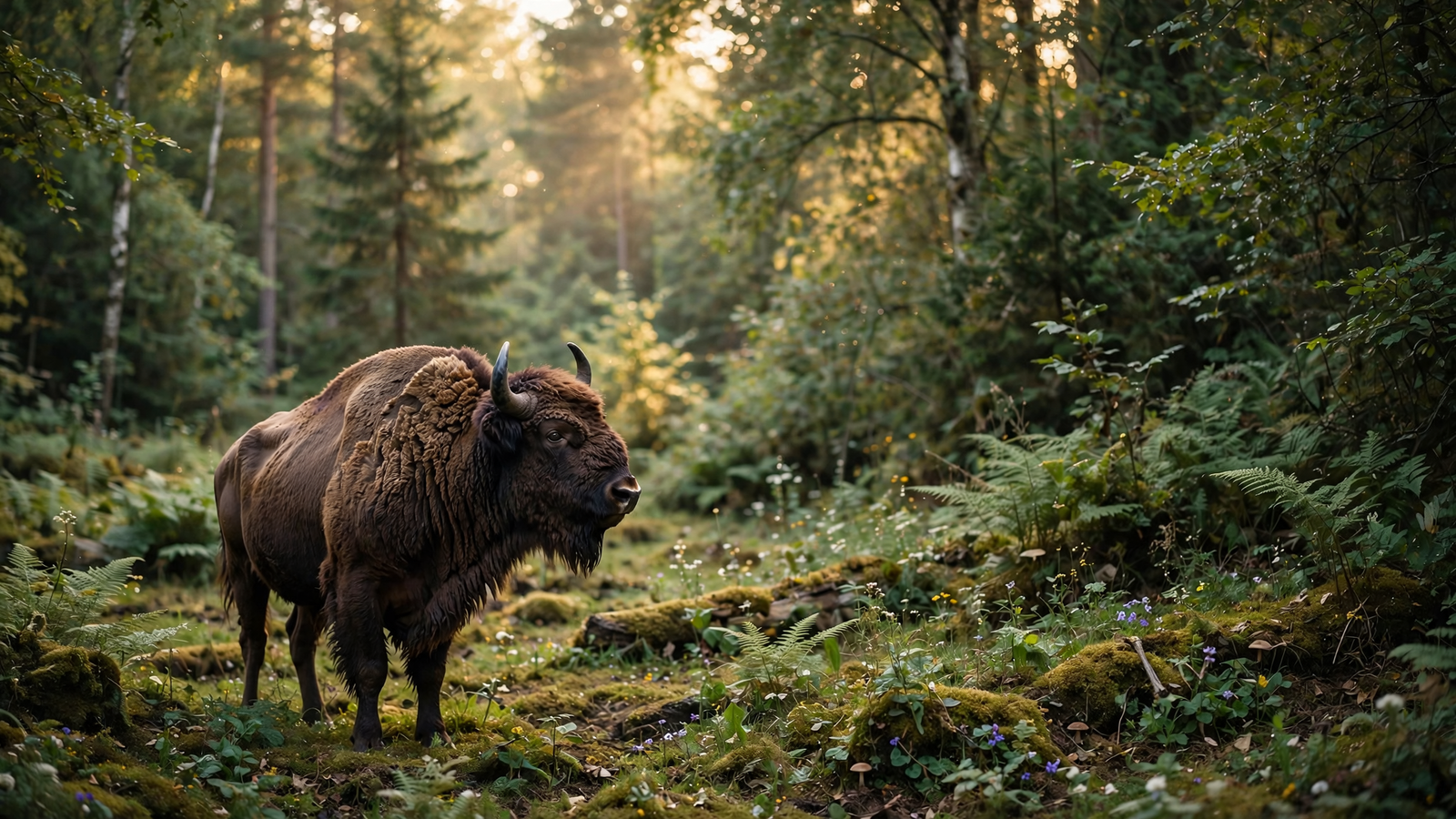
In the quiet forests of eastern Europe, one of the continent’s most remarkable recoveries is taking place on four heavy feet.
The European bison, or wisent, was once widespread across the continent. It appeared in prehistoric art, moved through ancient woodlands and became part of European folklore. But hunting, habitat loss and the upheaval of the First World War brought the species close to extinction. By the early 1920s, no European bison remained in the wild.
Today, herds roam in protected landscapes from Poland and Romania to Spain, Germany and the Netherlands. The recovery is not complete, and the species still depends on careful management. But it represents something rare in modern conservation: a large wild animal brought back from the edge through coordinated work across borders.
A species rebuilt from a tiny remnant
The European bison’s survival depended on animals kept in zoos and private collections. According to the International Union for Conservation of Nature, the global captive population numbered only a few dozen individuals after the wild population disappeared. Conservationists began organizing breeding programs, recording pedigrees and trying to preserve as much genetic diversity as possible.
That genetic history remains important. Modern European bison descend from a very small number of founders, which means the population has a limited gene pool. Carefully planned breeding and the movement of animals between herds are still used to reduce the risks associated with inbreeding.
The first major step was to return bison to protected areas. Poland’s Białowieża Forest became one of the best-known centers of the effort. The forest, which straddles the Polish-Belarusian border, contains some of Europe’s last remaining lowland old-growth habitat and had long been associated with the species.
From there, bison conservation expanded into a much wider European project. Zoos, national parks, universities, wildlife organizations and government agencies began working together to establish new herds in places where the animals had disappeared.
From reintroduction to natural behavior
Releasing an animal is only the beginning of a reintroduction. Conservation teams must assess food availability, forest structure, disease risks, roads, fencing and the attitudes of nearby communities. Some herds require supplementary feeding during difficult winters, while others are intended to become increasingly self-sufficient.
European bison are often described as forest animals, but they use a mosaic of habitats. They browse shrubs and young trees, graze grasses and move between woodland clearings, meadows and open land. Their feeding can help maintain varied vegetation, creating opportunities for insects, birds and other species that depend on a mixture of dense cover and open space.
That makes the bison more than a symbol. It is also an ecological participant. A large herbivore can influence where plants grow, how vegetation develops and how landscapes change over time. The precise effects differ from one location to another, but restoring the animal can help restore some of the natural processes that disappeared with it.
A recovery measured in more than one way
The IUCN’s assessment of the European bison recorded a substantial increase in numbers and distribution during the decades after reintroduction programs began. In 2020, the species was moved from “Vulnerable” to “Near Threatened” on the IUCN Red List—a meaningful improvement, though not a declaration that the work is finished.
Population estimates vary by year and by whether they include captive animals, semi-wild herds or only free-ranging populations. The important trend is clear: from a species that survived only because of a small captive remnant, Europe now has thousands of bison living in the wild or in large, open reserves.
Some of the most ambitious projects focus on landscapes where people and wildlife share space. In the Netherlands, for example, bison have been introduced into nature reserves near communities and agricultural areas. In Romania’s Southern Carpathians, conservation groups have worked to establish free-ranging herds in a region where the animals can help reconnect fragmented habitats.
These projects require local support. A bison can weigh hundreds of kilograms, damage crops if it wanders into farmland and create safety concerns near roads. Successful conservation therefore depends on monitoring, public information, compensation systems and practical rules for managing encounters—not simply on releasing animals and hoping for the best.
The lesson behind the comeback
The European bison’s return is sometimes told as a simple story of rescue: a species vanishes, people breed it, and the animal comes back. The reality is slower and more complicated. The bison remains genetically vulnerable, its populations are unevenly distributed and many herds are small. Disease outbreaks, habitat fragmentation and conflict with land users can still undermine progress.
Yet the story is hopeful precisely because it is practical. It shows what can happen when conservation is treated as a long-term public project rather than a single dramatic intervention. Zoos contributed animals and expertise. Scientists tracked family lines. Governments protected habitat. Local groups helped manage landscapes. Organizations in different countries shared animals and information.
It also demonstrates that “wild” does not always mean untouched. Much of Europe is a lived-in landscape, shaped by farms, roads and towns. Bringing back a large mammal in such a setting requires negotiation and planning. When that work succeeds, conservation can create room for wildlife without pretending that people are absent.
The European bison is still a species to watch, not a problem solved. But its presence in forests and open reserves across the continent is a powerful reminder that ecological loss is not always irreversible. Given protected habitat, careful science and enough time, even a species that disappeared from the wild can begin to belong there again.