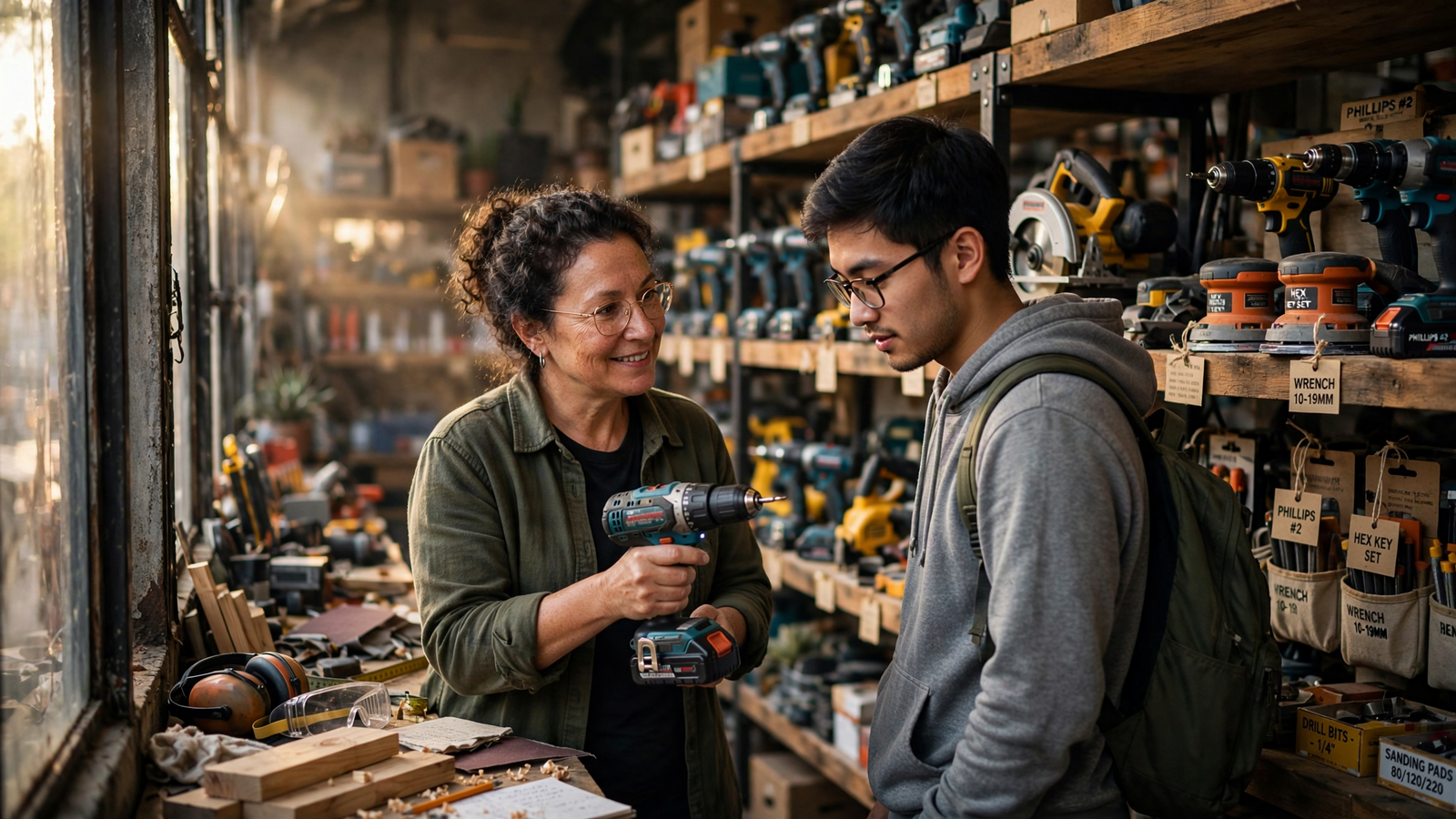
A home repair often begins with a deceptively simple question: Do we have the right tool?
For many households, the answer is no. A loose cabinet hinge may require a drill. A garden project may call for a soil cultivator. A bicycle repair may depend on a specialized wrench used only once every few years. Buying each item can be expensive, and storing it all can turn a closet, garage, or basement into a museum of postponed projects.
Tool libraries offer another answer: borrow it.
Like public libraries that lend books, tool libraries make shared equipment available for household work. Patrons can check out drills, saws, ladders, gardening equipment, sewing machines, automotive tools, and other practical items, depending on the collection. Some programs operate through public libraries. Others are independent nonprofits, neighborhood organizations, or membership-based cooperatives.
The idea is modest, but its effects reach beyond a single repair. A tool library can make home improvement more affordable, reduce the need to purchase rarely used goods, and give people a place to learn skills alongside their neighbors. It changes the meaning of ownership from “every household needs one” to “the community can keep one available.”
A library for the things between projects
One of the best-known examples is the Tool Lending Library operated by the Berkeley Public Library in California. The program began in 1979 and has grown into a collection of more than 3,500 tools, according to the library. Berkeley residents can borrow equipment for home repair, maintenance, gardening, and related projects.
The collection reflects a useful truth about domestic life: many tools are essential occasionally, not constantly. A homeowner may need a post-hole digger for one weekend, a pipe wrench for one plumbing job, or a floor sander for one renovation. A renter may need a stud finder or a small drill for hanging shelves. A community collection can serve all of those short bursts of need without requiring every person to maintain a full workshop. For related reading, see 826 Valencia: How a Pirate Supply Store Made Writing Feel Possible.
Public tool libraries also extend the traditional mission of libraries. A library is not only a place to obtain information; it can be a place to obtain the means to act on that information. Someone can read about repairing a gate, borrow the needed tool, and return with a working gate rather than a new purchase.
That combination of knowledge and equipment matters. Instructions are more useful when a person has a realistic way to try them. A tool is more empowering when the borrower can learn how to use it safely and understand what the job requires.
Small repairs, larger confidence
Home maintenance is often presented as a question of expertise. In practice, it is frequently a question of access: access to equipment, time, advice, and a low-risk opportunity to practice.
Borrowing can lower the first barrier. A person who would hesitate to spend $100 or more on a specialized tool may be willing to borrow it for a weekend. That first attempt can turn an intimidating task into a familiar one. The next repair may take less time, and the person may feel more comfortable asking questions or helping someone else.
Tool libraries can also make room for kinds of work that are easy to overlook. Gardening tools support community plots and backyard growing. Sewing and craft equipment can help people mend or adapt clothing. Bike tools can keep a working bicycle on the road. Basic construction equipment can help a household install shelves, repair a fence, or improve storage.
Not every project belongs in the do-it-yourself category. Electrical, structural, gas, roofing, and other high-risk jobs may require a licensed professional or specialized training. A responsible tool-lending program does not erase that distinction. Instead, it can help borrowers recognize the difference between a manageable task and one that deserves expert attention.
The environmental value of sharing
The environmental case for tool libraries is straightforward, though it should not be exaggerated. Manufacturing any tool uses materials and energy, and a tool that sits unused for years represents an inefficient use of those resources. Sharing can increase the amount of work obtained from each item already in circulation.
The U.S. Environmental Protection Agency places reuse near the top of the waste-reduction hierarchy because keeping products in use avoids the need to make and dispose of replacements. Tool libraries apply that principle to household equipment. They do not eliminate manufacturing, and they cannot make every project waste-free. But they offer a practical alternative to buying an item for a single task and discarding or forgetting it later. For related reading, see The Cuyahoga River’s Recovery Shows What Clean Water Can Make Possible.
Shared equipment can also support repair rather than replacement. A broken chair, loose gate, or damaged bicycle may still have useful life. When the right tool is available, the household has another option besides sending the object away and buying a new one.
That is one reason tool libraries fit naturally into the broader “library of things” movement. Some libraries lend kitchen appliances, board games, musical instruments, museum passes, hotspots, or outdoor equipment. The common idea is simple: a public or community institution can help people access useful goods without turning every item into an individual purchase.
What makes a tool library work
The tools themselves are only part of the model. A successful program also needs systems for safety, maintenance, lending rules, and inclusion.
- A practical collection: The most useful items are often not the most glamorous. Basic drills, screwdrivers, levels, clamps, ladders, shovels, pruners, and hand saws can support a wide range of household projects.
- Clear checkout policies: Borrowers need to know who is eligible, how long an item may be kept, whether reservations are allowed, and what happens if equipment is damaged or returned late.
- Maintenance and inspection: Tools need to be cleaned, tested, repaired, and retired when they are no longer safe. A collection is an ongoing service, not a one-time donation pile.
- Accessible guidance: Labels, instruction manuals, demonstrations, and knowledgeable staff can help new users understand what a tool does and what it does not do.
- Safety expectations: Protective equipment and safe operating instructions matter, particularly with power tools, ladders, cutting equipment, and anything used outdoors.
Berkeley’s program is especially notable because it has operated for decades within a public library system. Its longevity suggests that tool lending can become ordinary civic infrastructure rather than a novelty. Elsewhere, independent programs have developed their own approaches. The North American Tool Library in Portland, Oregon, for example, operates as a nonprofit tool-lending organization and combines borrowing with community-oriented education and repair culture.
A different kind of household economy
There is a quiet emotional benefit to borrowing tools: it can make a household feel less alone.
Home projects are often isolated experiences. A person discovers a problem, searches for instructions, shops for equipment, and tries to solve it without knowing whether the solution will work. A tool library inserts a human institution into that process. The borrower has a place to ask what an item is for, whether it is appropriate for a particular task, and how to return it in good condition. For related reading, see The Humpback Whale’s Return Shows What Protection Can Make Possible.
That connection can grow into informal knowledge-sharing. One member explains how to sharpen a hedge trimmer. Another learns to patch a wall. Someone who once borrowed a tool may later volunteer at a repair event or donate equipment that is no longer being used. Over time, the library becomes more than a storage room. It becomes a local memory of how things get fixed.
The model also offers a more realistic vision of sustainability than asking every individual to buy premium, long-lasting versions of everything. Durable goods are valuable, but not every household can afford them, and not every home has room for them. Shared access distributes usefulness more broadly.
How to find one near you
Availability varies widely. Some tool libraries are free to residents with a library card. Others charge a small membership fee, request a deposit, or limit borrowing to people who attend an orientation. Collections may be housed in a branch library, a nonprofit workshop, a makerspace, or a neighborhood center.
To look for one, search a local library system for “tool lending library,” “library of things,” or “things library.” It is also worth checking city sustainability offices, community repair groups, maker organizations, and bicycle cooperatives. A nearby program may not use the words “tool library” even if it lends equipment.
Before borrowing, check the rules carefully. Confirm that the tool is suited to the job, read the operating instructions, use recommended protective equipment, and ask for help if anything is unclear. For major repairs, consult a qualified professional rather than treating a loaner tool as a substitute for expertise.
The larger lesson is encouraging. A household does not need to own every object it may someday need. Sometimes the most useful thing in the neighborhood is not a new product, but a well-maintained one waiting on a shelf for its next useful life.
Use: Program history, location context, lending purpose, and reported collection size.
Use: Example of an independent nonprofit tool-lending organization and its community-oriented model.
Use: Reuse and waste-reduction context.
Use: General tool-safety context and the importance of safe operating practices.
Berkeley Public Library, Tool Lending Library — https://www.berkeleypubliclibrary.org/locations/tool-lending-library — Program history, location context, lending purpose, and reported collection size.
North American Tool Library — https://www.northamericantool.org/ — Example of an independent nonprofit tool-lending organization and its community-oriented model.
U.S. Environmental Protection Agency, Reducing Waste: What You Can Do — https://www.epa.gov/recycle/reducing-waste-what-you-can-do — Reuse and waste-reduction context.
U.S. Occupational Safety and Health Administration, Hand and Power Tools — https://www.osha.gov/hand-power-tools — General tool-safety context and the importance of safe operating practices.