Each autumn, whooping cranes leave the wetlands of northern Canada and begin a journey toward the Gulf Coast. Their route follows a chain of marshes, shallow ponds, grasslands, and river valleys—places where the birds can rest, feed, and shelter before continuing south.
That migration is more than a seasonal spectacle. It is evidence that one of North America’s most endangered birds has been given room to recover.
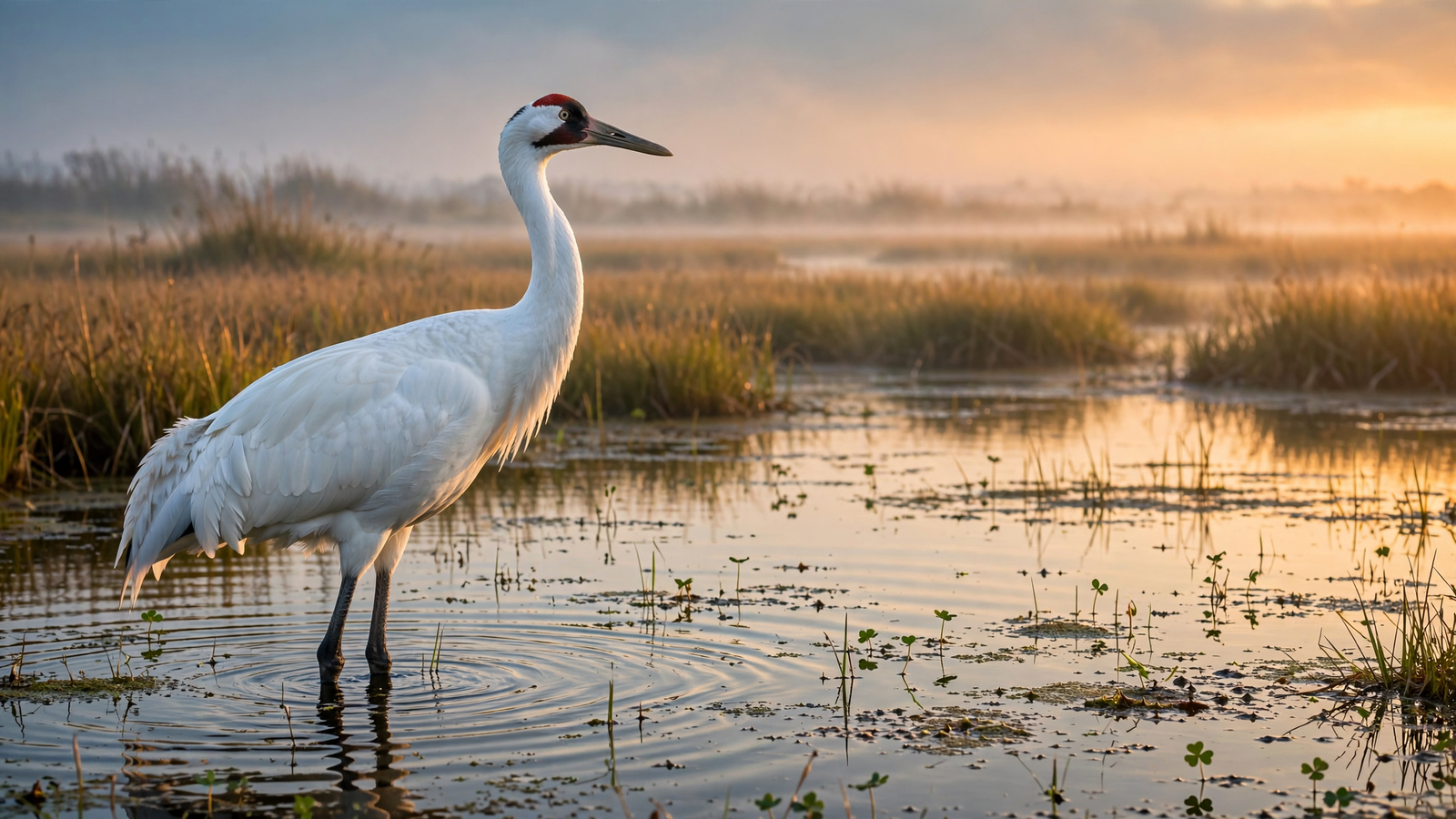
The whooping crane is the tallest bird in North America, standing nearly five feet high with a wingspan of about seven feet. Its white body, black wingtips, red crown, and trumpet-like call make it difficult to mistake. But by the middle of the 20th century, the species had nearly disappeared.
From a few dozen birds to a growing population
Hunting, habitat loss, and the conversion of wetlands for agriculture had reduced the whooping crane population to roughly two dozen birds in the 1940s. The remaining wild flock migrated between Wood Buffalo National Park in Canada and the Aransas National Wildlife Refuge on the Texas coast.
Protection under the Migratory Bird Treaty Act and the Endangered Species Act helped halt the decline. Scientists and conservationists also began protecting nesting and wintering areas, reducing disturbance, and studying the birds’ migration routes.
Those efforts did not produce an overnight turnaround. Whooping cranes mature slowly, raise only a small number of chicks, and depend on wetlands spread across two countries. Recovery required decades of monitoring and cooperation among federal agencies, state and provincial governments, private landowners, Indigenous communities, and conservation groups.
Today, the main wild migratory population numbers more than 500 cranes, according to the U.S. Fish and Wildlife Service and the International Crane Foundation. The species is still endangered, but it is no longer balanced on the edge of immediate disappearance.
A recovery built around habitat
The cranes’ progress shows why conservation is often less about one dramatic intervention than about protecting an entire landscape. During migration, a single bird may use many different stopover sites. Losing one wetland can make the journey more difficult, especially when drought or severe weather reduces food and shelter elsewhere.
At Aransas National Wildlife Refuge, whooping cranes feed in coastal marshes and shallow bays. Farther north, they nest in boreal wetlands. Along the migration corridor, conservation areas and working farms can provide important resting places when they are managed with wildlife in mind.
Researchers also track the birds with bands, observations, and surveys. That information helps managers identify important habitat and understand how changing water conditions affect the population. The work is practical and sometimes painstaking, but it gives conservationists a clearer picture of what the cranes need.
Why the cranes matter beyond their numbers
The whooping crane’s return is a reminder that endangered-species recovery can succeed when protection lasts longer than a news cycle. The birds benefited from laws, refuges, captive-breeding programs, habitat restoration, and international coordination working together.
Their recovery also benefits other species that share the same wetlands. Protecting marshes for cranes preserves habitat for waterfowl, shorebirds, amphibians, fish, and countless insects. In that sense, the crane serves as both a conservation success and a guide to the health of the places along its route.
There is still work ahead. The species remains vulnerable to habitat loss, drought, storms, disease, and collisions with power lines. But every migration completed by a healthy flock carries a hopeful message: with enough time, care, and connected habitat, a species can find its way back.