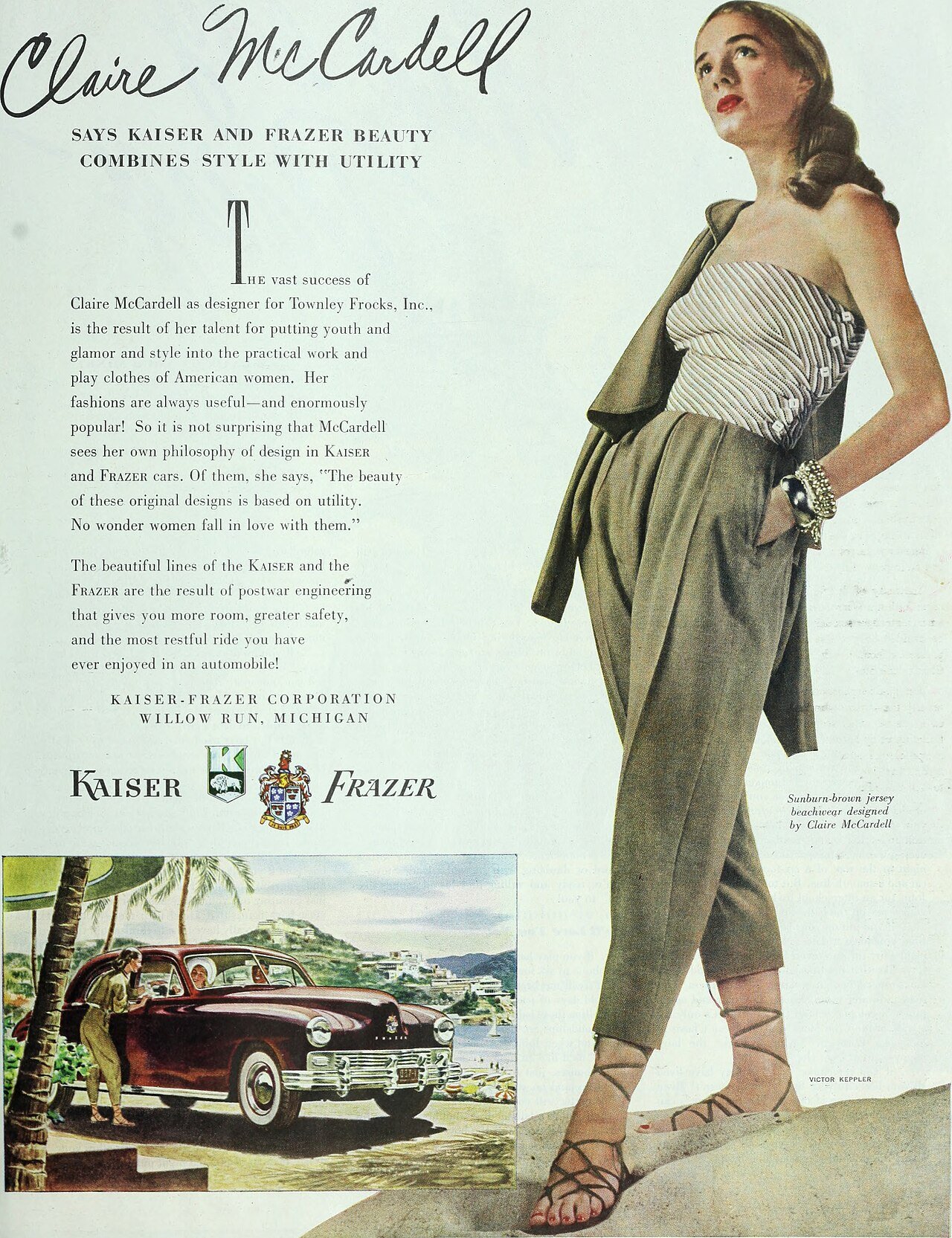
Fashion history often remembers the dramatic: the runway entrance, the sculptural gown, the silhouette that announces a new era. Claire McCardell made her case another way. Her clothes were meant to be worn—to sit in, walk in, travel in and get through the day. In the process, she helped establish a distinctly American approach to style: informal, adaptable and attentive to how people actually live.
McCardell was born in Frederick, Maryland, in 1905. After studying art and fashion, including time at the New York School of Fine and Applied Arts—now Parsons School of Design—she entered the New York garment industry. Her career unfolded as American designers were working to define a fashion identity beyond the influence of Paris couture. McCardell’s answer was not a rejection of elegance. It was a different idea of what elegance could do.
Design that started with the wearer
McCardell is associated with American sportswear, a broad category of clothing built around separates and everyday use rather than formal, head-to-toe dressing. The term does not mean only athletic clothes. It describes a way of designing that made room for a woman to combine pieces, move freely and dress for more than one occasion.
That approach took shape in details. McCardell favored practical closures, adjustable ties and pockets—features that could make a garment easier to put on or more useful once it was worn. She also worked with fabrics and shapes that suited an active daily life. The point was not to hide the body inside a rigid structure, but to make clothes that could work with it.
Her designs did not emerge in isolation. American women already adapted clothing to work, travel and changing routines, and the country had a growing ready-to-wear industry capable of making designer ideas available beyond a couture salon. McCardell’s importance lies in how clearly and consistently she brought those realities into fashion design.
The Monastic dress and a new kind of ease
One of her best-known early designs was the Monastic dress, introduced in the late 1930s. Its uncomplicated shape and waist tie offered a different proposition from clothing built around elaborate fitting. A wearer could adjust the tie to shape the dress, making the garment more flexible across bodies and occasions.
The dress became a signature, but its significance is larger than a single successful style. It showed how a simple form could feel deliberate rather than plain. Ease, in McCardell’s hands, was not the absence of design. It was the design.
That distinction helps explain why her work still reads as modern. A garment that can be adjusted, layered or worn in more than one setting offers a kind of freedom that does not depend on a trend. McCardell treated those practical choices as part of fashion’s creative vocabulary.
A “Popover” for life as it was lived
In 1942, McCardell introduced the Popover dress, a wrap-style garment associated with the practical demands of wartime life. Its design included a large pocket and a matching oven mitt, an unusual pairing that made the dress’s usefulness part of its identity. The idea was direct: a garment could be attractive and still acknowledge the work that filled a day.
The Popover was also a ready-to-wear design, made for production and everyday customers rather than only for a private couture client. That mattered in a period when fabric and resources were constrained and daily routines were changing. McCardell was not simply decorating a wartime moment; she was showing how thoughtful design could meet its conditions.
Her career offers a reminder that fashion is shaped by manufacturing and access as much as by individual taste. A clever design has a different cultural reach when it can be produced and bought. McCardell’s work helped make the case that American-made clothing could be both practical and distinctive.
Making an American fashion language
McCardell worked for Townley Frocks, the New York company that produced many of her designs. Rather than treating American fashion as a lesser copy of European luxury, she drew strength from the country’s ready-to-wear system and its less formal habits of dress. Her clothes reflected a culture in which people mixed separates, traveled, worked and expected garments to serve more than one narrow purpose.
That sensibility became a lasting feature of American sportswear. It can be seen in the enduring appeal of wrap dresses, useful pockets, comfortable flats and pieces designed to coordinate without requiring a complete matching outfit. McCardell did not invent every element associated with the category, but she helped give the approach a memorable and influential form.
Her work also complicates the idea that practicality is the opposite of style. In McCardell’s designs, function was visible and purposeful: a tie that adjusted fit, a pocket placed to be used, a shape that allowed movement. Those details did not diminish the clothes. They were how the clothes expressed their point of view.
A legacy in the everyday
McCardell died in 1958, but her influence is easiest to recognize not in a single look copied unchanged, but in the expectations she helped establish. Clothes should fit the circumstances of life. They should let the wearer participate in choosing how they sit and move. And usefulness can be a source of beauty, not a compromise with it.
That is a quieter legacy than a fashion revolution defined by one spectacular silhouette. It is also a durable one. Whenever a designer makes comfort, adaptability and ordinary use central to a collection, the question McCardell pressed into American fashion returns: what if getting dressed began with the person wearing the clothes?