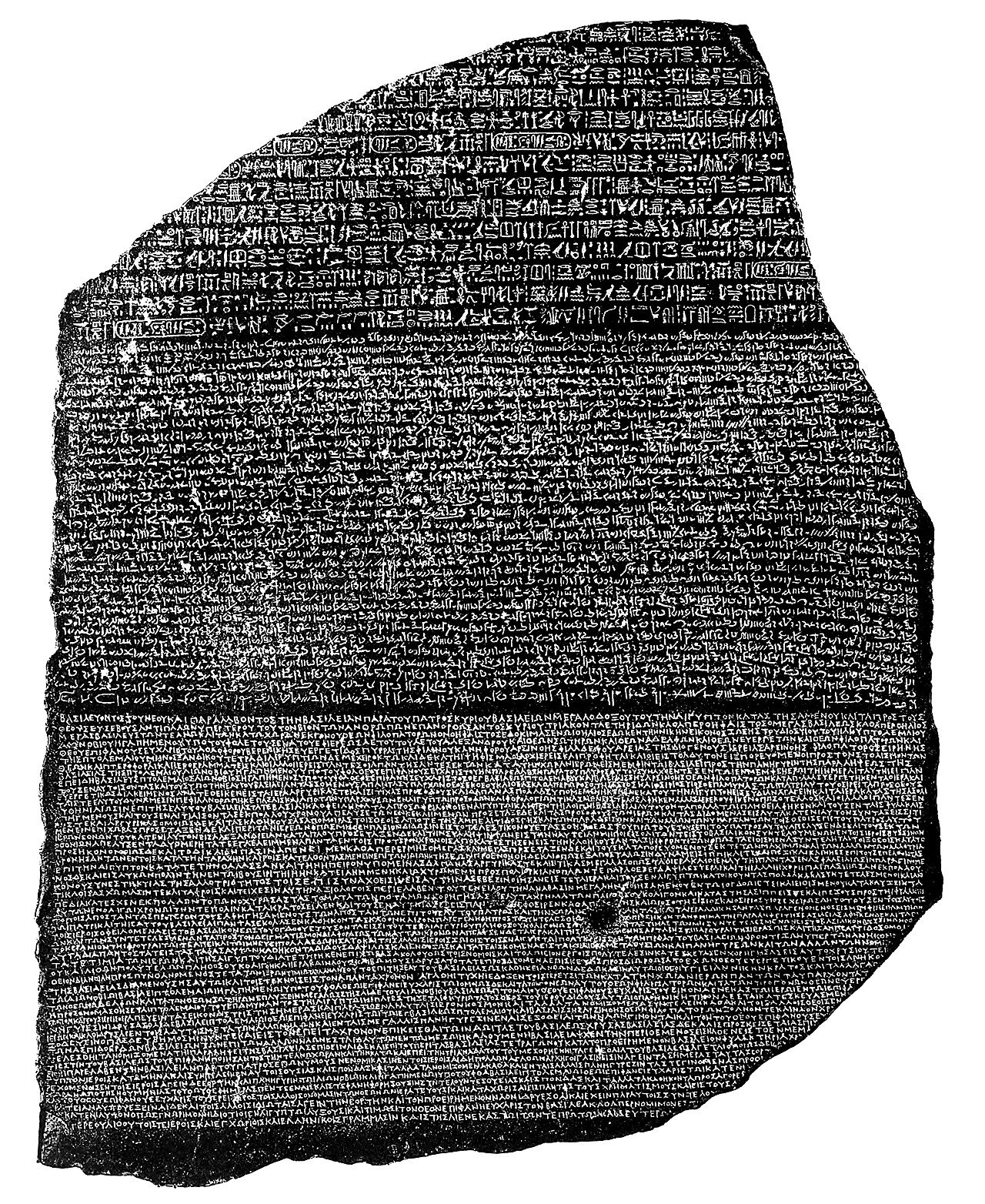
For centuries, Egyptian hieroglyphs were visible on temples and monuments but no longer widely readable. The Rosetta Stone did not solve that puzzle by itself. It offered something more practical: the same official decree inscribed in three writing systems, including ancient Greek, which scholars could read. By comparing the versions—and building on earlier work—researchers began to recover how ancient Egyptian writing worked.
The stone is a fragment of a larger slab, not a complete document. Its decree dates to 196 BCE, during the reign of Ptolemy V. Issued by a council of Egyptian priests, the text records honors for the king and instructions for publicizing them. The surviving inscriptions use hieroglyphic, Demotic and ancient Greek scripts. Their presence on one monument turned a royal proclamation into an unexpected tool for linguistic research.
A decree in three scripts
The scripts served different purposes in Ptolemaic Egypt. Hieroglyphs were associated with formal monumental and religious settings; Demotic was a widely used form of Egyptian writing; and Greek was the language of the ruling administration. These were not three entirely separate messages. They conveyed substantially the same decree, although the versions are not exact, line-for-line translations.
That distinction matters. The stone was not a ready-made word list in which every Greek term had a matching Egyptian equivalent. The texts differ in length and detail, and the Egyptian scripts were unfamiliar. Still, the Greek version supplied a foothold: scholars could identify the general subject of the decree and compare recurring names and phrases across the inscriptions.
The stone entered European scholarly attention after French soldiers found it in 1799 near the town of Rashid, known in European languages as Rosetta, during Napoleon’s campaign in Egypt. French forces were working on fortifications when the fragment came to light. After the French surrender in Egypt, the stone passed to the British and was transported to England. It has been held by the British Museum since 1802.
Comparison, copies and competing clues
Making the inscription useful required more than possessing the stone. Scholars needed accurate copies that could be examined far from the artifact. Printed reproductions circulated, allowing researchers across Europe to compare the scripts and test ideas against the same evidence.
One important clue came from the oval shapes, called cartouches, that enclose certain hieroglyphic groups. Thomas Young, an English scholar, investigated the signs in cartouches and connected some of them with royal names, including Ptolemy. That helped show that at least some hieroglyphic signs could represent sounds, rather than functioning only as symbols for whole ideas or words.
Jean-François Champollion carried the analysis further. His knowledge of Coptic—a language descended from ancient Egyptian and still used in the Egyptian Christian tradition—gave him a way to reason about the language behind the signs. In 1822, he announced a breakthrough in deciphering hieroglyphs. His work drew on the Rosetta Stone, but also on other inscriptions, prior scholarship and the insight that Egyptian writing could combine phonetic signs with signs for words or meanings.
So the familiar story of one brilliant person “cracking the code” compresses a longer process. Young’s research and the contributions of other scholars formed part of the path; Champollion’s work helped establish a more powerful reading of the writing system. The stone mattered because it made comparison possible, not because it contained a complete translation key.
Why one damaged object mattered
The Rosetta Stone is damaged, and much of its original inscription is missing. Even so, its value lay in the relationship between what survived: a readable Greek text beside two forms of Egyptian writing. That arrangement gave researchers a chance to test interpretations against parallel material, rather than treating hieroglyphs as mysterious pictures in isolation.
It also illustrates how documents can outlive their original purpose. The decree was made to affirm a king’s status and direct how his honors should be displayed. Its authors could not have anticipated that, many centuries later, the same public inscription would help scholars reconstruct a language’s written history.
Today, the stone is both an artifact and a reference point in the history of scholarship. It did not make ancient Egypt instantly transparent, and the work of reading inscriptions continues to depend on context, expertise and comparison. But it helped turn hieroglyphs from an apparently closed system into writing that could be studied systematically. A fragment of a political decree became a bridge between scripts—and a reminder that knowledge often advances when records can be compared.