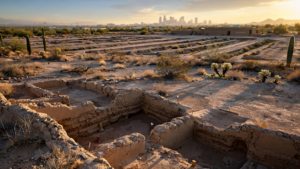
From the top of Monks Mound, the view stretches across the flat Mississippi River plain toward the modern skyline of St. Louis. The two places seem to belong to different worlds. But for centuries before St. Louis existed, a major city stood on this ground: Cahokia, an Indigenous urban center built from earth, timber and human labor.
The remains are in southwestern Illinois, near Collinsville and across the river from St. Louis. Today, Cahokia Mounds State Historic Site preserves part of a much larger archaeological landscape. Its grassy mounds can look quiet and isolated, but they once formed a connected city of homes, gathering places and monumental construction. UNESCO lists Cahokia Mounds as a World Heritage Site, recognizing its importance as a major pre-Columbian settlement.
A city built around open space
Cahokia developed over many centuries, but its greatest growth came around the 11th century. Archaeologists use the name Mississippian for the broad cultural tradition associated with Cahokia and other communities across much of the central and southeastern parts of what is now the United States. Cahokia was its largest known center.
At its height, the city may have held many thousands of people. Population figures are estimates, not a count from a census, and sources vary. What is clear from the site is the scale of the place: a broad central plaza surrounded by earthen mounds and residential areas, with settlements extending beyond the portion now preserved as the historic site.
The plaza was not simply empty ground between buildings. Open spaces could bring people together for gatherings, ceremonies, trade and other shared activities. The mounds, meanwhile, were not all the same. Some supported buildings or elevated platforms; others were used for burials or had different roles. Their arrangement gives archaeologists clues about how people organized public and ceremonial life, although the precise meaning of every mound is not known.
Monks Mound and the work beneath it
Monks Mound dominates the site. It is the largest earthen mound at Cahokia and the largest prehistoric earthen construction in the Americas, according to UNESCO. It rises above the surrounding plain in a series of terraces, with broad steps leading toward its summit. The name comes from French Trappist monks who farmed nearby land in the 19th century; it does not describe the mound’s original builders or purpose.
The mound was built in stages, with layers of earth carried and placed by hand. Its size makes the labor visible, but it also points to planning: people had to gather soil, move it, maintain the structure and coordinate work over time. Archaeological evidence indicates that substantial buildings once stood on the summit. Because the original structures were made of perishable materials, the mound’s present-day appearance is only part of the story.
Construction at Cahokia was not a one-time project. Mounds and buildings changed over generations, as communities altered the landscape to suit new needs. The earthworks are therefore better understood as a record of an evolving city than as a single completed design.
Woodhenge: a circle of posts, not stone
Another striking feature is Woodhenge, a series of large wooden post circles identified through archaeological evidence. The posts themselves have not survived, but postholes reveal where they stood. Reconstructions at the site help visitors picture the circle’s scale and layout.
Some of the post-circle arrangements align with important solar events, including the solstices. That makes Woodhenge a useful reminder that Cahokia’s residents observed the sky and built with attention to seasonal cycles. It does not, by itself, tell us every purpose the circles served. They may have had ceremonial or calendrical significance, but interpreting their role requires care rather than assuming a single explanation.
What the remains can—and cannot—tell us
Cahokia was connected to a wide network of communities. Archaeologists have found materials at the site that came from beyond the immediate region, evidence of exchange and movement across long distances. The city’s position near the Mississippi also placed it within one of North America’s major travel corridors.
Its growth did not continue indefinitely. Cahokia’s population and influence declined over time, and people eventually left the central settlement. Researchers study possible factors including environmental change, political and social shifts, and pressure on local resources. The evidence does not point to one simple explanation, and the details remain an area of research.
It is also important not to treat Cahokia as a vanished people with no present-day relevance. “Cahokia” and “Mississippian” are terms used in archaeology to describe a place and a broad cultural tradition. They do not substitute for the identities of Indigenous nations today. The site’s remains offer evidence of a remarkable society, while living Native communities carry their own histories, identities and connections to the continent.
Reading the landscape today
Walking the site makes its scale easier to grasp. From the central plaza, Monks Mound appears less like a hill than a built landmark, and the surrounding earthworks turn a seemingly open field into a carefully shaped environment. The mounds are not just scenic features: they are archaeological resources, and visitors should stay on designated paths and follow site guidance.
Cahokia’s significance lies partly in how it changes the mental map of North American history. Long before European colonization, people here created a dense, planned center with monumental architecture and links to communities across a vast region. The mounds still stand in the Mississippi plain, not as a mystery to be solved in a single visit, but as evidence of a city whose full story continues to emerge through research and Indigenous knowledge.