In the expansive geological record of the American Southwest, human habitation and deep prehistoric time frequently cross paths. While Arizona is widely recognized for its petrified wood, canyon exposures, and Mesozoic fossils, older strata occasionally emerge in unexpected places. On private land in Arizona, an unexpected discovery of fossilized tracks left by creatures that walked the Earth before the appearance of dinosaurs has highlighted just how close the ancient past lies beneath modern soil. The find also offers a reminder that evidence of ancient life is not limited to dramatic skeletons or carefully excavated sites: traces preserved in ordinary-looking stone can record animals moving through their environment.
A Surprise in Stone
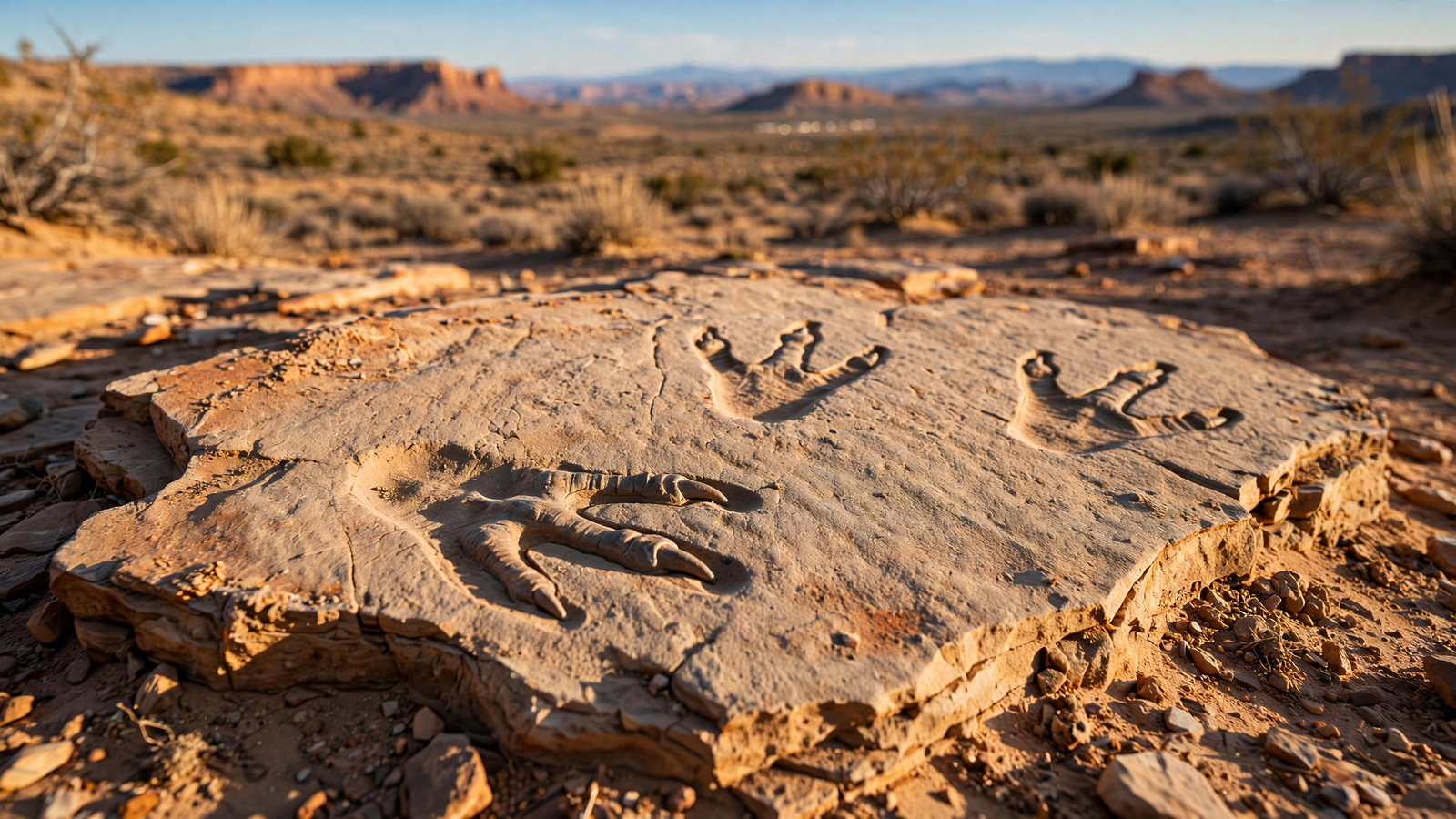
Everyday encounters with bedrock rarely hint at the complex ecosystems preserved beneath modern foundations. In Arizona, where layered sedimentary formations define plateaus, valleys, and river basins, rock surfaces frequently weather to expose cross-sections of ancient environments. An alert resident examining his property recognized that marks etched into stone were not random cracks or recent depressions, but fossil trackways. Distinguishing a track from an irregularity in the rock depends on noticing the shape and arrangement of the marks, rather than assuming that every indentation has a biological origin.
Rather than skeletal remains, trackways represent trace fossils—physical evidence of living organisms interacting with their immediate habitat. Footprints capture real-time behavior: stride length, pace, group dynamics, and substrate moisture. For paleontologists and geologists, identifying tracks that predate the dawn of the dinosaurs shifts the timeline back into the Paleozoic Era, an epoch hundreds of millions of years old when early land-dwelling animals were pioneering life away from coastal waters. Unlike bones, which preserve parts of an animal’s body, a trackway records an action. The marks can therefore offer information about how an animal moved across the surface as well as about the ground on which it walked.
The World Before the Dinosaurs
Popular fascination with ancient life often centers on towering reptiles such as sauropods and theropods of the Jurassic and Cretaceous periods. Yet long before those animals evolved, diverse lineages of tetrapods—four-limbed vertebrates including early amphibians, stem reptiles, and synapsids—inhabited continental landscapes. The tracks from this earlier world belong to a much broader story of vertebrates living and moving on land, rather than to the familiar age of dinosaurs.
During periods like the Carboniferous and Permian, extensive floodplains, dunes, and coastal mudflats covered regions that now form the arid plateau country of Arizona. Animals of varying sizes navigated damp sediment, leaving clear paw, claw, and digit impressions. When mineral-rich sediments gently buried these footprints before wind or water could wash them away, the impressions gradually hardened into rock under immense pressure over geological epochs. The sequence matters: an imprint first had to form in a suitable surface, then be covered and preserved, before it could eventually become visible again through exposure of the rock.
- Synapsids: Often described as mammal-like reptiles, these diverse quadrupeds flourished across ancient landmasses long before dinosaurs appeared. Their place among the ancient animals represented in the broader account helps illustrate how varied life on land was before the familiar dinosaur groups.
- Early Tetrapods: Splay-legged walkers and primitive amphibians whose tracks provide key evidence regarding the evolution of terrestrial gait and balance. Their impressions can preserve aspects of movement that are difficult to infer from remains alone.
- Trace Fossils: Distinct from bone mineralizations, trace fossils preserve movement patterns, gait speeds, and environmental conditions at the moment of deposition. They document interactions with a surface rather than simply preserving the body of the organism that made them.
Preservation on Private Land
Discoveries made on private property occupy a distinct place in field geology. Unlike organized digs in federal parks or state reserves, accidental backyard finds rely entirely on individual observation and community reporting. Recognizing an ancient imprint requires both curiosity and a sharp eye, as natural weathering and modern foot traffic can quickly obscure fragile rock surfaces. A mark that has survived for a vast span of geological time may still be vulnerable once it is exposed, which makes noticing and reporting it an important first step.
When landholders recognize the significance of such features, it enables specialists to document, photograph, and measure ancient trails in their original geological context. In situ documentation allows scientists to determine the precise sedimentary layer to which the stone belongs, helping correlate the tracks with regional geological formations across the Southwest. Recording the setting is valuable because a footprint viewed apart from its surrounding rock offers less geological context than a documented trackway in place. The landholder’s initial observation can thus connect a local discovery with a wider picture of ancient landscapes.
Reading the Ancient Arizona Landscape
The state of Arizona acts as an open-air archive for Earth history. Extensive erosion and dry climates keep rock strata visible rather than buried under thick layers of topsoil and dense vegetation. While northern Arizona is renowned for late Triassic deposits that record early dinosaur emergence, earlier formations document an entirely different menagerie of vertebrate life. The exposed layers provide a way to compare periods of the state’s past, from environments associated with early land-dwelling animals to those that later recorded dinosaurs.
The footprints found on the Arizona property preserve minute structural details of feet adapted for walking on damp earth or shifting sand. Such trails show whether the animal moved with a low, sprawling gait or a more upright posture, providing biomechanical insights that cannot always be determined from disarticulated bones alone. Furthermore, trackways demonstrate how animals crossed specific environments, whether migrating along drying shorelines or navigating ancient dune fields. In this way, the evidence links the animal’s movement to the texture and condition of the ground, giving the trackway meaning as both a biological trace and a record of an ancient setting.
The Value of Everyday Discoveries
Field science often advances through chance observations. When citizens notice anomalies in their surroundings and share them with the broader scientific community, they contribute crucial data points to broader maps of ancient biodiversity. Each confirmed fossil trackway refines knowledge regarding the geographic distribution of Paleozoic life across western North America. Even a discovery made in a residential setting can therefore have significance beyond the property where it appears, particularly when its geological context can be documented.
Discovering ancient prints predating dinosaurs on residential land serves as a reminder that the desert Southwest rests upon vast layers of history. What appears to be an ordinary slab of stone can carry the direct signature of an animal taking a quiet step across mud hundreds of millions of years ago, preserved through time to meet modern eyes. The tracks cannot tell every part of the animal’s story, but their form and setting preserve evidence of movement that bones alone may not provide. Looking closely at such traces helps make the deep past visible in a place where people live and work today.
Use: Reported on the discovery of fossil tracks on an Arizona resident's property that predate the age of dinosaurs.