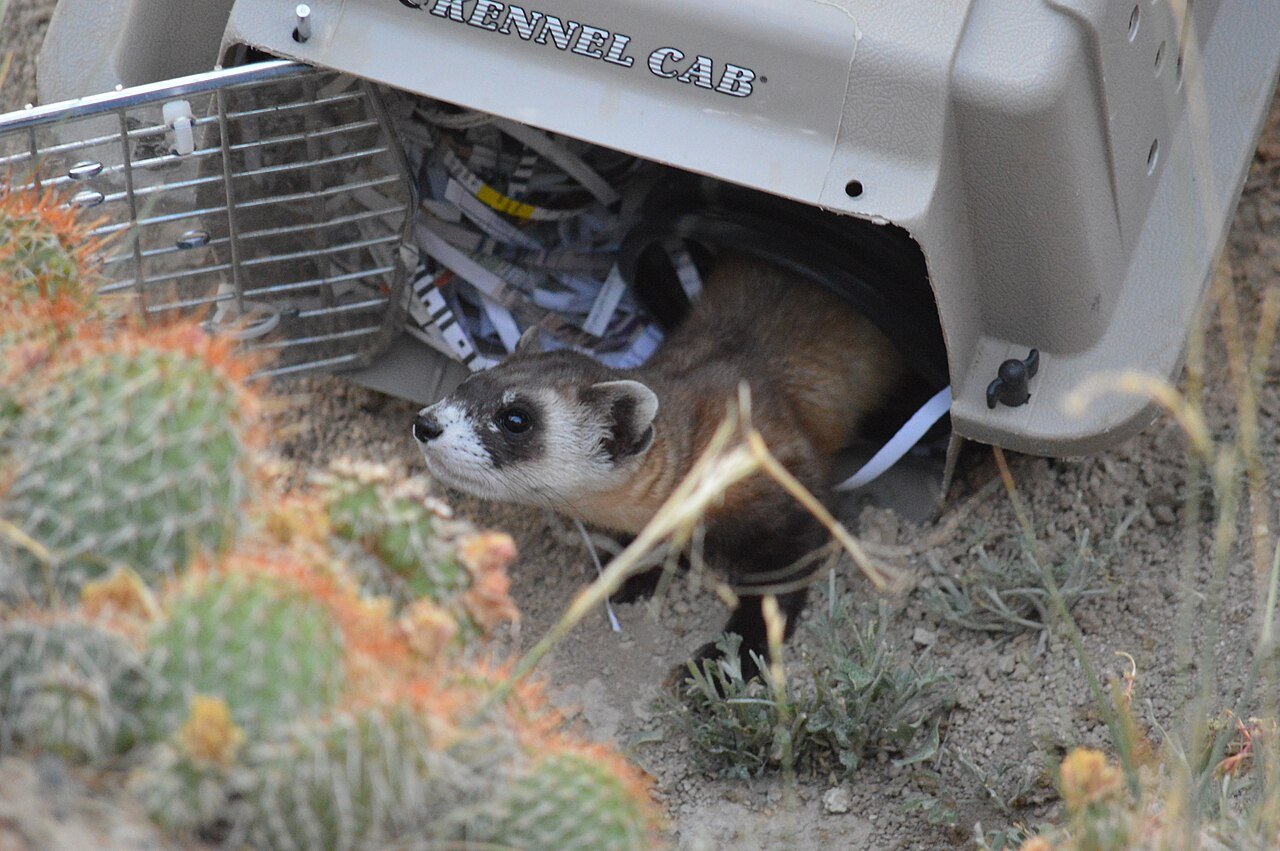
At night on the Great Plains, a black-footed ferret can slip through a prairie dog burrow and disappear underground. That hunting skill is part of what makes the small, nocturnal mammal remarkable—and part of what makes its survival so closely tied to the fate of prairie dogs.
The ferret nearly vanished from the wild. Its recovery is now a careful collaboration among captive-breeding programs, field conservation teams and, more recently, a laboratory technique that could restore genetic variation lost during the species’ dramatic decline. But cloning is only one tool. The ferret’s long-term prospects still depend on connected grasslands, abundant prey and protection from disease.
A prairie specialist nearly lost
Black-footed ferrets are native to North America’s grasslands. They rely heavily on prairie dog colonies for food and shelter: prairie dogs are their main prey, and the animals use the rodents’ burrow systems as places to rest and raise young. When prairie dog colonies shrink, ferrets lose both a food source and much of their underground habitat.
By the late 20th century, habitat changes, prairie dog control and disease had driven the ferret to the edge of extinction. A population found near Meeteetse, Wyoming, in 1981 became the focus of an emergency effort. After disease struck, the remaining known wild ferrets were brought into captivity. The captive-breeding program began with a tiny group of animals, and only a small number contributed genes to later generations.
That narrow beginning mattered. Captive breeding could produce ferrets for reintroduction, but when a population descends from very few founders, it also carries a limited share of the species’ original genetic diversity. The animals may all be black-footed ferrets, yet their family tree has unusually few branches.
From breeding pens to open prairie
Releasing captive-bred ferrets back into the wild was a major step, not a simple return to an untouched past. Teams had to identify suitable prairie dog colonies, prepare animals for life outside managed care and monitor whether released ferrets survived and reproduced. Reintroduction began in Wyoming in the early 1990s and expanded to other sites.
The work remains demanding because the ferret’s fortunes follow the prairie ecosystem. Sylvatic plague can devastate prairie dog colonies and can also kill ferrets. Land use and efforts to control prairie dogs can further reduce the patches of habitat the ferrets need. Conservation therefore involves more than releasing animals: it can include disease management, habitat protection, captive breeding and repeated monitoring.
That persistence has kept the species from disappearing, but it does not mean the ferret is secure. The U.S. Fish and Wildlife Service continues to list the black-footed ferret as endangered. A population maintained through intensive management is a conservation achievement—and a reminder that the species still faces serious risks.
What a frozen cell can—and cannot—do
In 2020, scientists announced the birth of Elizabeth Ann, a black-footed ferret cloned from cells preserved decades earlier. The cell donor, a ferret named Willa, was not represented among the animals that founded the modern captive population. Her preserved cells therefore offered something more than another way to produce a ferret: they held genetic material absent from the living population.
The procedure used somatic cell nuclear transfer. In simplified terms, researchers placed genetic material from a preserved body cell into an egg cell whose own nucleus had been removed, then stimulated the egg to develop. A domestic ferret served as the surrogate mother. The birth was a first for a U.S. endangered species and a demonstration that long-stored cells from a wild animal could still contribute to conservation.
Cloning does not make a species abundant, restore its habitat or automatically solve its genetic problems. A clone is nearly genetically identical to its cell donor; it is not a source of new diversity in itself. The potential conservation value comes from bringing back a lineage that would otherwise be missing from today’s breeding population. If animals carrying that lineage can reproduce and pass on their genes, it could broaden the population’s genetic base.
That possibility requires time and careful breeding. Scientists need healthy animals that can contribute to future generations, and managers have to weigh genetic goals alongside health, behavior and the needs of the wider breeding program. The original cloning announcement described a promising start, not a finished recovery.
The landscape remains the essential ingredient
The ferret’s story shows how conservation can move between scales. A frozen cell can preserve a genetic possibility across decades. A captive-breeding program can turn a handful of survivors into animals for release. Yet neither can substitute for prairie dog colonies and the open grasslands that support them.
For a ferret to thrive, the pieces have to connect: suitable habitat, prey, disease management and a population large and varied enough to withstand setbacks. The work is not as visible as the birth of a cloned animal, but it is what turns a scientific breakthrough into a chance of survival in the wild.
The black-footed ferret’s return is therefore not a neat tale of a species saved once and for all. It is a continuing effort that combines field conservation with new tools, while acknowledging the limits of both. The most hopeful detail is not that technology can bring back an individual animal. It is that a lost genetic line may again have a place in a living population—if the prairie can remain a place where ferrets can hunt, shelter and raise young.