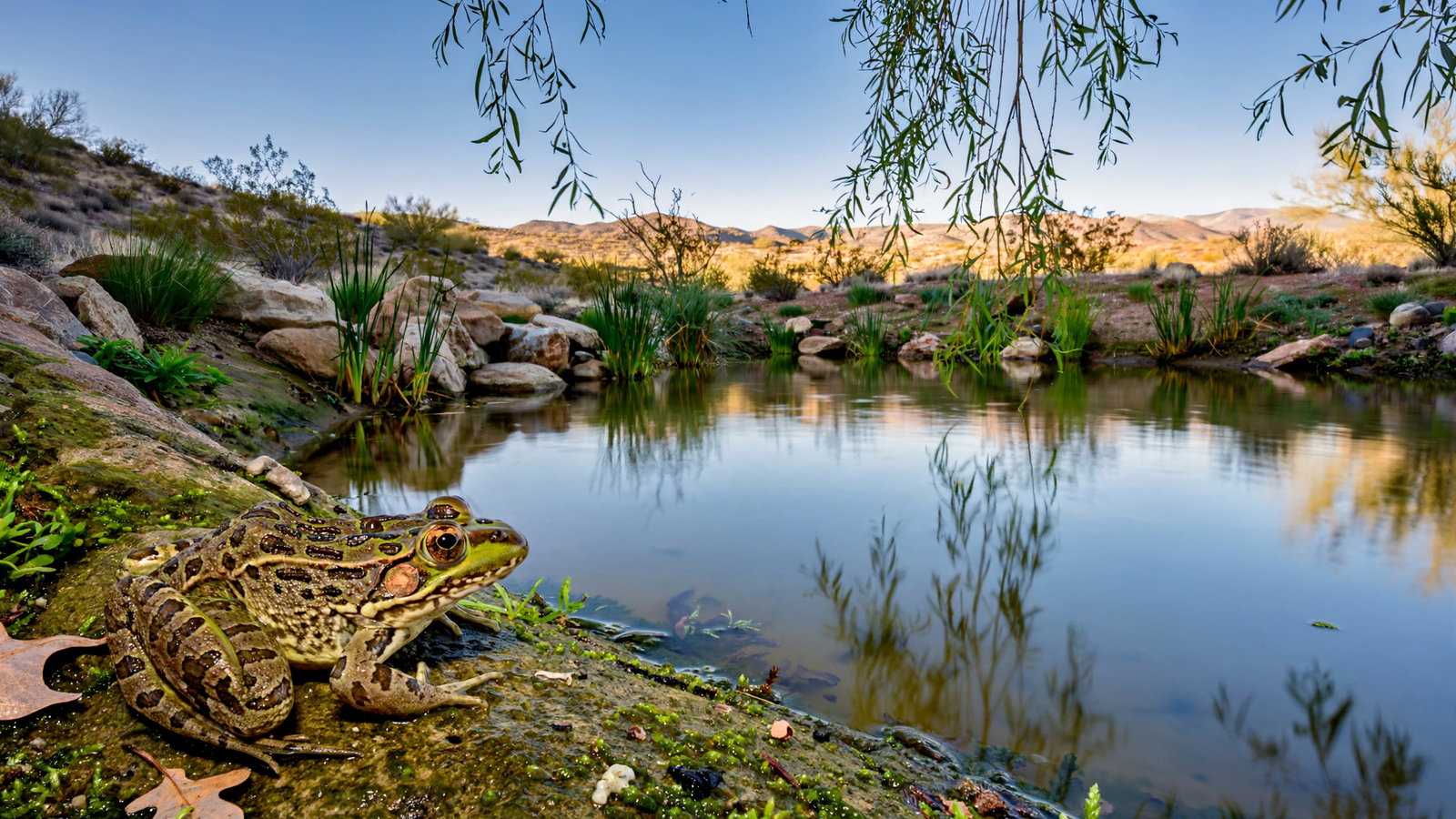
In southeastern Arizona, a small frog is helping redefine what conservation success can look like.
The Chiricahua leopard frog is not returning through one dramatic release or a single protected reserve. Its recovery is being assembled across mountain streams, ranch ponds, national forests, tribal lands, research facilities, and desert communities. Each restored wetland provides another place where the species might feed, breed, and withstand the pressures that have pushed it out of much of its historic range.
That makes the frog’s story both encouraging and instructive. The species remains threatened, and its future is not guaranteed. But conservationists have learned enough about its needs to begin repairing the network of places on which its survival depends.
A frog built for mountain water
The Chiricahua leopard frog once occupied a broad area of the Southwest, including portions of Arizona and New Mexico and parts of northern Mexico. It is a water-dependent species, typically associated with springs, cienegas, streams, stock tanks, ponds, and other wet places in an otherwise dry landscape.
Its name comes from the Chiricahua Mountains, one of the Arizona ranges where the frog is found. Adults are usually green or brown, often marked with dark spots, and they have the powerful hind legs associated with many North American frogs. The details that make the species distinctive are easy to miss beside the larger drama of the desert. Yet the frog is closely tied to the health of the small waterways that stitch southeastern Arizona’s mountain ranges together.
Those waterways are naturally scattered. In a dry region, a spring or shaded pool can function as an entire neighborhood for amphibians. When several wetlands are connected by suitable habitat, frogs can move between them and maintain a larger, more resilient population. When the links disappear, each remaining group becomes more isolated.
Why the species declined
The Chiricahua leopard frog’s decline has several causes, and their interaction has made recovery unusually difficult.
Habitat has been altered by drought, water diversion, grazing impacts, wildfire, changes in stream flow, and the loss or degradation of wetlands. Some historic frog sites have dried or become less suitable. Others remain wet but are no longer safe for the species because of predators, disease, or competition.
One of the most damaging arrivals has been the American bullfrog. Bullfrogs are larger than Chiricahua leopard frogs and can eat native frogs, tadpoles, and other wildlife. They may also carry pathogens that threaten native amphibians. In some places, invasive fish and crayfish add further pressure by consuming eggs and young frogs or competing for food.
Disease has been another major concern. The fungal disease chytridiomycosis has affected amphibians around the world, and research by federal and university scientists has linked chytrid infections to serious risks for southwestern frogs. A population already reduced by habitat loss can be especially vulnerable when disease moves through the remaining animals.
The United States listed the Chiricahua leopard frog as threatened under the Endangered Species Act in 2002. That status did more than recognize the species’ decline. It created a framework for coordinated recovery work, including habitat protection, monitoring, research, captive propagation, and carefully planned reintroductions.
Recovery starts with the places frogs can use
For the Chiricahua leopard frog, protecting land is not enough if the water is unsuitable. Conservation teams have therefore focused on the practical details of wetland recovery: maintaining springs, improving ponds, reducing invasive predators, protecting streamside vegetation, and managing water in ways that leave amphibians with places to reproduce.
Some of the work takes place on public lands in southeastern Arizona, including areas managed by the U.S. Forest Service, the Bureau of Land Management, and the National Park Service. Other projects depend on private landowners who maintain stock tanks or springs. A ranch pond may have been built for livestock, but with thoughtful design and management it can also become a refuge for native wildlife.
That shared responsibility is important because the frog’s range crosses administrative boundaries. A population cannot be made secure simply by protecting one pond if nearby wetlands remain occupied by bullfrogs or if a connecting stream is allowed to deteriorate. Recovery requires a landscape approach: many sites, managed over time, with local conditions taken seriously.
When the wild population needs help
In places where natural populations have become very small, biologists may raise frogs in controlled settings before returning them to the wild. Captive propagation is not a replacement for habitat, but it can provide a reserve of animals and a way to rebuild populations after threats have been reduced.
Young frogs can be especially vulnerable. Eggs and tadpoles may be eaten by invasive species, washed away by sudden floods, or lost when a pond dries at the wrong moment. Conservation programs can give some animals a safer start and release them when their chances of surviving are better.
The process is more complicated than simply placing frogs in a pond. Teams need to select suitable release sites, check water conditions, consider disease, monitor predators, and track whether the animals survive and reproduce. They also have to learn from unsuccessful releases. A frog that disappears from a site may have encountered a problem that was invisible at the beginning, such as an intermittent water supply or a disease risk that becomes apparent only later.
Zoos, universities, state and federal agencies, and conservation organizations have all contributed to this work. Their role is not just to keep frogs alive in captivity. It is to preserve genetic diversity, develop reliable husbandry methods, support research, and help return animals to functioning ecosystems.
Small wetlands, large consequences
One reason the Chiricahua leopard frog matters beyond its own survival is that amphibians are closely connected to the condition of their surroundings. They live partly in water and partly on land, absorb moisture through their skin, and respond quickly to changes in temperature, water quality, and disease. Their presence can provide useful information about whether a wetland is still functioning as habitat.
Restoring a frog site can also benefit many other species. A spring or pond with healthy vegetation may support dragonflies, aquatic insects, birds, reptiles, bats, and mammals. Streamside plants can shade the water, slow erosion, and provide cover for wildlife. A project designed for one threatened frog may therefore strengthen an entire small ecosystem.
The work also demonstrates why ordinary infrastructure can become part of conservation. In the Southwest, a stock tank, culvert, spring box, or fence may determine whether wildlife can reach water safely. Replacing or modifying one feature can sometimes make a site more useful without transforming it into a formal preserve.
A recovery measured in possibilities
There is no single moment when the Chiricahua leopard frog’s recovery will be declared complete. The species still faces drought, invasive species, disease, habitat fragmentation, and a changing climate. In parts of its range, populations remain small or absent, and conservationists must continue monitoring places where frogs have been reintroduced.
But the trajectory is not defined only by what has been lost. Each occupied site can preserve genetic diversity. Each successful breeding season can produce frogs that disperse or strengthen a local population. Each invasive bullfrog removed from a sensitive wetland can reduce pressure on native amphibians. Each landowner who keeps a spring or pond healthy adds another piece to the recovery network.
That is the hopeful lesson in southeastern Arizona. Recovery does not always arrive as a spectacular comeback visible from a highway. Sometimes it appears as a chorus of frogs in a restored pond, a population that survives another dry year, or a wetland that remains available when young animals leave the water.
The Chiricahua leopard frog is still a threatened species. Yet its story shows that decline does not have to be the final chapter. When agencies, scientists, communities, and landowners work on the same landscape—and keep returning to the work year after year—even a fragile amphibian can be given a future.
Use: Species status, range, threats, Endangered Species Act listing, and recovery information.
Use: Recovery objectives, habitat needs, threats, and conservation strategies.
Use: Regional ecology and information about amphibians of southeastern Arizona.
Use: Federal research context concerning amphibian decline, disease, monitoring, and conservation.
U.S. Fish and Wildlife Service — Chiricahua Leopard Frog — https://www.fws.gov/species/chiricahua-leopard-frog-lithobates-chiricahuensis — Species status, range, threats, Endangered Species Act listing, and recovery information.
U.S. Fish and Wildlife Service — Chiricahua Leopard Frog Recovery Plan — https://ecos.fws.gov/docs/recovery_plan/030919.pdf — Recovery objectives, habitat needs, threats, and conservation strategies.
National Park Service — Chiricahua National Monument, Amphibians — https://www.nps.gov/chir/learn/nature/amphibians.htm — Regional ecology and information about amphibians of southeastern Arizona.
U.S. Geological Survey — Amphibian Research and Monitoring Initiative — https://www.usgs.gov/programs/amphibian-research-and-monitoring-initiative — Federal research context concerning amphibian decline, disease, monitoring, and conservation.