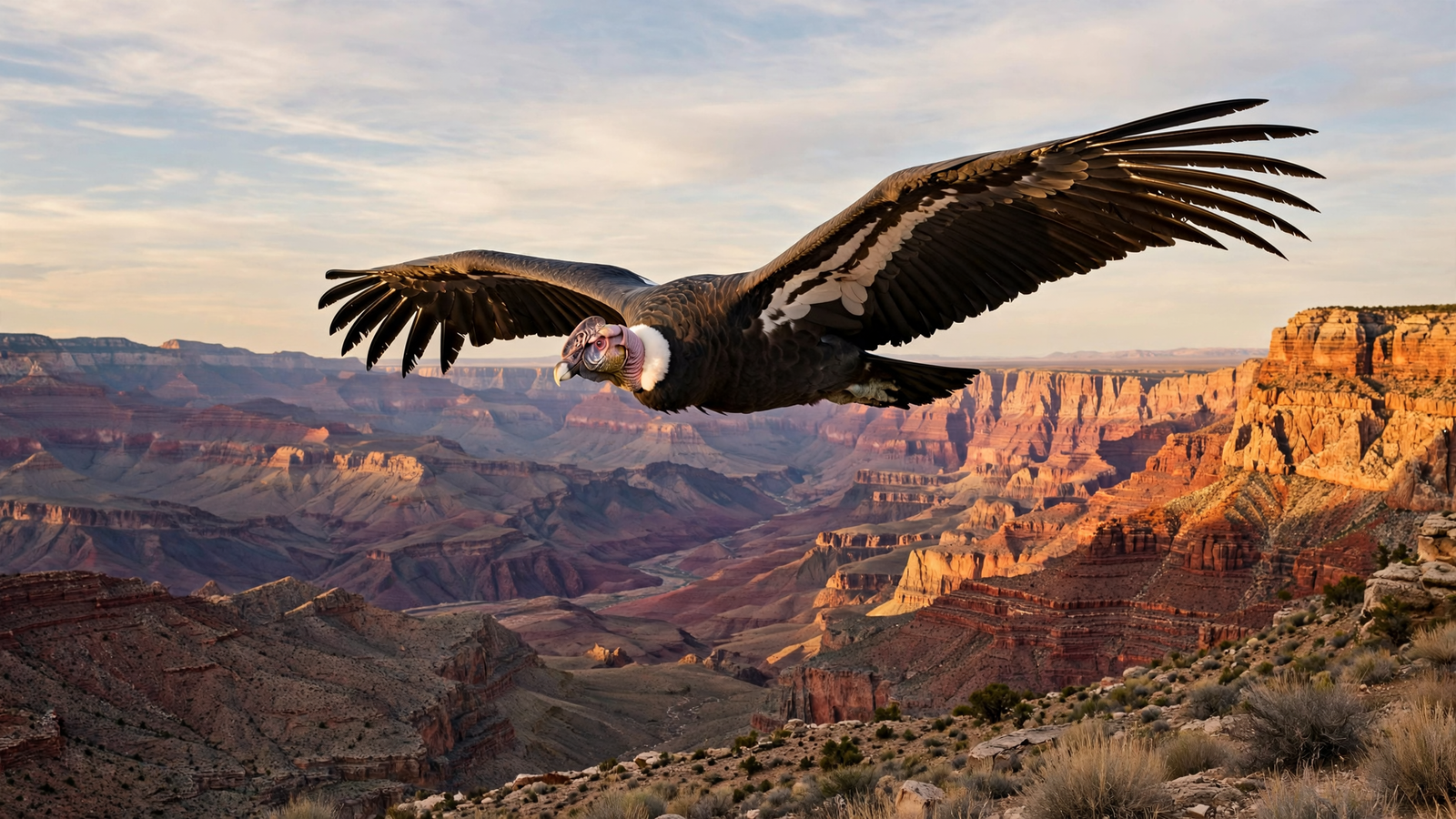
High above the red walls of the Grand Canyon, a California condor can seem almost too large to be real. Its wings may stretch nearly 10 feet from tip to tip, yet the bird can ride a rising column of warm air without a visible wingbeat. For much of the twentieth century, that sight disappeared from the Arizona sky. For related reading, see Arizona’s Condor Comeback: How the Grand Canyon Became a Second Chance for North America’s Largest Flying Bird.
Today, condors are flying again across northern Arizona and southern Utah. Their return is not the result of a single release or a sudden reversal in fortune. It is the product of a long, careful conservation effort involving federal agencies, wildlife biologists, tribal communities, zoos, field crews and the public. For related reading, see The Sonoran Pronghorn: How Arizona Helped a Desert Runner Find Its Way Back.
The latest population counts show why that work matters. The total California condor population now numbers more than 500 birds, with hundreds living in the wild. The Arizona-Utah flock remains one of the species’ key wild populations and one of the most visible signs that a bird once nearly lost to extinction can be given another chance. For related reading, see The Chiricahua Leopard Frog: How Arizona Is Giving a Vanishing Amphibian Room to Return.
A bird that came close to vanishing
California condors once ranged across much of the western United States and into Mexico. Their enormous wings made them efficient travelers, allowing them to search broad landscapes for carrion. They also played an important ecological role by consuming carcasses that might otherwise remain in the environment.
But the species’ size and slow reproduction made it especially vulnerable to human pressures. Condors do not begin breeding until they are several years old, and a female generally raises only one chick at a time. A population cannot quickly replace adults lost to poisoning, shooting, habitat changes or other threats.
By the 1980s, the remaining wild population had fallen to just a few dozen birds. Conservation managers made the difficult decision to capture the last wild condors and begin a coordinated captive-breeding program. That step was controversial because it meant temporarily removing the species from the sky. It also created the possibility of managing reproduction, preventing further losses and eventually returning birds to the wild.
The California condor became extinct in the wild in 1987. The recovery program that followed has been an experiment in whether an endangered species can be rebuilt after reaching the edge of disappearance.
Why Arizona became central to the effort
Northern Arizona offered several qualities that made it a promising release area. The Grand Canyon and surrounding public lands contain large, rugged expanses with cliffs suitable for nesting and roosting. The landscape also supports populations of deer and other animals whose carcasses can provide food.
In 1996, the first captive-bred California condors were released in northern Arizona. Releases have continued in and around the Grand Canyon region, creating a flock that moves across a vast landscape rather than remaining within a small reserve.
That freedom is one of the program’s greatest achievements and one of its hardest management challenges. Condors can travel many miles in a day. A bird raised near the Grand Canyon may cross state lines, visit private land, move through tribal lands or follow food sources far from its release site.
Instead of treating the birds as inhabitants of one park, biologists must work across an entire region. Field teams monitor the flock with wing tags, radio transmitters and GPS devices. Those tools help researchers understand where the birds travel, which nesting areas they use and where they encounter danger.
The biggest threat is not lack of food
Condors are scavengers, so they are exposed to whatever is present in the animals they eat. The most serious known threat remains lead poisoning, usually caused when birds consume fragments of ammunition in the remains of hunted animals.
A condor may feed on a carcass that appears harmless from a distance. But a bullet can leave tiny pieces of lead scattered through the tissue. Once ingested, those fragments can damage a condor’s nervous system and internal organs. Severe cases can kill a bird; other cases require capture and treatment.
For that reason, Arizona’s recovery program includes more than releasing birds. Biologists periodically capture condors to test blood lead levels, replace or check tracking equipment and provide medical care when necessary. Birds with dangerous lead exposure may be treated and returned to the flock after they recover.
Wildlife agencies and conservation groups also work with hunters to encourage the use of non-lead ammunition. That approach addresses the problem before a condor encounters it. In some areas, voluntary participation has helped reduce the risk, though lead exposure remains a persistent challenge across the condors’ range.
Other hazards include power-line collisions, microtrash and the possibility that young birds will be harmed by natural or human-made dangers. Condor chicks and juveniles may pick up small pieces of plastic, glass or metal, mistaking them for food. Field crews therefore monitor nesting areas and remove dangerous debris when they can do so without disturbing the birds.
Rearing birds for a wild life
Captive breeding is more complicated than simply producing as many chicks as possible. Condors must learn how to behave like condors, avoid people and navigate the social structure of a flock.
Young birds are raised with limited human contact. Handlers use puppets or carefully designed barriers during feeding so that the chicks do not imprint on people. The birds also spend time with older condors that can model normal behavior before release.
That preparation matters after the birds reach Arizona. A released condor must learn where to roost, how to locate food and how to interact with other members of the flock. Older, experienced birds can guide younger ones toward useful habitat and away from some dangers.
The social nature of the species gives the recovery effort both an advantage and a responsibility. Condors learn from one another, but harmful behavior can also spread. Managers have had to respond when young birds investigate vehicles, people or other objects they should avoid. The goal is not merely to keep individual birds alive; it is to establish a self-sustaining wild population with normal behavior.
Progress measured one bird at a time
California condor recovery is often described through population totals, but the numbers tell only part of the story. A population can grow while still depending on intensive management. In Arizona, conservationists continue to monitor birds, test for lead, support nesting and release captive-bred individuals.
Even so, the long-term trend is meaningful. The species has moved from a final remnant in the 1980s to a population distributed among several wild flocks in California, Arizona and Utah, with a separate population in Baja California. The Grand Canyon flock has produced wild-hatched chicks, an important sign that released birds are not simply surviving but beginning to reproduce.
Every wild-hatched chick represents more than one new bird. It suggests that adult condors are finding one another, selecting nesting sites, raising young and passing knowledge through the flock. Those are the processes a recovery program ultimately hopes to make routine.
A recovery story that depends on cooperation
The condor’s return also shows why wildlife recovery rarely belongs to one institution. The National Park Service protects important habitat in the Grand Canyon region. The U.S. Fish and Wildlife Service coordinates recovery under the Endangered Species Act. Arizona Game and Fish Department staff assist with field monitoring and public outreach. The Peregrine Fund and other partners have played major roles in breeding, releases and research.
Tribal nations and local communities are part of that landscape as well. Condor movements do not follow administrative boundaries, and long-term recovery requires communication among the people who live, work and manage land across the bird’s range.
Members of the public have a role, too. Visitors should keep a respectful distance from condors, avoid feeding or approaching them and report sightings through official wildlife channels when requested. Hunters can ask about non-lead ammunition and proper carcass practices. Simple choices can reduce the risks facing a bird that may travel across an entire canyon system in a single day.
The meaning of seeing one again
A California condor flying over Arizona is not proof that the species is safe. The birds remain endangered, and their recovery still depends on active management. Lead poisoning alone can undo years of progress if the threat is not reduced.
But the condors’ presence is proof that extinction is not always the final chapter. A species can disappear from the wild and still return if enough habitat remains, if people are willing to manage the threats and if conservation work continues across generations.
In the Grand Canyon, that work is visible as a dark shape circling above the cliffs. The bird may be a released adult, a wild-hatched youngster or one of the descendants of the first condors brought back to Arizona. Its identity matters to researchers. To everyone else, the larger meaning is simpler: a sky that once went quiet is beginning to fill again.
Use: Background on the condor’s history, Arizona releases, monitoring and recovery challenges.
Use: Federal recovery information, population context, threats and conservation actions.
Use: Arizona-specific information on the Grand Canyon flock, public guidance and field conservation.
Use: Information on captive breeding, releases, monitoring and condor biology.
National Park Service — California Condor Recovery Program — https://www.nps.gov/articles/000/california-condor-recovery-program.htm — Background on the condor’s history, Arizona releases, monitoring and recovery challenges.
U.S. Fish & Wildlife Service — California Condor Recovery Program — https://www.fws.gov/program/california-condor-recovery — Federal recovery information, population context, threats and conservation actions.
Arizona Game and Fish Department — California Condor — https://www.azgfd.com/wildlife/conservation/california-condor/ — Arizona-specific information on the Grand Canyon flock, public guidance and field conservation.
The Peregrine Fund — California Condor Recovery — https://peregrinefund.org/explore-raptors-species/california-condor — Information on captive breeding, releases, monitoring and condor biology.