High in Arizona’s White Mountains, cold streams thread through forests of spruce, fir, pine and aspen. In those waters lives a fish found nowhere else on Earth: the Apache trout. For related reading, see Arizona’s Apache Trout Recovery Shows What Patient Conservation Can Do.
Its range is limited, but its recovery story reaches far beyond the size of the fish. The Apache trout shows what conservation can look like when biologists, anglers, land managers and tribal communities work on the same long timeline. The species is still protected and still vulnerable. Yet it is no longer defined only by decline. For related reading, see Arizona’s Apache Trout Is Reclaiming Its Mountain Streams.
Instead, its future is being built stream by stream.
A trout born in the White Mountains
Apache trout are native to the upper Little Colorado River and its tributaries in eastern Arizona. Their historic home includes high-elevation streams in the White Mountains, where water stays cool enough for trout even as the surrounding desert grows hot and dry. For related reading, see Arizona’s Condor Comeback: How the Grand Canyon Became a Second Chance for North America’s Largest Flying Bird.
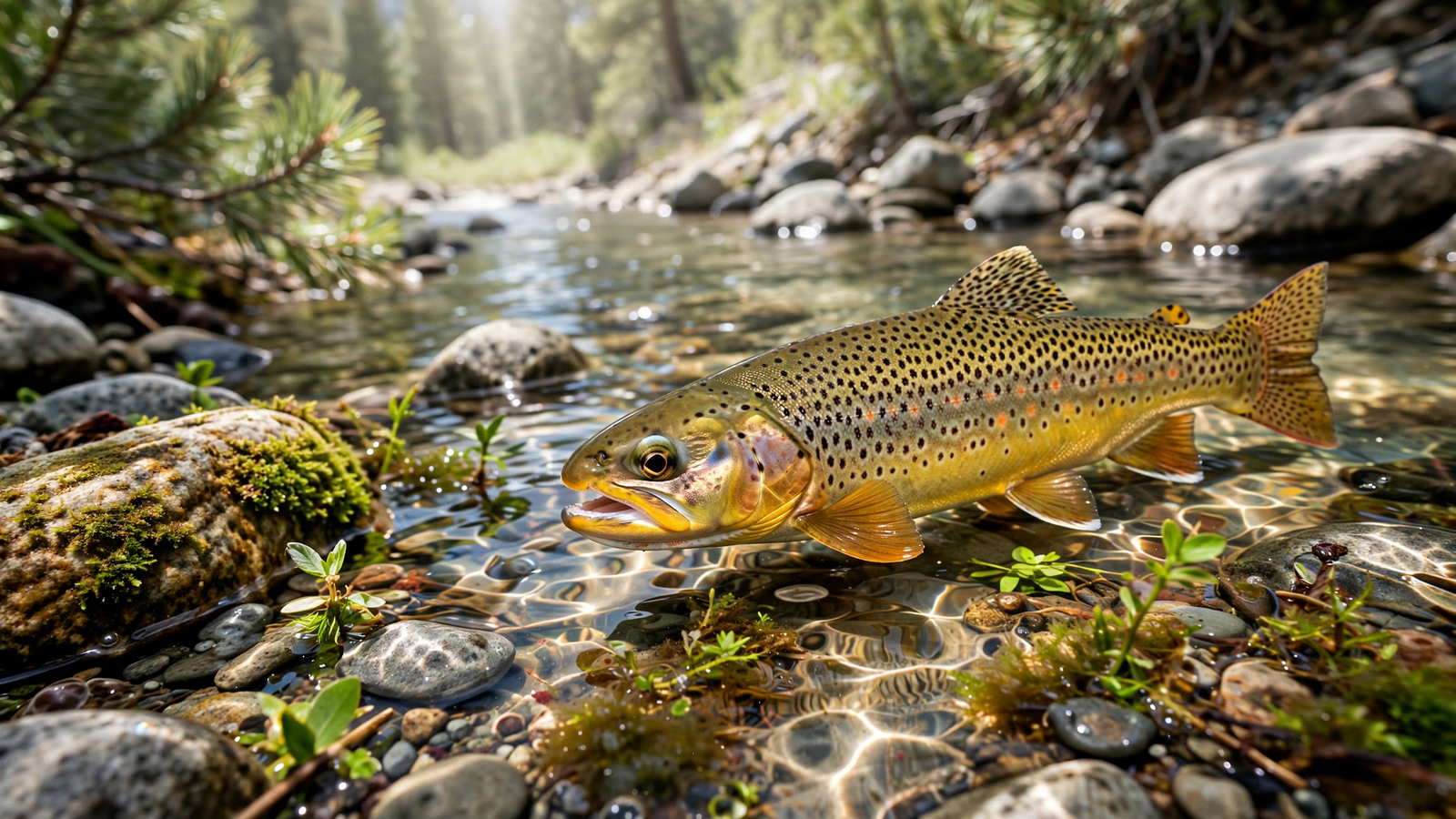
The fish is recognizable by its golden-yellow body, dark spots and distinctive black markings beneath the lower jaw. That marking has given the species one of its common names: the “cutthroat” of the White Mountains, although the Apache trout is a separate species from the cutthroat trout found farther west.
For generations, these fish evolved in relative isolation. That isolation helped create a uniquely Arizona trout, but it also left the species exposed when people altered the streams and introduced fish from elsewhere.
How a native fish came close to disappearing
Apache trout faced several pressures at once. Logging, roads, livestock grazing and water diversion changed parts of their stream habitat. Introduced trout competed with them for food and space. Some nonnative trout could also breed with Apache trout, weakening the genetic identity of the native fish.
In the middle of the 20th century, the species occupied only a fraction of its former range. The federal government listed Apache trout as endangered in 1969. Six years later, after early conservation work began to show results, the species was reclassified as threatened.
That change was important, but it was not a declaration that the work was finished. A threatened species can still be at serious risk, especially when its remaining populations are separated across small streams and face continuing drought, wildfire and invasive species.
Recovery is a network, not a single release
One of the most important ideas in Apache trout conservation is that a species needs more than one healthy population. A single stream can be damaged by a fire, a flood, disease, drought or a failed spawning season. A network of populations gives the species a better chance of surviving local setbacks.
That network is being supported in several ways.
- Habitat protection: Agencies and landowners work to keep stream channels, banks and nearby forests in better condition. Healthy vegetation along a stream can provide shade, reduce erosion and help maintain cooler water.
- Barrier removal and stream connectivity: Some barriers can prevent native trout from reaching suitable habitat. Improving passage can reconnect parts of a watershed, although managers must also prevent nonnative trout from moving into protected Apache trout waters.
- Hatchery production: Conservation hatcheries can raise Apache trout for carefully planned stocking and restoration projects. Hatcheries are not a substitute for functioning streams, but they can provide a population source when wild numbers are low.
- Genetic protection: Managers track which fish are pure Apache trout and which have mixed ancestry. That information helps guide where fish can be moved and where nonnative species must be removed.
- Monitoring: Electrofishing surveys, visual counts and other field methods help biologists measure whether restored waters are supporting young fish as well as adults.
The process can be painstaking. A stream may need to be treated to remove nonnative trout before Apache trout are reintroduced. Biologists then have to return to see whether the native fish reproduce, whether young fish survive and whether the population remains genetically secure.
The importance of tribal and public lands
A large part of the Apache trout’s story unfolds on lands connected to the White Mountain Apache Tribe. The tribe’s reservation contains important high-country waters and has long been central to the species’ conservation.
That makes Apache trout recovery more than a project carried out by a single state or federal agency. It depends on cooperation among the White Mountain Apache Tribe, the U.S. Fish and Wildlife Service, the Arizona Game and Fish Department, the U.S. Forest Service and other partners.
Each partner brings a different responsibility. Tribal and public land managers oversee habitat and access. Fisheries biologists provide surveys and restoration expertise. Hatcheries support carefully designed stocking programs. Anglers, in turn, can help by following regulations intended to protect native fish.
This shared approach matters because streams do not follow administrative boundaries. A fish does not know where a forest boundary ends or where one management jurisdiction begins. Conservation has to follow the watershed.
Why climate change makes the work harder
Apache trout recovery is taking place in a landscape where water is becoming an increasingly important constraint. Warmer temperatures can reduce the amount of cold water available in summer. Drought can shrink streams and concentrate fish into smaller pools. Severe wildfire can damage watersheds, increase erosion and temporarily change water quality.
These pressures do not erase the gains made by recovery teams, but they make resilience essential. Protecting shade along streams, maintaining connected habitat and keeping multiple populations healthy can give the species more options when conditions change.
The fish’s high-elevation habitat offers some protection compared with warmer lowland waters, but it is not immune to a changing climate. Conservationists therefore have to think beyond restoring a historic snapshot. They must ask which waters are likely to remain suitable, how populations can be connected safely and how genetic diversity can be maintained over time.
A recovery story that remains unfinished
The Apache trout’s status is a reminder that conservation success is rarely a clean ending. A species can move away from the brink and still require protection. It can return to streams and still face invasive fish, drought and habitat loss.
That may be the most useful lesson of all. Recovery is not a single dramatic moment when an animal is released into the wild. It is the accumulation of small, verifiable improvements: a cooler streambank, a restored reach of habitat, a population that produces young fish, a barrier that no longer blocks movement, and a monitoring survey that shows the fish are still there.
For the Apache trout, those improvements have added up to a future that once seemed unlikely. The species remains one of Arizona’s rarest native fish, but it is also one of the state’s clearest examples of what sustained conservation can accomplish.
In the White Mountains, the work continues. The goal is not simply to keep Apache trout in hatcheries or isolated refuges. It is to make room for self-sustaining populations in the cold streams where the species evolved—and to ensure that those streams remain part of Arizona’s living landscape for generations to come.
Use: Species status, range, conservation history and federal protection.
Use: Arizona-specific information about the fish, habitat, management and recovery work.
Use: Federal recovery-planning context and conservation actions.
U.S. Fish and Wildlife Service — Apache Trout — https://www.fws.gov/species/apache-trout-oncorhynchus-apache — Species status, range, conservation history and federal protection.
Arizona Game and Fish Department — Apache Trout — https://www.azgfd.com/fishing-2/native-fish/apache-trout/ — Arizona-specific information about the fish, habitat, management and recovery work.
U.S. Fish and Wildlife Service — Apache Trout Recovery — https://www.fws.gov/program/apache-trout-recovery — Federal recovery-planning context and conservation actions.