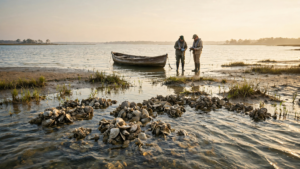
At first glance, an oyster reef can look like a jumble of shell on the bottom of a creek. But in Chesapeake Bay, these structures are also habitat: they give young oysters a place to attach, create hiding places for other animals and help shape the underwater landscape. In Maryland’s Harris Creek, restoration teams have spent years rebuilding that living structure—not just adding oysters, but laying the groundwork for a reef that can support them.
Harris Creek is a tributary of the Choptank River on Maryland’s Eastern Shore. Its restoration became one of the largest oyster-reef projects in the Chesapeake region. The work, carried out by government agencies and partners, covered roughly 350 acres of reef area. It offers a useful case study in what habitat restoration involves, and why progress is measured in more than the number of oysters placed in the water.
Why a reef needs a foundation
The Eastern oyster (Crassostrea virginica) is native to the Chesapeake Bay. Oysters settle on hard surfaces, including the shells of other oysters. Over time, generations can build up a reef: a three-dimensional structure that may provide shelter and feeding space for fish, crabs and other animals.
That structure can be lost when reefs are heavily harvested or when conditions make it difficult for oysters to survive and reproduce. If the old shell material disappears, young oysters may have fewer suitable places to attach. Restoring a reef therefore begins with the physical habitat. Crews place shell or other approved reef material on the bottom to create a stable surface, then add young oysters. In some restoration projects, these are “spat-on-shell”—young oysters that have already settled on shell before it is deployed.
The sequence matters. Adding seed oysters to a muddy or unstable bottom may not create a lasting reef. Building the reef base first gives oysters a better chance to attach and grow. Restoration plans also have to account for the site’s depth, water conditions and history.
A large project, built in stages
Work in Harris Creek was part of a wider effort to restore oyster habitat across the Chesapeake. Rather than treating a whole creek as a single construction site, teams worked in sections, placing reef material and oysters at selected locations. The project’s scale—about 350 acres—made it a major undertaking, but acreage alone does not show whether a reef is functioning.
After construction, researchers and managers monitor the sites. They look at measures such as oyster numbers, oyster size and the amount of living oyster tissue, alongside the condition of the reef. Monitoring helps distinguish a reef that has simply been built from one where oysters are surviving and growing. It can also show where follow-up work or adjustments may be needed.
Restoration managers set performance targets for projects and use field surveys to assess them. Reports on Harris Creek describe reefs that met restoration benchmarks, an encouraging sign that the constructed habitat can support oysters. That is a meaningful result, but it is not the same as saying the entire Chesapeake Bay’s oyster population has recovered. A successful restoration site is one part of a much larger ecosystem, and conditions can differ from one tributary to another.
More than an oyster count
Oysters are filter feeders, drawing water across their gills as they feed. A healthy, abundant oyster population can filter substantial amounts of water, although the effect at any one location depends on oyster numbers, water conditions and other factors. Reefs also add physical complexity to a bay floor that might otherwise offer little shelter.
Those benefits are why restoration projects are often designed with habitat in mind, not simply as a way to increase harvestable oysters. A reef’s nooks and surfaces can be used by other organisms, while its shape provides structure in the water. In this way, restoring oysters can also mean rebuilding a habitat that supports a broader community.
There are limits to what reef construction can accomplish by itself. Water quality, disease, extreme weather and the availability of suitable habitat all influence oyster survival. Restoration does not remove those pressures, and it cannot guarantee that a reef will persist indefinitely. That makes long-term monitoring important: it helps managers learn which approaches are working under local conditions and where the ecosystem remains vulnerable.
What Harris Creek shows about restoration
The project’s central lesson is practical: habitat restoration is a process, not a one-time delivery. First, a suitable foundation has to be built. Then oysters must be established and the result checked over time. A reef that supports oysters and develops into living habitat is a stronger measure of success than a count of shells dumped or seed oysters released.
Harris Creek also shows how a local project can contribute to a wider recovery effort without being mistaken for a complete solution. Restored reefs can add structure and oyster populations in specific places, while broader improvements depend on conditions across the bay and its watershed. The work is incremental, but the outcome is tangible: sections of the creek floor that were selected for restoration now provide a foundation for oysters to grow and for reef habitat to develop.
That is what makes the project worth watching. Rebuilding an ecosystem does not always mean returning it to a past condition in one dramatic leap. Sometimes it means restoring the building blocks—hard reef surface, young oysters and sustained monitoring—that let a living habitat take shape again.