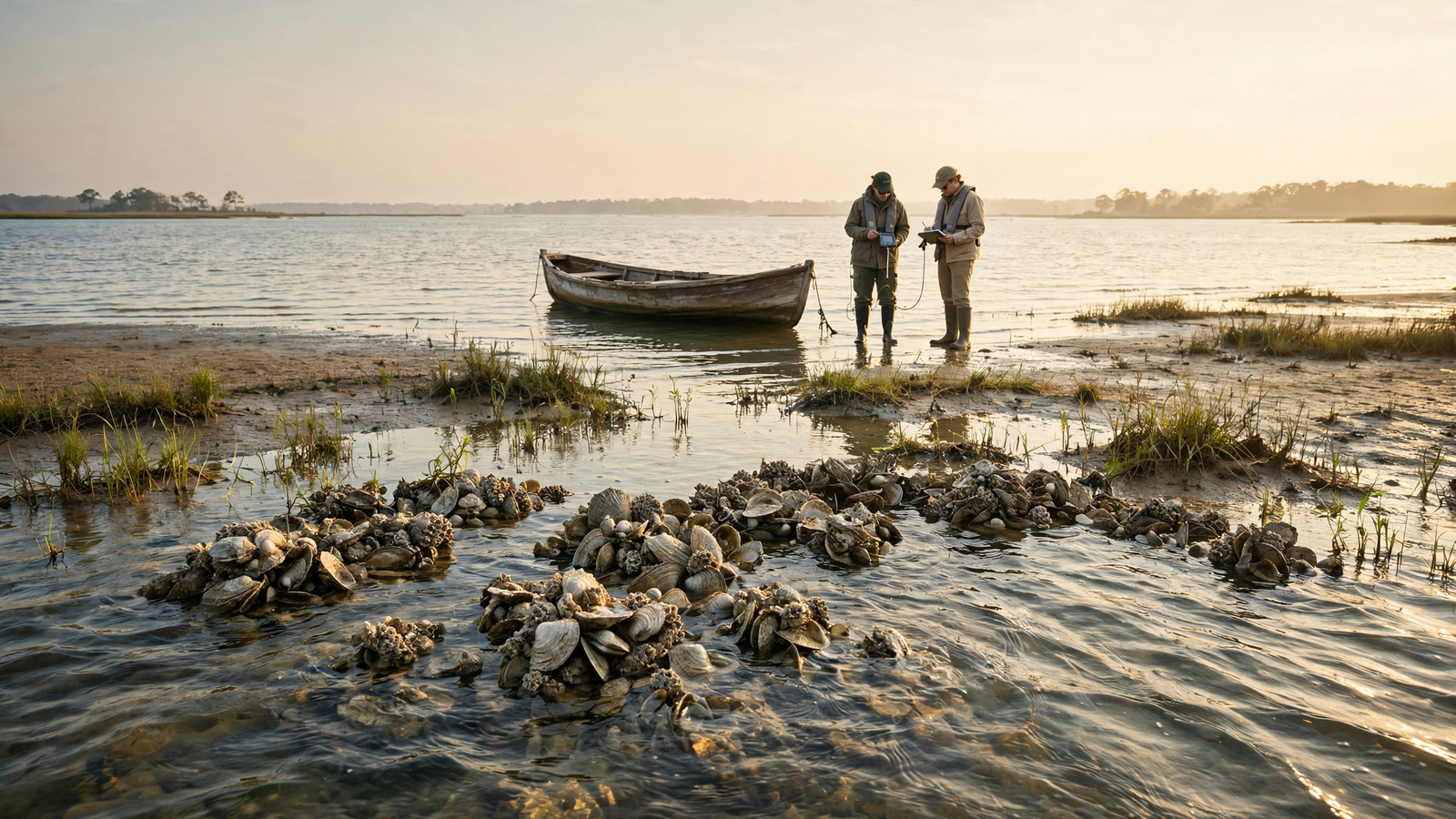
Along the edges of the Chesapeake Bay, restoration does not always look like a grand engineering project. Sometimes it arrives by barge, in a truck, or inside a bucket carried by a volunteer. Shells are placed in the water. Young oysters settle onto them. Over time, a flat bottom becomes a living reef.
That transformation is one of the Chesapeake’s most hopeful conservation stories. After decades of decline, oysters are being given back the habitat they need to grow: hard, three-dimensional reefs where they can feed, reproduce, and shelter other animals. The work is taking place across Maryland and Virginia, involving public agencies, universities, oyster growers, commercial watermen, restaurants, conservation groups, and local residents.
The goal is not simply to produce more seafood. It is to restore an animal that once helped shape the character of the entire estuary.
An animal that builds a neighborhood
The eastern oyster, Crassostrea virginica, begins life as a free-swimming larva. After a short period in the water, it looks for a hard surface. A clean oyster shell is one of the best places to settle. Once attached, the young oyster grows beside and on top of older oysters, creating the layered structure known as a reef.
That structure changes the bottom around it. A reef provides crevices for small fish, crabs, shrimp, worms, and other invertebrates. It gives larger fish a place to forage. It also turns loose shell and sediment into a more stable surface in a landscape where storms and currents are constantly rearranging the bottom.
Oysters are also filter feeders. They draw water across their gills and remove microscopic food particles. That process does not make an oyster reef a cure for pollution, and healthy water still depends on reducing excess nutrients and sediment throughout the watershed. But filtration is one reason oysters are considered an important part of a functioning estuary.
The Chesapeake Bay Program describes oysters as both a valuable fishery and a habitat-forming species. In other words, the oyster is not only an animal living in the Bay. In sufficient numbers, oysters help create the place where other animals can live. For related reading, see The Apache Trout: How Arizona’s White Mountains Became a Living Laboratory for Recovery.
Why the reefs disappeared
For centuries, oysters were among the Chesapeake’s most abundant resources. Indigenous communities harvested them long before European colonization, and the oyster fishery later became a major part of the region’s economy and culture.
As the commercial fishery expanded, however, the Bay lost much of its oyster habitat. Intensive harvest removed both living oysters and the shells that young oysters needed for attachment. Disease, poor water quality, storms, and changes in the estuary added further pressure. When the reef structure was removed, the loss was larger than a drop in the number of oysters: an entire kind of underwater neighborhood became less common.
Restoration therefore requires more than releasing animals into the water. Oysters need a suitable surface, appropriate salinity, enough food, and protection from excessive disturbance. The work begins with rebuilding the foundation.
Shell becomes a starting point
One of the simplest materials in the restoration effort is discarded oyster shell. Shell collected from restaurants and seafood businesses can be cleaned, stored, and returned to the Bay. It may be placed directly on a restoration site or used at a hatchery, where young oysters can attach before being moved into the estuary.
This approach closes a useful loop. A shell that once held an oyster can become the surface on which another generation begins. Because shell is natural, durable, and already shaped for oyster settlement, it is an especially valuable restoration material.
Where natural shell is scarce, managers may also use alternatives such as granite, concrete structures, or specially designed reef material. The exact method depends on the location, depth, salinity, navigation needs, and restoration goal. In each case, the basic idea is the same: give oysters a stable place to build upward.
Hatcheries add another piece of the puzzle. Researchers and restoration programs produce juvenile oysters, often called spat, and place them on shell or other material. Once the oysters are large enough for the next stage, they can be moved to designated restoration reefs. For related reading, see The Sonoran Pronghorn: How Arizona Helped a Desert Runner Find Its Way Back.
Restoration at the scale of a bay
Maryland and Virginia manage different parts of the Chesapeake, but both states have developed large-scale oyster restoration programs. Maryland’s efforts include protected oyster sanctuaries, hatchery production, shell recycling, and partnerships with watermen and conservation organizations. Virginia combines sanctuary restoration with a major commercial oyster industry and research led by state agencies and the Virginia Institute of Marine Science.
The work is deliberately spread across multiple tributaries rather than concentrated in one showcase location. A bay is not restored by a single reef. Managers must consider where oysters can survive, where reefs can benefit fish and water quality, and where restoration can coexist with navigation and a working fishery.
That makes the Chesapeake a useful example of conservation as a long-term civic project. It involves biology, engineering, regulation, local knowledge, seafood culture, and public participation. A restored reef may be built by a state crew, supplied by a hatchery, monitored by scientists, and supported by shells collected at restaurants.
A reef is also a nursery
Oyster reefs are valuable partly because they concentrate life. Their rough surfaces and narrow spaces offer shelter that a smooth, muddy bottom cannot provide. Small fish can use the reef as cover. Blue crabs can forage around it. Other shellfish and bottom-dwelling animals find attachment points and hiding places.
These benefits can extend beyond the reef itself. Fish and crabs may use nearby shallows, underwater grasses, and marsh edges as part of the same connected habitat. A restored oyster reef is therefore one piece of a larger estuarine mosaic.
Reefs can also help protect shorelines. Their physical structure may slow waves and currents before they reach marshes or other vulnerable edges. Oyster restoration is not a replacement for every form of coastal protection, but living reefs can complement marsh restoration and other nature-based approaches.
What success looks like
Success is measured in more than the number of oysters placed in the water. Scientists track survival, growth, reproduction, reef height, habitat use, water conditions, and the return of other organisms. They also examine whether restored sites continue to function after the initial construction work ends. For related reading, see The Humpback Chub: How a Grand Canyon Fish Swam Back From the Edge.
That patience matters. An oyster reef is not finished when shell is dropped onto the bottom. It must mature. Oysters must survive long enough to reproduce, and new larvae must find the reef. Storms, disease, changing salinity, and water quality can all influence the outcome.
The Chesapeake’s restoration programs have had setbacks as well as gains. Not every site performs equally, and no single project can reverse the pressures affecting a watershed that covers a vast area. But the growing network of reefs demonstrates an important shift: restoration is no longer limited to protecting what remains. People are actively rebuilding habitat and giving a native species the physical conditions required to return.
A working estuary with a future
The oyster’s recovery also shows why conservation does not have to mean choosing between nature and human use. Some areas are managed primarily as sanctuaries, while others support regulated harvest. Together, these approaches can provide places where oysters grow undisturbed and places where the fishery remains part of the region’s economy and identity.
Restaurants, too, have a role. Shell-recycling programs turn a familiar meal into restoration material, connecting diners with the next stage of the oyster’s life. Schools and volunteer groups can help explain why shell matters. Watermen bring practical knowledge of the Bay’s bottom, currents, and changing conditions.
The most encouraging part of the story is its physical clarity. Put back the foundation, protect the young animals, and allow the reef to grow, and the ecosystem begins to gain structure again. The work is gradual, but it is visible in the transformation from scattered shell to living habitat.
For the Chesapeake Bay, the oyster is both an old resident and a future-building species. Each restored reef is a small act of repair: a place where water is filtered, fish find cover, and a new generation can attach. Taken together, those places offer something larger than a revival of one fishery. They offer the possibility of a bay with more living shoreline, more habitat, and more room for wildlife to return.
Use: Background on oyster restoration, reef construction, hatcheries, and the ecological role of oysters in the Chesapeake Bay.
Use: Information on eastern oyster biology, filtration, habitat, historical importance, threats, and restoration.
Use: Maryland’s restoration methods, oyster sanctuaries, shell recycling, and hatchery-related work.
Use: Research context on oyster reefs, restoration ecology, and the role of oysters as habitat-forming organisms.