When Dolly Parton started a small book‑gifting pilot in her Tennessee hometown more than three decades ago, the hope was simple: get storybooks into the hands of very young children so families could read together. That quiet idea has grown into a global program that now mails millions of free books to families every month and — according to recent, large-scale research — appears to strengthen the home routines that matter most for early literacy.
From Sevier County to more than a dozen countries
The Imagination Library began as a local initiative in the mid‑1990s and has scaled through partnerships with local organizations and governments. The Dollywood Foundation notes that the program was founded in 1995 and that the first Imagination Library books were gifted to Sevier County children in 1996. ([dollywoodfoundation.org](https://dollywoodfoundation.org/history/))
Today the program distributes books across multiple countries and communities. In a June 29, 2026 update, the Imagination Library’s official news feed reported that the program now “gifts over 3.5 MILLION books each month” and, “as of June 2026, the Imagination Library has gifted over 325 million books” to children in the United States, Canada, the United Kingdom, Australia and the Republic of Ireland. ([dollyparton.com](https://www.dollyparton.com/news/dolly-partons-imagination-library-celebrates-a-summer-of-milestones))
How the program works — and why monthly matters
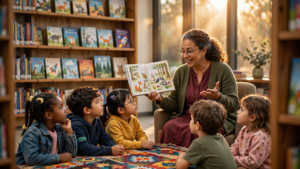
The Imagination Library mails one age‑appropriate book per child each month from birth until a child’s fifth birthday, so an enrolled child can receive up to 60 titles over the program cycle. Books arrive with short caregiver tip sheets designed to encourage shared reading and suggest simple ways to make storytime interactive. The Dollywood Foundation describes the program as funded through a mix of foundation support and local partners so families never pay to receive the books. ([dollywoodfoundation.org](https://dollywoodfoundation.org/about/))
That monthly cadence is more than a distribution detail. Book‑gifting programs differ in frequency and touchpoints, and research shows that repeated, early exposure to books can help establish reading routines. A rigorous meta‑analysis that pooled decades of research on three major book‑giving programs — Bookstart, Reach Out and Read, and Imagination Library — concluded that book‑giveaway interventions have a measurable, positive effect on the home literacy environment and children’s early literacy‑related behaviors and skills. The analysis found, overall, that book giveaways increase the frequency with which caregivers read aloud and that these programs produce modest but consistent gains in children’s early literacy measures. ([journals.sagepub.com](https://journals.sagepub.com/doi/10.3102/0034654320922140))
The evidence from a worldwide look at families
Until recently, most research on the Imagination Library used local or regional samples. A new cross‑country study collected survey data from caregivers across five countries and compared families who had received Imagination Library books for a year with a large comparison group that had not yet received books. The study — the largest dataset yet on the program — found that caregivers enrolled in the Imagination Library were significantly more likely to report reading with their child at least four days per week, reported more children’s books in the home, and began reading to their children at younger ages. The authors caution that caregiver‑reported measures are not the same as direct testing of children’s skills, but they concluded the results support ongoing distribution programs like the Imagination Library as a way to enhance the home literacy environment. ([link.springer.com](https://link.springer.com/article/10.1007/s44020-026-00120-5))
Why scale and local partnerships matter
Part of the program’s power is practical: sending a book to a child’s home removes barriers that prevent some families from acquiring age‑appropriate titles, such as transportation, cost, or simply not knowing where to start. Local partners — libraries, United Ways, school districts and nonprofit funders — raise money to pay for mailing and help enroll children, while the Dollywood Foundation negotiates book pricing and covers overhead. That shared model lets small towns and large states alike tailor outreach without charging families. ([dollywoodfoundation.org](https://dollywoodfoundation.org/about/))
Researchers note that book distribution on its own is not a silver bullet; programs that combine books with personal contact, demonstrations of shared reading, or caregiver education can show even larger effects. Still, the scale of monthly distribution — hundreds of millions of books over thirty years — means the program acts like a persistent nudge: small, repeated interactions that can lead caregivers to read more often and earlier with young children. ([journals.sagepub.com](https://journals.sagepub.com/doi/10.3102/0034654320922140))
A modest but reliable seed for literacy
At a time when early‑childhood programs compete for limited attention and funding, the Imagination Library’s approach is notable for being low‑cost to families, easy to scale locally, and supported by an accumulating research base. For caregivers who may never have owned children’s books before, a monthly parcel in the mail is both a practical resource and a ritual: a reason to sit down together, turn pages and talk about the world. More than three decades after Dolly Parton first imagined it, that combination of reach and repetition — backed by studies showing measurable changes in home reading habits — is the reason educators and funders still point to the program as a useful tool in the effort to give more children a better start with books. ([dollyparton.com](https://www.dollyparton.com/news/dolly-partons-imagination-library-celebrates-a-summer-of-milestones))
Want to look up availability? The Imagination Library website has a program locator to see whether a child in your area can enroll; many communities maintain local sign‑up pages through libraries and United Way chapters. ([dollyparton.com](https://www.dollyparton.com/news/dolly-partons-imagination-library-celebrates-a-summer-of-milestones))