In the Weddell Sea, beneath cold, dark water near Antarctica’s Filchner Ice Shelf, a camera sled moving over the seafloor recorded something unexpected: fish nests, then more nests, and then a breeding ground that seemed to go on and on.
The survey revealed one of the largest known fish-breeding colonies. Researchers estimated that about 60 million nests covered roughly 240 square kilometres of seafloor. The finding, published in Current Biology in 2022, turned a stretch of deep ocean into a remarkable natural history story—and a reminder of how much marine life can remain out of sight.
A discovery made by looking closely
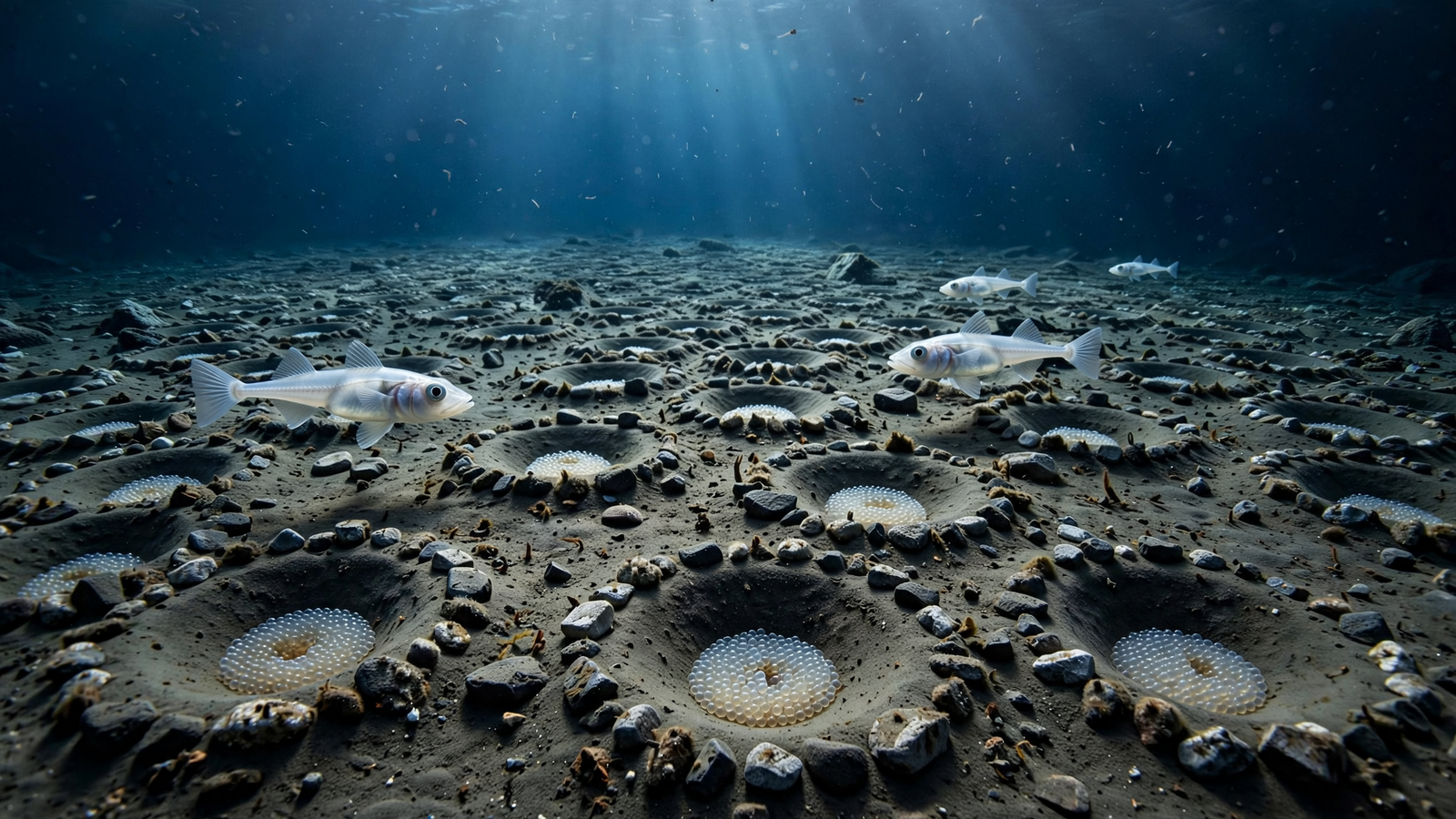
The team was aboard the research vessel Polarstern when it used an underwater camera system to examine the seabed. The camera sled, towed behind the ship, sent back images of circular nests on the soft bottom. Many held eggs, and many had an adult fish positioned at or beside them.
The nests belonged to Jonah’s icefish, Neopagetopsis ionah, an Antarctic species. Rather than finding a few isolated nests, the researchers encountered a remarkably dense and extensive concentration. Their estimate of about 60 million nests was based on survey observations and the area over which the nesting pattern extended; it was not a count of every nest one by one.
That distinction matters. A camera survey offers a view of a place at a particular time and along particular routes. But the density and continuity of the nests made clear that this was no small pocket of activity. It was a breeding aggregation on a scale rarely documented in the deep sea.
More than eggs on the ocean floor
A fish nest is a small patch of carefully prepared seabed, but a colony of millions changes the scale of the story. The nests create a distinctive habitat, and the adult fish attending them provide evidence of parental care in a place where direct observation is difficult.
The images also suggest that breeding activity is organized across the seabed rather than scattered randomly. Researchers saw areas with especially dense nesting and found adult fish guarding nests. The colony’s size raises questions that a single survey cannot settle: how long it has existed, whether it shifts over time, and how many fish return to breed there in other seasons.
Scientists also considered the colony in relation to animals higher in the food web. Tracking information for Weddell seals showed that seals used the surrounding region. That overlap points to a possible ecological connection, but it does not by itself prove that seals were feeding on fish from the colony. The finding instead gives researchers a reason to investigate how this breeding ground fits into the wider Antarctic ecosystem.
Why the deep sea still surprises
For much of the ocean, scientists have far fewer direct observations than they do on land. A camera sled can reveal details that ship-based measurements alone might miss: the shape of nests, the presence of adults, and the way one type of habitat gives way to another. The Weddell Sea discovery shows how a focused survey can uncover a major concentration of life in a remote region.
It also illustrates why large estimates should be read carefully. The figure of 60 million is a research estimate derived from observed nest density and the mapped extent of the colony—not a precise census of individual fish. Even with that uncertainty, the scale is striking. Researchers were not just seeing a busy patch of seabed; they were documenting an extensive breeding area that had been unknown before the survey.
What protection could mean
The discovery has implications beyond marine biology. The Commission for the Conservation of Antarctic Marine Living Resources (CCAMLR) considers proposals for marine protected areas in the Southern Ocean. A large, concentrated breeding ground is the kind of ecological feature that can inform discussions about how to manage human activity in a region. The existence of the colony does not, on its own, establish what protections are in force or guarantee a particular conservation outcome.
More observations would help answer practical questions: whether the colony remains in the same location year after year, how sensitive it is to disturbance, and how its boundaries relate to ocean conditions and the movements of predators. Continued monitoring could also show whether the patterns captured by the camera sled represent a stable feature or one part of a changing system.
For now, the most powerful detail is also the simplest: on a dark Antarctic seabed, fish were tending nests across an area large enough to be seen as a landscape. The discovery did not make the deep ocean less mysterious. It gave scientists a new place to begin asking questions—and revealed a nursery on a scale few had imagined.