Some trees survive by growing fast and reaching for the canopy. Great Basin bristlecone pines take a different route: they grow slowly in exposed, high-elevation places where cold, wind and limited moisture make life difficult. The payoff is remarkable longevity. In California’s White Mountains, living bristlecone pines have been dated to more than 4,800 years old.
That age is not a guess based on a tree’s height or girth. Researchers count annual growth rings, using the patterns in the wood to establish how many growing seasons a tree has lived through. The record also reaches beyond living trees: scientists can compare ring patterns in dead wood with those in living trees, building long chronologies that help reconstruct past climate.
A tree built for difficult ground
Great Basin bristlecone pines (Pinus longaeva) grow in the western United States, including the White Mountains of California and mountain ranges in Nevada and Utah. They can thrive near timberline, where growing seasons are short and conditions are demanding. Some stands grow on dolomite, a rocky, alkaline substrate that supports relatively little competing vegetation.
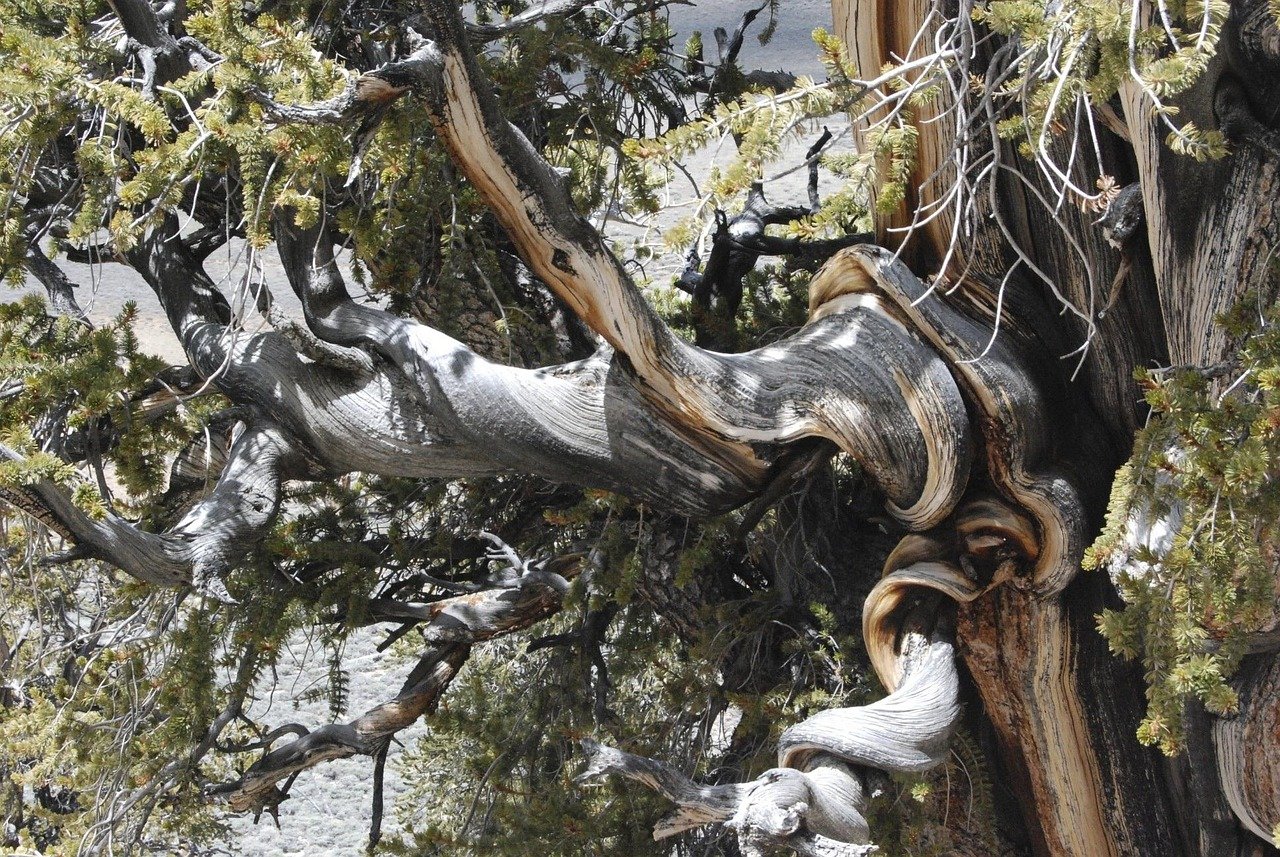
The trees’ famously gnarled shapes reflect exposure and long lives, but age is not the only part of their story. A bristlecone may keep growing even as portions of its trunk and branches die. In some old trees, a narrow strip of living tissue continues to connect roots and foliage. The surrounding dead wood can remain standing for a long time in the dry, cold environment.
That combination—slow growth, survival in difficult sites and wood that persists—helps explain why bristlecones are useful to both ecologists and climate researchers. Their rings preserve a dated sequence of growth conditions. When matched carefully with other evidence, those sequences help researchers study how climate varied before modern weather records began.
Reading the rings without disturbing the forest
Tree-ring research often uses small core samples rather than cutting down a tree. A narrow increment borer can remove a pencil-thin cylinder of wood, allowing researchers to examine the annual rings while leaving the tree standing. The resulting patterns are compared with other samples to check dates and assemble longer records.
Not every ancient tree is identified for visitors. The Forest Service protects the precise location of some especially old individual trees, while designated areas such as the Ancient Bristlecone Pine Forest in the Inyo National Forest let visitors see the landscape and its trees without turning a single specimen into a target.
There is a useful distinction between the oldest individual tree and the longest tree-ring chronology. A living tree can preserve thousands of years of growth; linking its rings with older wood can extend the climate record farther back. Those are related achievements, but they are not the same measurement.
Bristlecone pines are not invulnerable, and their ancient age does not mean every tree will persist indefinitely. Their story is more instructive than that: survival can depend on fitting a particular place, growing at a pace its conditions allow, and leaving evidence that later generations can read. In the high country, a tree’s rings make time visible one season at a time.