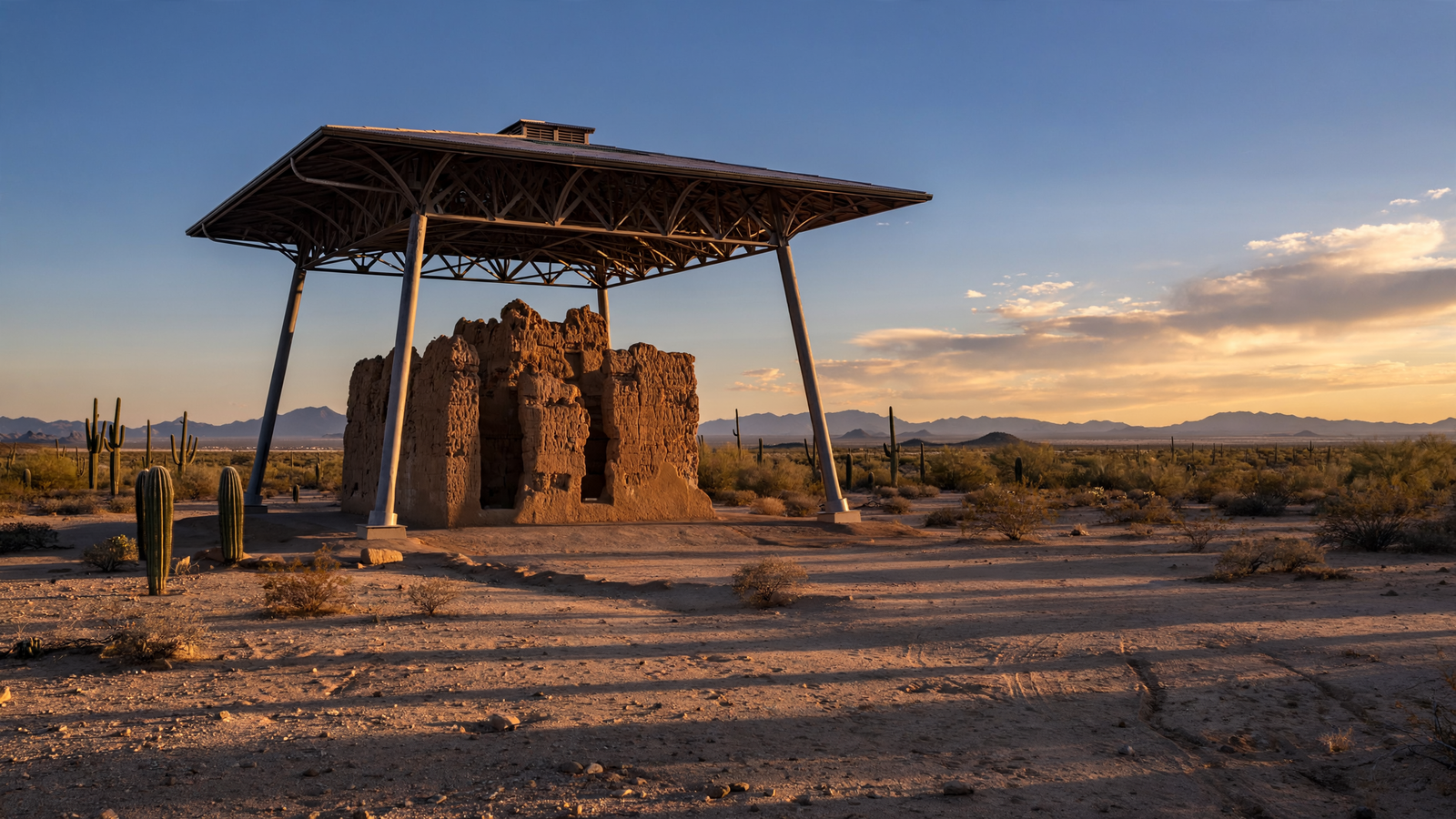
Not far from the modern roads and subdivisions of central Arizona, an ancient building rises from the desert floor beneath a broad protective roof. Its walls are made of earth. Its windows are small. Its rooms are quiet now, but the structure still carries the presence of the people who built it.
This is the Great House at Casa Grande Ruins National Monument, near Coolidge, about an hour southeast of the Phoenix metropolitan area. The building is one of the most recognizable remnants of the ancestral communities that transformed the Sonoran Desert into a productive, organized landscape.
Casa Grande is often approached as an architectural mystery: Why was the enormous adobe structure built? How was it used? What did its builders know about the movement of the sun and stars? Those questions matter, but they can also draw attention away from the larger achievement. The Great House was not created in isolation. It belonged to a wider settlement network supported by farming, engineering, trade, ritual, and a detailed understanding of desert water.
A great house in a carefully managed desert
The people associated with Casa Grande are described by the National Park Service as the Ancestral Sonoran Desert people. Archaeologists have also used the term Hohokam for the broader cultural tradition represented across central and southern Arizona, although that label is not a name these communities used for themselves. Modern O’odham communities are among the Indigenous peoples connected to the region’s ancestral history.
The Great House was built sometime between about 1250 and 1450, during a period when communities in the Gila River Valley developed large settlements and extensive irrigation systems. The desert can look inhospitable at first glance, but the Gila and nearby rivers offered water that could be directed toward fields. Canals helped support crops such as corn, beans, squash, and cotton.
That agricultural system required more than digging channels. It demanded cooperation, seasonal planning, maintenance, and a shared understanding of the river’s behavior. A canal could bring life to a field, but it could also fail if sediment accumulated, floodwater broke through, or a community could not organize the work needed to keep the system functioning.
Casa Grande therefore represents more than a single old building. It is a visible piece of a much larger human landscape—one in which people made a home by working with the opportunities and limits of the Sonoran Desert.
What the Great House may have been
The structure’s modern name comes from Spanish descriptions of a “big house,” but its original purpose remains open to interpretation. The Great House may have served as a gathering place, a ceremonial or administrative center, a residence for important community members, or a combination of functions that changed over time.
Its design suggests that the building was planned with care. The four-story structure stood within a larger compound, and its thick earthen walls created a striking presence on the flat valley landscape. Openings in the walls, the building’s orientation, and the changing patterns of sunlight have prompted generations of researchers to consider whether the Great House was connected to observations of the sky and the calendar.
It is tempting to search for one definitive explanation. Yet the uncertainty is part of the site’s meaning. Archaeology rarely gives us a complete script. Instead, it offers fragments—walls, tools, fields, pottery, canals, soil layers, and traces of movement—and asks us to build interpretations carefully.
That approach also encourages visitors to see the Great House as part of a living cultural history rather than as a deserted puzzle. The people who built it were not simply “mysterious” inhabitants of a vanished past. They were farmers, engineers, craftspeople, traders, families, and neighbors who made decisions in a particular environment.
How an adobe structure survived
Adobe is durable when it is protected, but exposed earthen walls are vulnerable to rain, wind, erosion, and the repeated cycles of wet and dry weather. In the Sonoran Desert, summer monsoon storms can arrive with intense force. Water running down a wall can remove small amounts of material, and over many years those small losses can become a serious threat.
By the late nineteenth century, the Great House had already attracted visitors and suffered from unauthorized digging and the effects of exposure. In 1892, President Benjamin Harrison set aside Casa Grande as a federal reserve, making it one of the earliest archaeological sites in the United States to receive federal protection.
That protection did not instantly solve the preservation problem. The monument’s caretakers had to find ways to protect the building while allowing people to see it. In the early twentieth century, temporary measures were used to shield the walls from weather. A large protective roof was completed over the Great House in 1932, creating the familiar silhouette that now defines many views of the monument.
The roof is easy to read as an engineering solution, but it also represents a philosophical choice. Preservation is not always about leaving a historic object untouched. Sometimes care requires intervention: drainage, monitoring, stabilization, controlled access, or a structure that changes the way a visitor experiences the original place.
At Casa Grande, the shelter makes it possible for visitors to stand near the ancient walls without pretending that the desert climate has stopped acting on them. The monument remains a place shaped by weather, and its preservation is an ongoing responsibility rather than a completed project.
A national monument with a local horizon
Casa Grande Ruins National Monument is part of a region where ancient canals, settlements, and agricultural landscapes extend beyond the boundaries of any one protected site. The monument preserves an important concentration of evidence, but it cannot contain the whole story.
That larger context matters because historic places are sometimes reduced to their most photogenic object. At Casa Grande, the Great House naturally becomes the focus. But the surrounding landscape helps explain why the building existed there at all. The valley’s rivers, fields, canals, and settlement patterns formed the setting for community life.
For visitors, the experience can begin with the structure and widen outward. The building’s walls invite close attention: the texture of the earth, the thickness of the construction, the deliberate openings. Then the view stretches across the desert, where the absence of visible canals or ancient homes can make the earlier landscape seem empty. Interpretation and archaeology help restore some of what the eye cannot immediately see.
This is one of the quiet strengths of a place like Casa Grande. It does not need to imitate the past with a reconstruction village or a staged performance. The surviving structure, paired with careful explanation, leaves room for imagination without requiring invention.
Why the place still matters
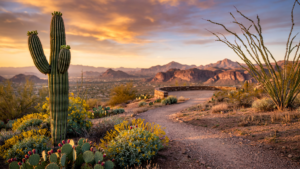
Casa Grande offers a useful correction to the idea that the Arizona desert is naturally empty. The landscape has always been more active than that description suggests. People have observed its seasons, cultivated its river valleys, traveled its routes, and adapted their lives to its extremes for centuries.
The monument also demonstrates how preservation can become a form of respect. Protecting the Great House does not mean claiming to know every answer about it. It means accepting that an irreplaceable place deserves time, study, and restraint. The walls can be examined without being consumed by constant access. Questions can remain questions while the evidence is kept available for future generations.
That balance gives Casa Grande its lasting power. It is an archaeological site, a national monument, and a place of Indigenous ancestral history. It is also a lesson in how a community can make the desert habitable—and how later generations can choose to care for the physical traces of that achievement.
Under its shelter, the Great House no longer serves the same role it did centuries ago. But it continues to gather people, focus attention, and connect the wide Arizona sky with the human work beneath it. Its walls endure because they were well made, because the landscape around them was understood, and because preservation turned an exposed ruin into a place where the past can remain present.