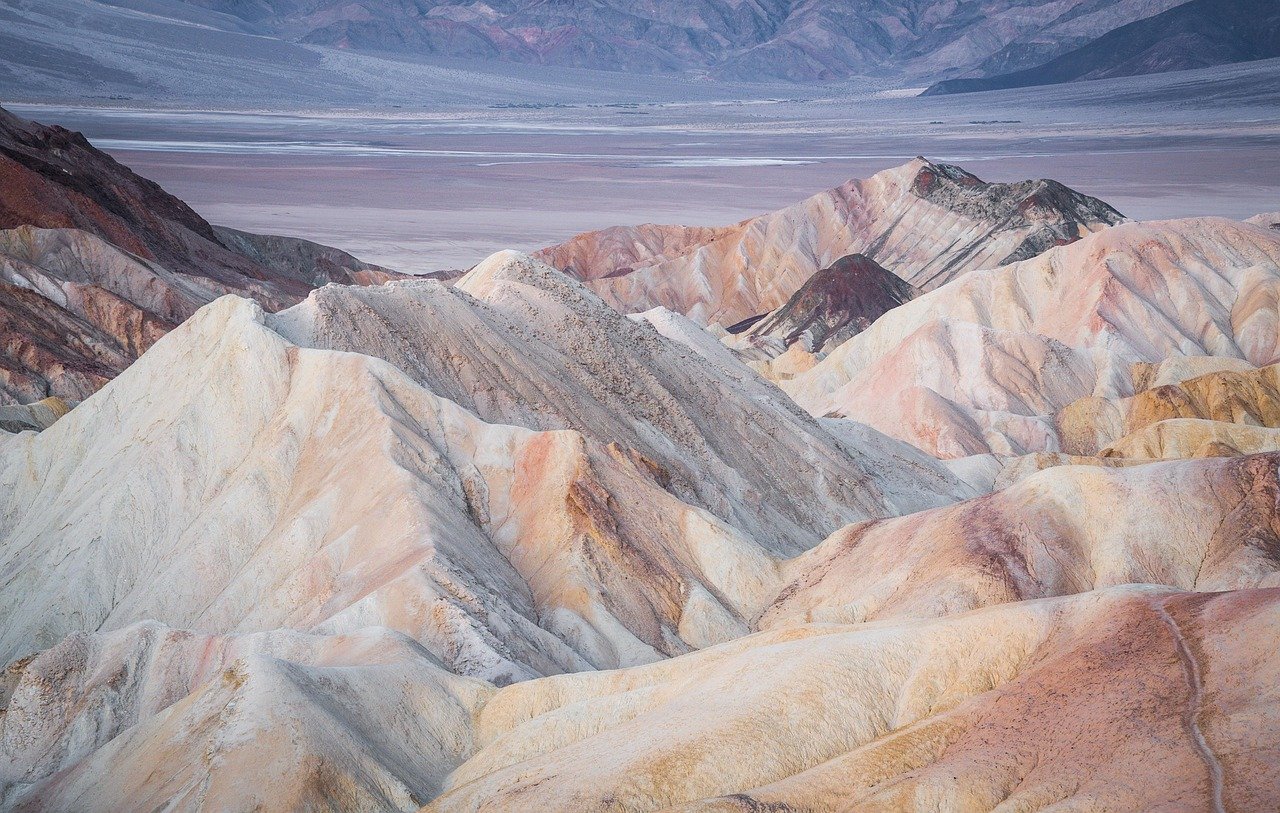
Across Racetrack Playa, a dry lakebed in California’s Death Valley National Park, stones leave long, winding trails in the mud. Some paths stretch for many times the length of the rocks that made them. The marks can look like evidence of a powerful force—or a mystery still waiting to be solved.
The explanation is less dramatic, but more remarkable: under the right conditions, a shallow pool, thin sheets of ice and a modest breeze can work together to move rocks across the playa. Researchers directly observed the process in the winter of 2013–14, turning a famous desert puzzle into a study of how small forces can produce striking landscapes.
A lakebed that records movement
Racetrack Playa is a nearly level basin surrounded by mountains. Water occasionally collects on its surface after rain or snowmelt, but the shallow water does not last. As it evaporates, it leaves soft mud that can later dry into a surface capable of holding a trail.
The rocks themselves come from the surrounding slopes. Once they reach the playa, they may remain in place for years. When a stone does move, it can carve a groove through the mud. The trail persists after the surface dries, making the movement visible long after the event is over.
For decades, explanations focused on combinations of wind, water and ice. But the rocks rarely moved when visitors or researchers were there to see it. Without direct observations, it was difficult to know which conditions mattered—or whether the stones moved in one dramatic episode or many smaller ones.
Watching the conditions come together
Researchers set up cameras and instruments to monitor the playa and its rocks. In December 2013, rain and melting snow left a shallow pool. Overnight temperatures allowed thin ice to form. When the ice broke into broad, floating panels, even light winds could push the panels—and the rocks they touched—across the muddy surface.
The team recorded multiple episodes of movement. In their 2014 paper, they reported that rocks moved when the playa was flooded, ice had formed and winds were strong enough to shift the ice panels. The panels were only a few millimeters thick, yet covered large areas. Their movement nudged rocks along the wet ground, leaving trails behind.
The finding helps explain why the stones do not need hurricane-force winds or a thick slab of ice. The ice acts less like a heavy bulldozer than a broad, wind-pushed sheet that can transfer force to the rocks. Water helps the rocks slide over the muddy surface; when the water disappears, the playa preserves the route.
A landscape shaped by brief events
The process depends on a narrow set of conditions, which helps explain why it went unseen for so long. A visitor might find the playa dry and still, while the movement itself happens during a short period of cold, shallow flooding. The trails are the record of that brief conjunction, not proof that rocks routinely glide across the desert.
That distinction matters: the tracks can be impressive, but they are not a supernatural puzzle or evidence that wind alone pushes every stone. The observed movement involved water, ice, wind and the shape of the ground working together. Different rocks may leave different paths as they encounter changing conditions.
Racetrack Playa’s appeal lies partly in this contrast. A broad, quiet basin preserves marks made by forces that are easy to miss in the moment. Careful observation revealed that the apparent impossibility is a rare, understandable meeting of ordinary elements—one that leaves an extraordinary signature in the desert mud.