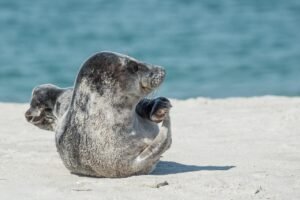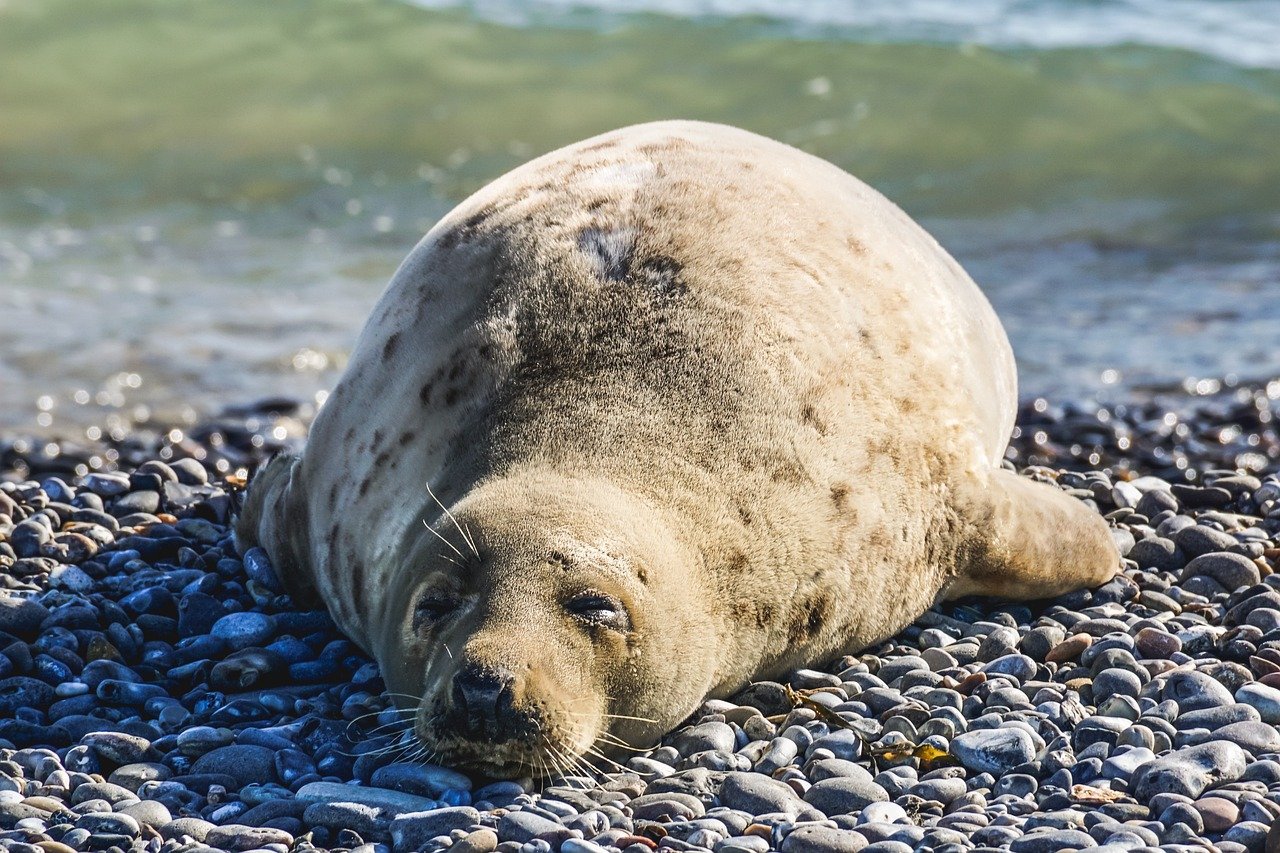
For a northern elephant seal, a safe place to sleep may be hundreds of feet underwater. A 2023 study found that young seals on foraging trips rest in brief bouts during dives, sometimes turning upside down and spiraling toward the seafloor. The finding offers a rare look at how a mammal can sleep while navigating a world where surfacing may carry risks.
The seals in the study were not taking long, uninterrupted nights. Researchers estimated that they sleep about two hours a day while at sea, in bouts that can last roughly 10 minutes. On land, their sleep patterns are different. The contrast points to a striking trade-off: at sea, these animals spend much of their time searching for food and may limit sleep to fit life underwater.
A mammal’s unusual sleeping place
Northern elephant seals are built for long ocean journeys. They leave land to forage, diving repeatedly to find prey, and return to shore for major parts of their breeding and molting cycles. NOAA describes the species as a deep-diving marine mammal whose life includes extended trips at sea. For a seal that spends so much time underwater, sleep cannot simply happen in a sheltered den.
That raises a basic question: how can scientists tell when a seal is asleep beneath the waves? Watching from a boat can reveal where an animal dives, but not what its brain is doing. The research team addressed that problem with temporary sensors attached to seals. The equipment recorded brain activity alongside other signals, including movement and depth, allowing researchers to identify sleep stages during dives.
The work, led by researchers at the University of California, Santa Cruz, documented sleep in young female seals. The recordings showed the animals moving through recognizable stages, including deep, slow-wave sleep and REM sleep. During REM sleep, the body’s muscles become markedly less active. Underwater, that relaxation can change a seal’s posture and movement in ways that would be alarming on land—but are part of the observed diving pattern.
Sleeping as the seal sinks
In the recorded sleep dives, seals descended before resting. Some rolled onto their backs and drifted downward in a gradual spiral. Their paths could resemble a falling leaf more than a purposeful plunge. The seals eventually woke and resumed swimming, sometimes before reaching the bottom. In shallower areas, the researchers also observed seals resting on the seafloor.
The posture and descent are not just visual curiosities. They help show that the animal is not actively swimming in its usual way while asleep. The researchers’ measurements made it possible to match behavior in the water with brain activity, rather than guessing from a track or a surface observation alone.
Sleep underwater does involve limits. A seal needs to return to the surface to breathe, and a sleeping animal must still manage its position and oxygen use. The brief bouts recorded by the team make sense in that context: sleep occurs within a dive, then the animal wakes and continues its routine. The study does not suggest that seals can sleep indefinitely below the surface.
Why keep sleep brief?
The researchers proposed that the seals’ sleeping depth may help reduce exposure to predators. Predators such as orcas and white sharks can threaten seals near the surface, while deep water may offer a different level of risk. The study’s observations are consistent with the idea that seals sleep at depths where they are less vulnerable, but they do not establish that predator avoidance is the only reason for the behavior.
That distinction matters. An animal’s behavior can have several causes, and a study of sleep dives cannot by itself prove what a seal is weighing—or whether it is weighing anything at all. The observations instead offer a plausible explanation for why sleep happens during deep dives and show how the pattern fits the seals’ underwater lives.
The estimate of about two hours of sleep per day at sea is also not a continuous brain recording of every seal throughout an entire migration. It is an estimate based on the sleep patterns measured during the study and the animals’ diving behavior. The work involved young female seals, so it should not automatically be treated as a complete account of sleep in every age group, sex, or situation.
What the study makes possible
Studying sleep in free-ranging marine mammals is technically difficult. Researchers need to collect physiological data without keeping the animals in a laboratory, while also ensuring the recording equipment can function underwater and be recovered. The team’s approach opened a window into a behavior that is normally hidden beneath the surface.
It also reframes a familiar idea. Sleep is often imagined as a quiet interval when an animal is safe, still, and removed from the demands of its environment. For a seal at sea, rest is woven into the demands of diving. The animal descends, sleeps briefly, and returns to the work of finding food and breathing at the surface.
That routine is not a simple trick for avoiding danger, nor does it mean the seals have solved every challenge of life in the ocean. It is a behavior researchers can now measure more directly. By pairing brain recordings with dive data, scientists can ask how sleep changes with depth, habitat, age, or the pressures of a long foraging trip.
For now, the clearest picture is of a mammal whose rest is as adapted to the ocean as its diving. A northern elephant seal may get only short stretches of sleep while at sea, but those minutes take place in a remarkable setting: far below the waves, drifting downward in a slow, sleeping spiral.