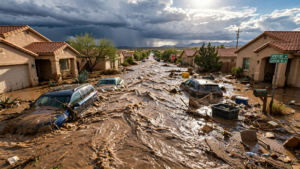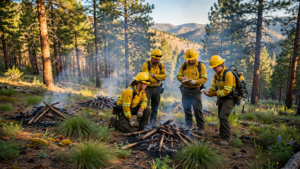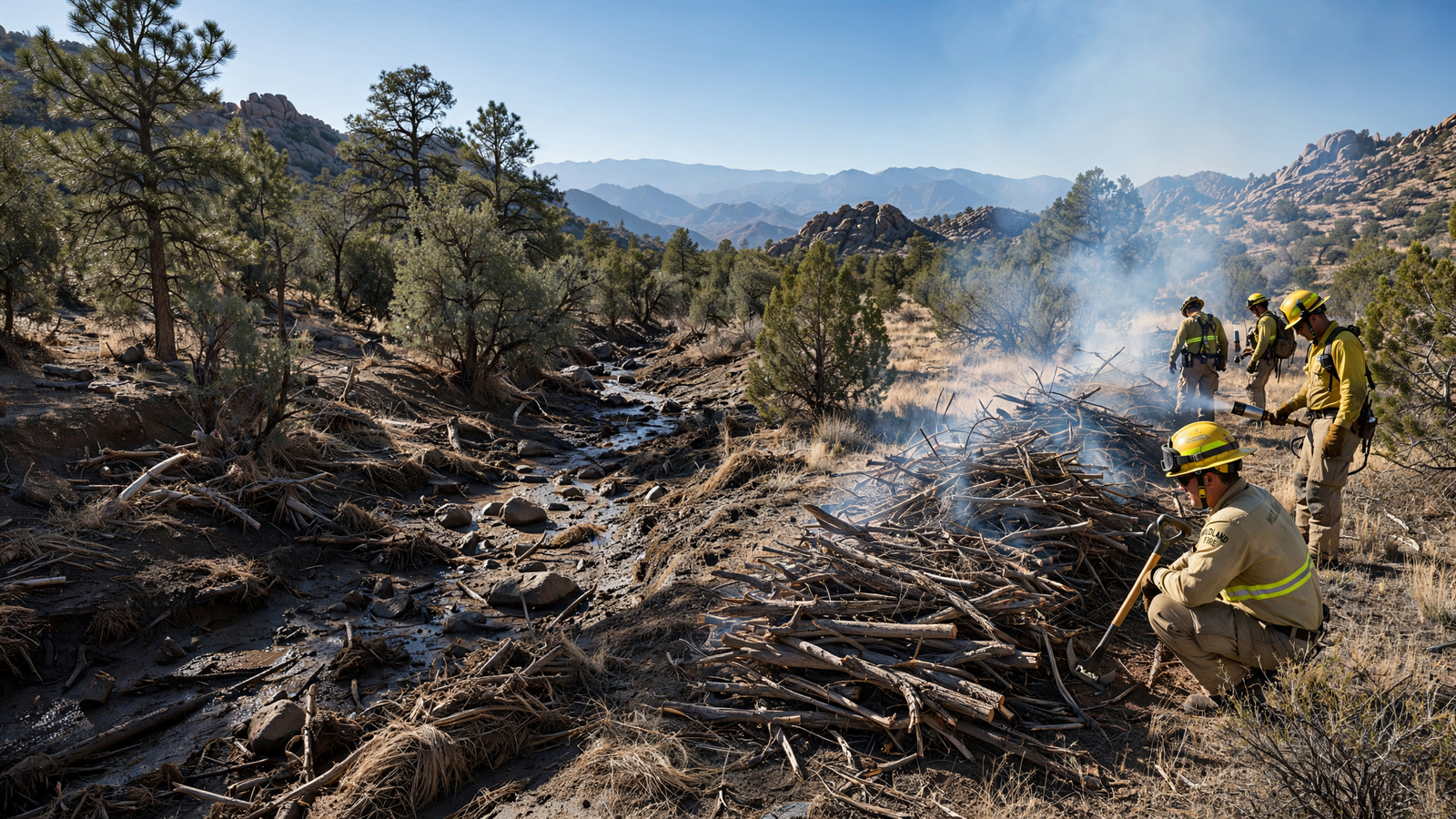
Two developments landed on the Prescott-area news calendar less than a week apart, each involving the movement of natural materials across the landscape. One was sudden and destructive: reported five-foot flash flooding overwhelmed a Prescott Valley neighborhood. The other was scheduled: officials said pile burning in Prescott National Forest would continue through August.
Placed side by side, the headlines can create a confusing picture of a region simultaneously dealing with too much water and deliberately applying fire. But these are not two parts of a single incident. They occurred in differently identified places, on different timelines and under very different circumstances.
That distinction matters for anyone trying to understand what is happening around Prescott this summer. It also offers a useful lesson in reading local hazard news: begin with the exact location, separate an emergency from a planned operation and resist drawing a connection that the available reporting does not establish.
Two reports, six days apart
On July 20, 2026, AZ Family reported that flash flooding estimated at five feet had overwhelmed a neighborhood in Prescott Valley. The report’s headline conveyed extensive destruction, although the research available here does not establish a complete damage count, the precise boundaries of the affected area or a detailed recovery timetable.
Six days later, on July 26, 12News reported that Prescott National Forest would experience pile burning through August, according to officials. That headline establishes an extended operational period, but it does not provide enough information here to identify every burn location, the schedule for individual piles or the conditions that could change daily activity.
The dates create a shared late-July context, not proof of a shared cause. Nothing in the supplied reporting links the Prescott Valley flooding to the forest’s pile-burning work. Readers should therefore treat them as separate developments unless an authorized agency or a fully reported account explicitly establishes otherwise.
Start with the place named in each headline
“Prescott area” is a convenient regional phrase, but it can flatten meaningful geographic differences. The flooding report identifies a neighborhood in Prescott Valley. The burning report identifies Prescott National Forest. A resident looking only at the word “Prescott” could miss that the stories describe different settings.
This is more than a matter of labels. Location determines which questions are relevant. For the flooded neighborhood, readers may want information about access, damage, cleanup and immediate safety. For forest pile burning, they may need current operational notices, site-specific restrictions and confirmation of whether work is active on a particular day.
The supplied sources do not answer all those questions. That absence should not be filled with assumptions. A dramatic image or headline from Prescott Valley does not establish conditions across the national forest. Likewise, an announcement covering Prescott National Forest does not mean pile burning is occurring throughout every part of the forest at once.
Geographic precision helps prevent both unnecessary alarm and misplaced reassurance. Someone outside the flooded neighborhood should not conclude that the entire Prescott region experienced the same impacts. Someone near forest land should not assume an August operational window reveals exactly what will happen near a specific road, trail or home.
Sudden event versus scheduled window
The most important difference is temporal. Flash flooding is described in the AZ Family headline as an event that overwhelmed a neighborhood. Pile burning is described by 12News as work expected to continue through August.
Those formulations imply two different information cycles. After a damaging flood, early reporting may focus on what happened, where the worst effects occurred and what immediate needs emerged. Details can develop as damage is assessed and access changes. Readers should pay attention to timestamps because an early account may not represent the final picture.
An announcement covering pile burning through August operates differently. It identifies a broader window rather than one unchanging event. “Through August” should not be read as “everywhere, every day.” The supplied reporting supports only the larger time frame and the fact that officials announced the work. It does not support a detailed day-by-day forecast.
This difference affects how updates should be interpreted. Flood information can shift as responders and residents document consequences. Burning information can shift as officials issue operational notices. In both cases, the newest location-specific update is more useful than a generalized regional impression.
Why the juxtaposition can mislead
Water and fire naturally invite a larger environmental narrative. It may be tempting to treat the two headlines as evidence of one regional pattern, or to suggest that one development directly affected the other. The supplied sources do not provide the factual basis for either conclusion.
The responsible connection is narrower: both developments require careful public communication in the broader Prescott area during the same part of summer. Each can generate urgent questions, but the questions are not interchangeable.
For the Prescott Valley flooding, the central fact is the reported scale of water that overwhelmed a neighborhood. For Prescott National Forest, the central fact is that officials anticipated pile burning continuing into August. One concerns the consequences of a sudden event; the other concerns an announced activity over a period of time.
Keeping those stories separate does not diminish either one. Instead, it preserves the information people need. Flood survivors should not have their experience reduced to a backdrop for a general discussion about seasonal conditions. Forest operations should not be characterized as an emergency merely because they appear near a destructive flood report on the calendar.
What readers can verify—and what remains open
Based on the supplied reporting, several points are clear:
- AZ Family reported on July 20 that five-foot flash flooding overwhelmed a Prescott Valley neighborhood.
- 12News reported on July 26 that officials expected pile burning in Prescott National Forest to continue through August.
- The reports name different places and describe different types of events.
- The supplied material does not establish a causal connection between the flooding and the pile burning.
Several practical details remain outside the available evidence. The packet does not provide a verified tally of damaged structures, a complete list of affected roads, a recovery schedule or the boundaries of the flooded neighborhood. It also does not provide a calendar of individual pile burns, exact sites, daily start times or an account of possible operational changes.
Those gaps are significant because they define what cannot responsibly be claimed. A useful local article should make uncertainty visible rather than disguising it with confident-sounding generalities.
A better way to read summer hazard updates
When a new Prescott-area notice appears, a short sequence of questions can make it easier to understand:
- What exact place is named? Look beyond the regional shorthand. Prescott Valley, Prescott National Forest and Prescott are not automatically interchangeable references.
- Is this an emergency report or a planned-activity notice? The answer changes which details matter most.
- When was the information published? A July 20 flood report and a July 26 forest announcement belong to different update cycles.
- What does the source actually confirm? Separate stated facts from conclusions that merely seem plausible.
- Which details still require an official, location-specific update? Do not use a broad headline as a substitute for current instructions.
This approach is especially valuable when multiple developments share a regional name. News feeds often compress geography, time and institutional boundaries into a few words. Readers have to expand those words carefully before deciding what a report means for them.
The clearest August outlook is a cautious one
The available reporting supports one forward-looking statement: Prescott National Forest pile burning was expected to continue through August. It does not support predictions about the exact pace or visibility of that work. The flooding story, meanwhile, establishes a serious event in Prescott Valley but does not supply enough information here to forecast the duration of recovery.
For residents, the result is not a single regional alert but two distinct reasons to seek precise, current information. People following the flood need updates tied to the affected neighborhood and its recovery. People following pile burning need notices tied to forest operations and specific locations.
Late July brought both stories into the same news cycle. Accuracy requires resisting the urge to merge them. Around Prescott, the most useful question is not simply, “What is happening?” It is, “What is happening where, on whose timetable, and according to which verified update?”
Use: Used for the date, location and reported five-foot scale of the Prescott Valley flash flooding.
Use: Used for the July 26 publication date and the announcement that Prescott National Forest pile burning would continue through August.