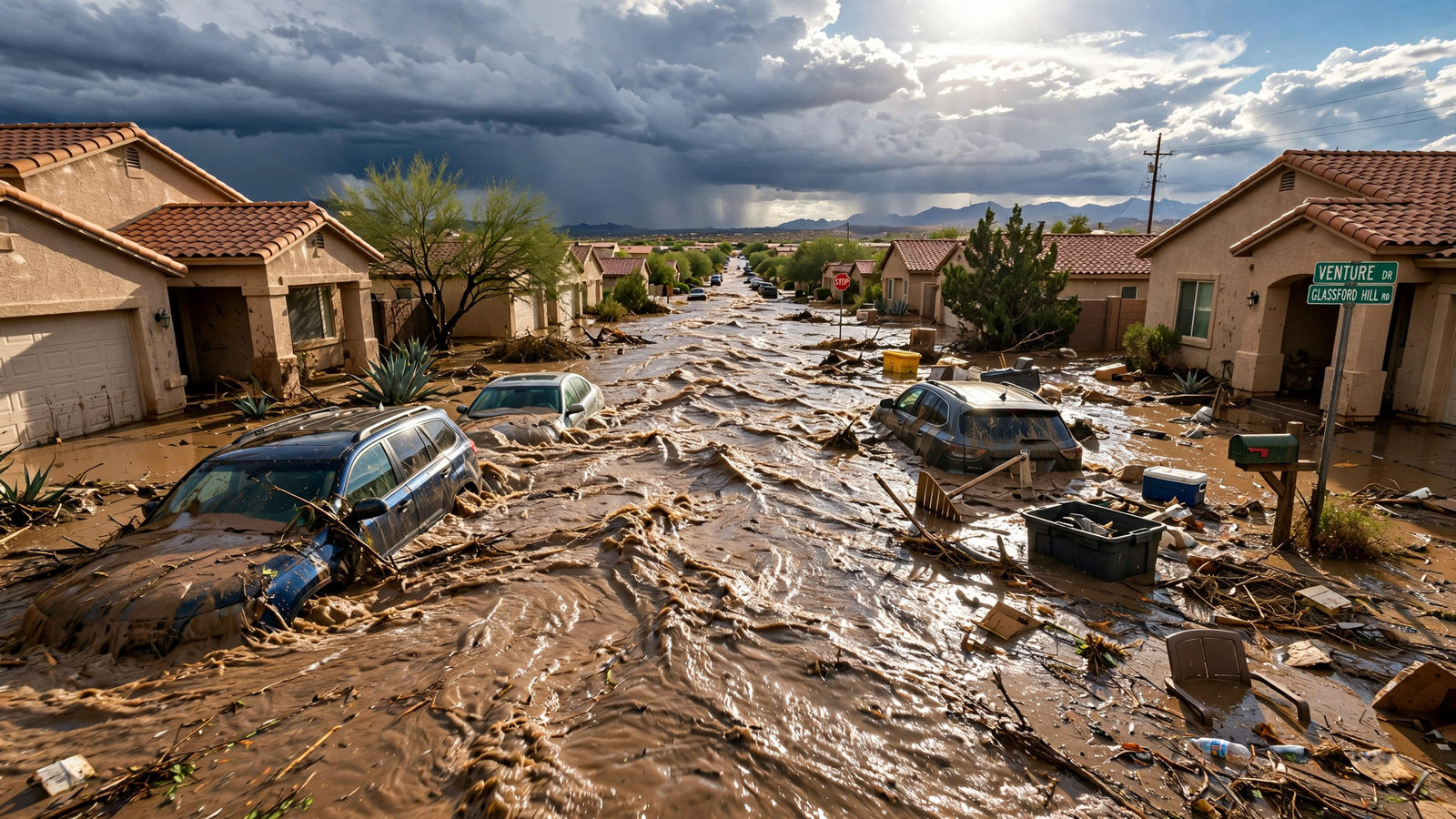
A reported five-foot flash flood overwhelmed a Prescott Valley neighborhood in July, confronting residents with a sudden and destructive emergency.
AZ Family reported the flooding on July 20, 2026. Its account characterized the damage as severe and included a description of complete destruction. The report’s headline did not identify the neighborhood, specify how many properties were affected or provide a confirmed accounting of injuries, evacuations or losses.
Those gaps matter. They limit what can responsibly be said about the event, even as the reported height of the floodwater communicates an alarming scale. A five-foot measurement is not a minor accumulation. In the context of a neighborhood, it describes water high enough to overwhelm ordinary assumptions about where people, vehicles and belongings are safe.
The immediate story is therefore both clear and incomplete: a Prescott Valley neighborhood experienced a powerful flash flood, residents faced serious destruction, and a fuller picture of the consequences had yet to emerge from the reporting available.
A sudden emergency at neighborhood scale
The phrase flash flood is central to understanding the report. It signals an event defined not simply by standing water but by speed. For residents, that distinction shapes the experience. A slowly developing problem may offer time to move possessions or make plans. An abruptly rising flow can collapse the time available for decisions.
The reported five-foot level also turns an abstract weather story into a story about lived spaces. Neighborhoods are organized around familiar boundaries: roads, driveways, yards, garages and front doors. Floodwater at the scale described in the report can erase those everyday distinctions, making a street and a property part of the same moving hazard.
AZ Family’s framing indicates that the consequences were not limited to inconvenience. Destruction was described as complete, although the available material does not establish what was destroyed or whether that description applied to a home, another structure, personal property or a broader area.
That uncertainty should not diminish the seriousness of the account. It should instead keep the focus on what has been reported without expanding it into unsupported claims.
What is known—and what is not
The available report establishes three significant points:
- Location: The flooding affected a neighborhood in Prescott Valley.
- Scale: Floodwater was reported at five feet.
- Impact: The neighborhood was overwhelmed, with at least one account describing destruction in sweeping terms.
Beyond those points, essential details remain unconfirmed in the source material available for this article. There is no verified property count, financial estimate or official damage assessment. The report excerpt does not identify the people quoted, explain how the five-foot figure was measured or say whether that depth was widespread or confined to a particular location.
It also does not establish the precise timing or duration of the flooding. Nor does it provide the storm total, identify an affected drainage or say whether roads, utilities or public facilities were damaged.
These are not small omissions. Each would help residents understand the flood’s footprint and help readers distinguish between the most intensely affected location and conditions across the wider community.
The absence of those details also means the event should not be generalized to all of Prescott Valley or the Prescott area. The source specifically refers to a neighborhood. Without a mapped impact area or additional official information, extending the claim beyond that description would risk overstating the flood’s reach.
Why the five-foot report commands attention
Numbers often become the shorthand for disasters, but a depth figure needs context. The reported five feet should not be treated as a complete measurement of the entire event. It may describe a peak, a specific channel, a structure or another localized point. The available reporting does not say.
Even with that limitation, the figure is important because it conveys the physical scale residents reportedly confronted. Five feet is a height people can readily picture. It places the water above many household objects and makes clear why the neighborhood was described as overwhelmed.
At the same time, the number cannot answer the questions that will matter during recovery. Water depth alone does not reveal how many homes were entered, how long water remained, what repairs will be required or which residents may have been displaced. Those outcomes require direct assessments rather than inference.
That distinction is especially important in early disaster coverage. The first vivid figure can dominate public understanding, while slower and less dramatic information—property inspections, cleanup needs and household losses—may emerge later.
The human story is still taking shape
A neighborhood flood is not one uniform event. Even within a small area, residents may experience very different outcomes. The available report does not provide enough detail to describe those individual circumstances, and it would be inappropriate to imagine them.
What can be said is that the language used in the report points to substantial disruption. A description of complete destruction suggests a loss that cannot be reduced to water depth alone. Yet without knowing who made that assessment or what it referred to, it remains an account from the scene rather than a comprehensive finding.
Future reporting will need to establish the scope of that loss. Useful information would include the number and type of structures affected, whether residents can return, whether public infrastructure needs repair and what formal assessments find.
It will also be important to separate immediate damage from longer-term recovery. The dramatic moment of flooding may pass quickly, but determining what can be cleaned, repaired or replaced is a different phase of the story. The supplied reporting does not yet document that phase.
A region managing more than one summer concern
The flood report arrived during a period when another land-management activity was drawing attention in the Prescott area. On July 26, 12News reported that officials expected pile burning in Prescott National Forest to continue through August.
The two developments should not be connected without evidence. The available reporting does not establish any relationship between forest pile burning and the Prescott Valley flood. They are separate stories involving different conditions and different immediate concerns.
Together, however, they illustrate the range of environmental news that residents may encounter during the same part of the year. One report concerned a sudden neighborhood emergency. The other concerned a planned activity in the national forest over a period extending through August.
Keeping those stories distinct is essential. Shared geography or timing does not establish causation, and nothing in the supplied sources supports such a conclusion.
Questions that remain after the first report
Several questions could substantially change the public understanding of the Prescott Valley flood:
- Where did the deepest water occur? A specific location would clarify whether the reported five-foot level represented a broad area or a concentrated low point.
- How many properties were affected? A verified count would establish the size of the recovery effort more clearly than descriptions from the initial scene.
- Were residents injured or displaced? The available material does not provide that information.
- What was damaged? Homes, vehicles, roads and other property can face different consequences, but the initial report does not offer an itemized assessment.
- What do official inspections show? Early visual impressions may differ from later findings about structural or infrastructure damage.
- What assistance or local response followed? The source material does not identify shelters, cleanup operations, relief programs or other organized measures.
Until answers are documented, they should remain questions rather than assumptions.
A serious event with an unfinished account
The core fact remains stark: according to AZ Family, flash flooding reaching five feet overwhelmed a Prescott Valley neighborhood. The reported scale and the account of severe destruction make the event an important local story.
But the first description is not the final record. The neighborhood’s identity, the number of affected households and the extent of damage were not established in the material available here. Those details will determine whether the event is understood primarily as an intensely localized disaster or as part of a wider episode.
For now, careful reporting requires holding two ideas at once. The flood was serious enough to produce an extraordinary account of destruction. The evidence available is also too limited to quantify the full toll.
That restraint does not understate what happened. It preserves the distinction between a powerful first report and the verified assessment that residents, officials and the broader Prescott Valley community still need.
Use: Primary source for the report of five-foot flash flooding, the Prescott Valley location and the description of severe destruction.
Use: Used only for separate regional context about announced pile burning in Prescott National Forest through August.