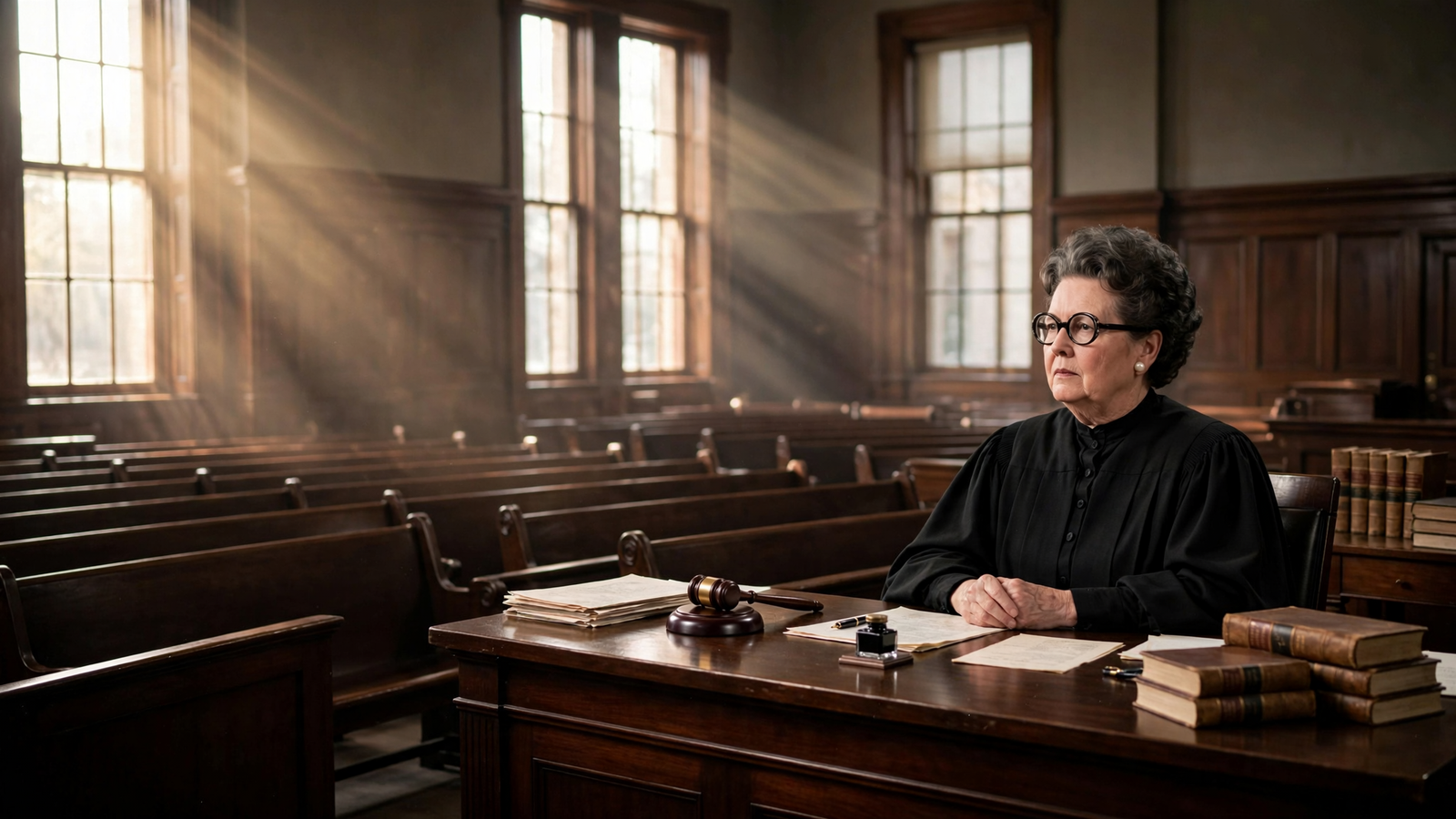
In the middle of the 20th century, an Arizona lawyer reached a position that no woman in the United States had held before. Lorna E. Lockwood became chief justice of the Arizona Supreme Court in 1965, making her the first woman to lead a state’s highest court.
Her achievement was historic, but it was not sudden. Lockwood spent decades building a legal career in a profession that often treated women as outsiders. She worked as a lawyer, legislator, trial judge, and appellate justice before taking the court’s top position. Each step gave her another chance to demonstrate that authority was not a matter of custom or gender. It was a matter of preparation, judgment, and public trust.
Lockwood’s story is also an Arizona story. She was born in Douglas, a copper-mining community near the Mexican border, and developed her career in a young state whose institutions were still taking shape. Her path through Arizona’s courts helped make the state an important chapter in the history of women in American law.
A legal education in a young state
Lorna Elizabeth Lockwood was born on March 24, 1903, in Douglas, Arizona Territory. Arizona had not yet become a state when she was born; statehood came in 1912. Her early life unfolded during a period when Arizona was building schools, courts, municipalities, and professional institutions that would define its future.
She attended the University of Arizona in Tucson and graduated in 1923. She then studied law at the University of Arizona College of Law, receiving her law degree in 1925. At the time, women could enter the legal profession, but the profession was still overwhelmingly male. A law degree did not guarantee that courts, firms, or clients would treat a woman as a full professional.
Lockwood entered practice in Phoenix. According to biographical accounts from the Arizona courts and the Arizona Women’s Hall of Fame, she worked in private practice and developed a reputation for careful preparation. She also became involved in public life, serving in the Arizona Legislature during the 1930s.
That legislative experience mattered. A judge does not only interpret legal rules; judges also work inside institutions shaped by budgets, procedures, elections, and public expectations. Lockwood’s early career exposed her to those practical dimensions of government before she moved into the judiciary.
From the Legislature to the bench
Lockwood’s career advanced at a time when the number of women in the legal profession was growing, but their presence on the bench remained unusual. She became a judge of the Maricopa County Superior Court in 1961, after years of legal and civic work. The position placed her at the center of Arizona’s most populous county and gave her responsibility for cases involving families, property, business, and criminal law.
Her judicial career was not built around a single symbolic appointment. It developed through the ordinary demands of judging: hearing arguments, evaluating evidence, applying statutes, and explaining decisions. That routine work was part of the larger change she represented. A woman on the bench could not remain only a symbol. She had to be seen as a judge whose decisions carried the same force and seriousness as those of her male colleagues.
In 1960, Lockwood joined the Arizona Supreme Court. She was the second woman to serve on the court, following Justice Nellie T. Bushnell, who had served briefly in the 1930s. Lockwood’s appointment and subsequent electoral success gave her a lasting place in the state’s judicial history.
The Arizona Supreme Court during Lockwood’s tenure handled the difficult legal questions of a rapidly changing state. Arizona’s population was growing, cities were expanding, and disputes over government power, property, business, and individual rights were reaching the courts. The justices were also working in an era when Americans were debating the meaning of equal protection and the proper role of courts in public life.
The first woman to lead a state supreme court
In 1965, Lockwood became chief justice. The milestone made her the first woman in the United States to serve as chief justice of a state supreme court. She later held the position again, serving a second term as chief justice in the early 1970s.
The title was more than an honor. A chief justice helps manage the work of the court, assigns responsibilities, represents the judicial branch, and often participates in broader conversations about court administration. In a period when women were still fighting for equal access to many professions, Lockwood’s appointment challenged a deeply rooted assumption: that leadership of a state’s legal system naturally belonged to men.
Her example was especially important because it was visible. The highest court is a public institution. Its decisions are published, its proceedings are watched, and its members become part of the civic story of a state. When Lockwood presided over the Arizona Supreme Court, women entering law could see someone like themselves occupying the profession’s highest offices.
That visibility did not erase the barriers faced by other women. Law firms, judicial appointments, elected offices, and legal education remained unevenly accessible. But representation at the top altered the argument about what was possible. Lockwood’s career gave younger lawyers a concrete answer when they encountered the suggestion that women were not suited for judicial authority.
A record beyond the first
It can be tempting to remember Lockwood only through the word “first.” That description is accurate, but incomplete. Her significance rests not only on breaking a barrier, but on the length and range of the career that followed.
She worked across several parts of public life: private law, legislation, trial judging, and appellate judging. That range distinguished her from a figure who might receive a historic appointment without having had time to shape an institution. Lockwood’s professional life showed how a woman could build authority step by step inside the legal system.
Her judicial service also coincided with a broader transformation in American law. The civil rights movement, changing ideas about equality, and new challenges to traditional family and workplace rules were reshaping the courts. Judges of Lockwood’s generation had to apply older legal structures to a society asking new questions about fairness and citizenship.
Available histories of the Arizona Supreme Court emphasize Lockwood’s role as a pioneering jurist and institutional leader. They also place her within the development of Arizona’s judiciary, where the state’s courts were becoming more professionalized and more prominent as Arizona grew. Her story therefore belongs both to women’s history and to the history of Arizona government.
Why Arizona mattered
Lockwood’s rise in Arizona is a reminder that important national changes do not always begin in the country’s largest cities. Arizona was a comparatively young state, and its political institutions were still flexible enough for determined individuals to help define them. A woman from Douglas could study law in Tucson, practice in Phoenix, serve in the Legislature, and eventually preside over the state’s highest court.
That geography matters. Her achievement was not simply imported from a national movement elsewhere. It grew out of Arizona’s own schools, courts, elections, and professional networks. Lockwood helped make the state’s legal institutions more representative while those institutions were still establishing their identity.
She remained on the Arizona Supreme Court until 1976. She died in 1978, after a career that had lasted more than five decades. Her name has since been associated with Arizona’s legal history, women’s advancement, and the continuing effort to make courts reflect the public they serve.
A door that stayed open
The most meaningful measure of a barrier-breaking career is what becomes possible afterward. Lockwood was not the last woman to serve on a state supreme court, and her achievement did not end the struggle for equality in law. But once she had occupied the chief justice’s office, the idea of a woman leading a state court could no longer be dismissed as theoretical.
Her story offers a particularly durable lesson: institutional change is often made through persistence in ordinary work. Lockwood did not reach the top of Arizona’s judiciary through a single dramatic event. She built credibility over years, accepted responsibilities as they came, and continued in a profession that had not been designed with women in mind.
Today, her career stands as a landmark in Arizona history. Lorna Lockwood helped transform the question from whether a woman could serve in the highest levels of law to how many more women would follow.
Use: Used to verify Lockwood’s service on the Arizona Supreme Court, her role as chief justice, and the court’s institutional history.
Use: Used for biographical details about Lockwood’s Arizona background, education, legal career, and public service.
Use: Used to cross-check Lockwood’s national significance as a pioneering woman in the judiciary.
Use: Used as institutional context for Lockwood’s legal education in Arizona.
Arizona Judicial Branch, Arizona Supreme Court history and biographies — https://www.azcourts.gov/Arizona-Courts/Arizona-Supreme-Court — Used to verify Lockwood’s service on the Arizona Supreme Court, her role as chief justice, and the court’s institutional history.
Arizona Women’s Hall of Fame, Lorna E. Lockwood — https://azwhf.org/lorna-e-lockwood/ — Used for biographical details about Lockwood’s Arizona background, education, legal career, and public service.
National Women’s Hall of Fame, Lorna E. Lockwood — https://www.womenofthehall.org/inductee/lorna-e-lockwood/ — Used to cross-check Lockwood’s national significance as a pioneering woman in the judiciary.
University of Arizona James E. Rogers College of Law — https://law.arizona.edu/ — Used as institutional context for Lockwood’s legal education in Arizona.