Singapore is a city-state with little land, no large natural lakes and limited room for storing rain. Its position at the southern tip of the Malay Peninsula gives it a tropical climate, but frequent rain does not automatically make water security easy. Rain arrives in intense bursts, demand is concentrated in a dense urban area, and much of the island’s natural drainage has been reshaped by development.
Singapore’s answer has been to make water part of a national infrastructure system rather than depend on a single source. Rainwater is collected, water is imported, seawater is desalinated and used water is treated until it can safely serve demanding industrial and municipal purposes. The most distinctive part of that system is NEWater: high-grade reclaimed water produced from treated used water.
The idea is simple but consequential. Water does not become worthless after one use. With enough treatment, monitoring and public trust, it can re-enter the supply cycle.
A water problem created by geography
Singapore’s modern water policy was shaped by a basic constraint: the country needed more water than its own natural sources could reliably provide. The island has a large urban population and a major industrial economy, but its land area is limited. There is no broad mountain watershed feeding a large inland river system, and urban surfaces can quickly carry rainfall away during storms.
For decades, Singapore relied partly on water imported from neighboring Malaysia. The arrangement provided an important supply, but it also made water security dependent on infrastructure and agreements beyond Singapore’s borders. At the same time, the government expanded reservoirs, protected catchments and built a national network capable of moving water around the island.
That long-term planning produced what Singapore’s national water agency, PUB, calls the “Four National Taps”: water from local catchments, imported water, NEWater and desalinated water. The phrase is more than a slogan. It describes a deliberate effort to avoid placing the country’s future on one source alone.
What NEWater actually is
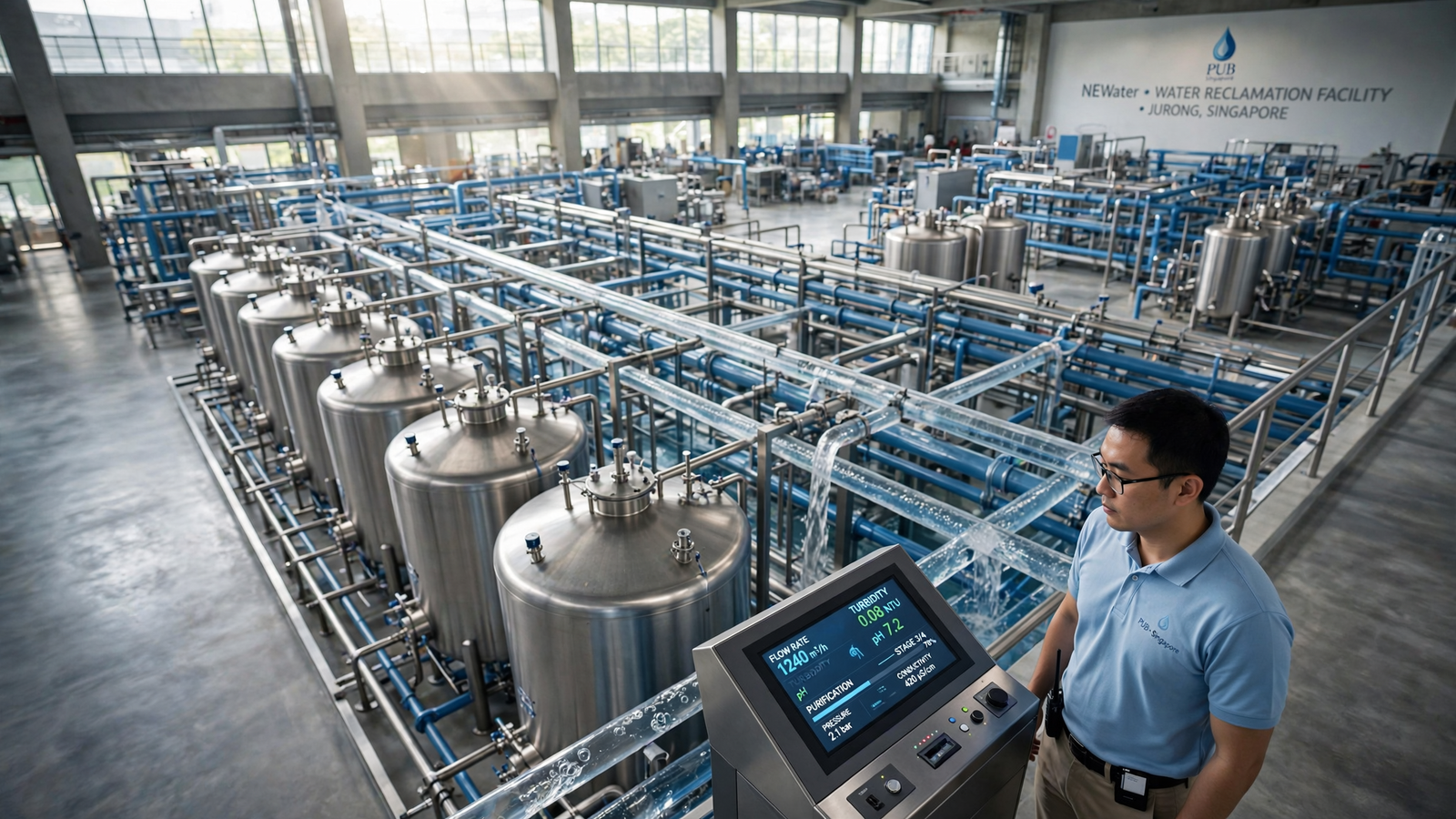
NEWater begins as treated used water. After conventional wastewater treatment, the water passes through several additional barriers designed to remove particles, microorganisms, dissolved contaminants and other impurities.
- Microfiltration or ultrafiltration removes suspended solids and many microorganisms.
- Reverse osmosis uses a membrane that allows water molecules through while rejecting a wide range of dissolved substances.
- Ultraviolet disinfection provides another barrier against microorganisms.
The result is high-grade reclaimed water. It is not simply wastewater that has been filtered once, and it is not produced through one single machine. It is a multi-stage treatment process backed by testing, operational controls and ongoing monitoring.
Singapore mainly supplies NEWater to industrial and commercial users that require very clean water, including facilities involved in electronics and semiconductor manufacturing. During dry periods, some NEWater is also added to reservoirs. After mixing with raw water, it receives conventional treatment before entering the drinking-water network.
This approach is known as indirect potable reuse. The reservoir provides an additional environmental and operational buffer, although the safety of the system depends on the treatment steps and monitoring that come before it.
From technical experiment to national supply
Singapore’s reclaimed-water program was not created overnight. Researchers and public agencies spent years testing treatment methods, studying water quality and examining how people might respond to the idea of drinking water that had once been used.
The first NEWater demonstration plant opened in 2000. After further testing and public education, Singapore opened its first large-scale NEWater facilities in 2002, and the national program was officially launched in 2003. The timing mattered: NEWater was introduced as part of a wider water strategy, not as a desperate replacement for every other supply.
That distinction helped the program gain credibility. Residents were shown the treatment process, quality testing was publicized and the new source was connected to a broader national message about water conservation. The aim was to make reclaimed water understandable rather than mysterious.
Over time, NEWater became an important part of Singapore’s supply portfolio. PUB says it can meet up to 40 percent of the country’s current water demand, with plans for that share to rise as new facilities and infrastructure are developed. Desalination is also expected to grow, giving Singapore two sources that are less dependent on rainfall.
Why the system is more than a recycling project
It is tempting to describe NEWater as a clever way to recycle wastewater, but its larger significance is institutional. Singapore has built a connected system in which drainage, reservoirs, wastewater collection, advanced treatment and public supply are managed as parts of the same water cycle.
Rain that falls on urban areas can be captured in reservoirs. Used water is collected through sewers and treated. Some of that water becomes NEWater, while other treated water is safely discharged. Desalination adds a supply that does not depend directly on rain. Water demand is managed through pricing, efficiency standards, public campaigns and restrictions on wasteful use.
Each part supports the others. Reservoirs provide storage. Reclaimed water reduces pressure on freshwater sources. Desalination adds resilience during dry conditions. Efficient appliances and industrial practices reduce the amount of new supply the system must produce.
The result is not a world without limits. Producing NEWater requires energy, sophisticated equipment and constant maintenance. Desalination also consumes substantial energy. Treatment plants generate residual materials that must be handled responsibly. A circular water system still has environmental costs; it simply makes those costs visible and manageable instead of assuming that fresh water will always be available.
The trust challenge
The most difficult barrier to potable water reuse is often psychological rather than mechanical. People may accept recycled paper, reclaimed metals or treated stormwater more easily than water associated with sewage. Technical proof alone does not automatically create public confidence.
Singapore addressed that challenge with a long public-communication effort. NEWater visitor centers explain the treatment stages, and water-quality information is presented as part of the program’s public case. The system’s design also gives reclaimed water a clear role: NEWater is heavily used for industrial demand, while reservoir augmentation adds another managed step before water reaches consumers.
This does not mean public acceptance is permanent or automatic. It has to be maintained through transparent standards, competent regulation and a record of reliable operation. The lesson for other cities is not that a single slogan can make water reuse popular. It is that trust must be treated as infrastructure too.
A model with limits—and possibilities
Singapore cannot simply be copied by every city. It has a highly centralized water authority, strong engineering capacity, dense development and the financial resources to build advanced treatment facilities. A rural watershed, a poorer municipality or a fragmented regional system may need different solutions.
Still, the underlying principles travel well. Cities can reduce leaks, protect catchments, collect rain, reuse treated water for industry and landscaping, and design buildings to use less potable water. Wastewater treatment can be viewed not only as a sanitation obligation but also as a potential source of water, energy and recoverable materials.
Climate change makes this broader way of thinking more valuable. Some regions face longer droughts; others experience intense rainfall that runs off before it can be stored. Coastal communities confront saltwater intrusion and rising demand. A diversified water system cannot eliminate those risks, but it can give communities more options when one source becomes unreliable.
The future of the water cycle
Singapore’s water story is ultimately about changing the definition of waste. Used water is still contaminated and must be handled carefully, but it is not necessarily the end of the resource. With treatment, measurement and responsible management, it can become part of the next supply cycle.
That idea is becoming increasingly important in a world where population growth, urbanization and climate pressure are making old assumptions less dependable. The most resilient water systems may not be the ones with the largest natural supply. They may be the ones that understand their limits early, invest patiently and connect every available source into a system that wastes as little as possible.
NEWater does not promise an endless supply. It offers something more practical: another dependable source, built through decades of research and public planning. Singapore’s achievement is not that it made water unlimited. It made water security more deliberate.