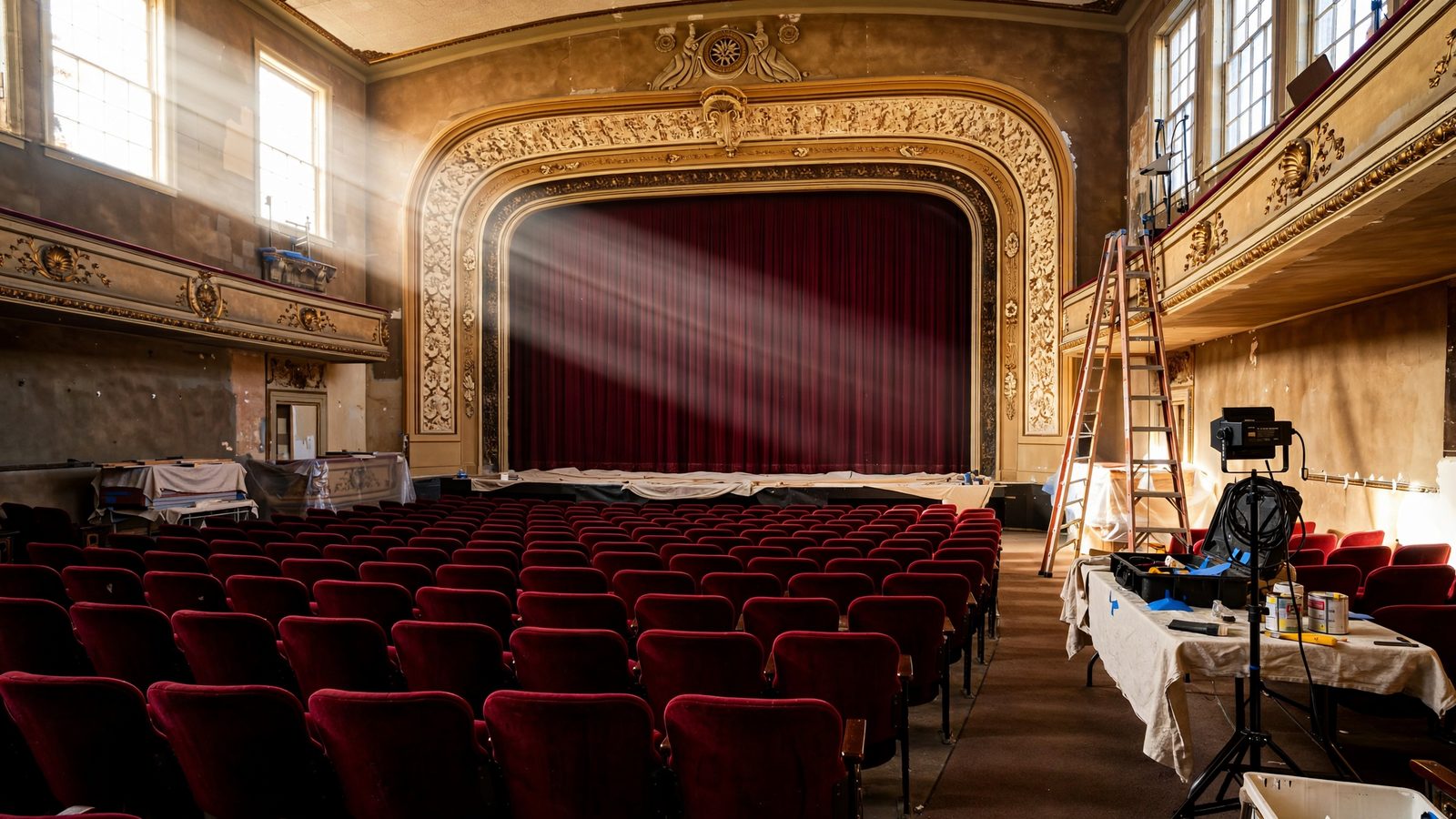
In Prescott, the Elks Theatre is both a place to see a performance and a reminder that downtown development does not always begin with a new building. The project around the historic theater has instead centered on reusing a long-standing cultural space and supporting it with additional facilities for the performing arts.
That approach links preservation with a practical question facing many downtowns: how can an older building continue to serve the community as needs change? At the Elks, the answer has been to keep the historic theater in use while developing a broader performing-arts center around it.
A theater with deep roots in downtown
The Elks Theatre traces its history to 1905, when Prescott’s Elks lodge built an opera house in the city center. Its continued presence gives the project a particular character: the work is not simply about adding an arts venue, but about sustaining a building associated with the city’s public life for more than a century.
Historic theaters can be difficult to adapt. Their stages, seating, circulation, and backstage areas were designed for earlier patterns of use. Meanwhile, performance groups may need rehearsal space, flexible rooms, or facilities that can support different kinds of events. In Prescott, the development effort has paired the historic theater with additional performing-arts spaces rather than treating the original auditorium as the only venue.
Preservation as a working project
The distinction matters. A building can be preserved as an object, maintained but largely closed to everyday activity. A working theater has a different relationship with its surroundings: audiences arrive, performers use the space, and local organizations have a reason to return. The Elks Performing Arts Center’s model keeps the historic theater at the center while providing other spaces for arts activity.
That is a form of adaptive reuse—giving an existing building a continuing role instead of replacing it. In this case, the historic stage remains part of a larger arts operation. The value is not limited to the building’s appearance. Its ongoing use gives preservation a public purpose, while the wider center can accommodate activity beyond a single auditorium.
The organization’s own materials describe the Elks as a performing-arts center in downtown Prescott, with the historic theater as a central venue. That institutional structure is important: a restoration is not finished simply because construction ends. A venue also needs programming, management, maintenance, and community participation to keep its spaces active.
Why this is also a development story
Business and development stories often focus on square footage, construction schedules, or new commercial projects. The Elks offers another measure: whether investment can make an existing downtown place more useful. Reusing a historic property can preserve a recognizable part of a city’s built environment while adapting it to contemporary cultural needs.
That does not mean an arts venue automatically produces a particular economic result. The available information about the Elks does not establish a specific number of jobs created, businesses supported, or dollars generated for nearby shops. It is more accurate to describe the center as cultural infrastructure: a place that gives performers, arts groups, residents, and visitors a shared destination in the city center.
Such a destination may contribute to downtown activity, but the extent depends on practical details—how often the venues are used, who can access them, and whether local organizations find them useful. Those are questions to assess over time, not outcomes to assume from a renovation alone.
The challenges of keeping an old venue useful
Older buildings require ongoing care, and performance spaces bring their own operating demands. A historic structure may need sensitive maintenance, while a contemporary arts program needs reliable equipment, staffing, and a calendar that attracts audiences. Balancing those needs is part of the project’s long-term work, not a problem solved once the building opens.
There is also a programming challenge. A center’s potential is shaped by the range of people who can use it, from established performers to community groups and emerging artists. The more varied the activity, the more the venue can function as a living part of downtown rather than a monument visited only on special occasions.
For visitors, the distinction can be easy to miss. The historic façade is visible from the street; the less visible development work involves making the building and its companion spaces function as a contemporary arts organization. The project’s success, in that sense, is measured not only by what has been retained, but by whether the place continues to be used.
A model with limits—and promise
Prescott’s Elks Theatre does not offer a universal formula for saving historic buildings. Every property has different structural needs, ownership arrangements, costs, and community demand. Nor does preservation eliminate the need to plan for operating expenses and future repairs.
But the project illustrates a useful principle for downtown development: new activity does not always require starting from scratch. A historic building can remain part of a city’s present when restoration is connected to a continuing purpose and to spaces that support that purpose.
More than a century after its beginnings as an opera house, the Elks Theatre still has a role in Prescott’s cultural life. Its story is therefore not only about what the city chose to keep. It is about the harder, ongoing work of giving a familiar place reasons to remain open, active, and relevant.